

Organizations implementing purpose-built AI coaching platforms report sustained manager engagement (4+ interactions per week) and measurable direct report satisfaction improvements, while embedded AI features in existing HR tools see engagement drop to 10–20% within months. The difference comes down to three architectural factors: coaching methodology, cross-platform integration, and proactive workflow presence.
Purpose-built AI coaching platforms are standalone systems designed for leadership development. Embedded AI coaching refers to general AI capabilities added as features within existing HR software (performance management systems, learning platforms). The architectural difference determines whether the AI applies coaching methodology or generates conversational responses to workplace questions.
Foundation. Purpose-built platforms train on coaching frameworks. Pascal's models were developed with ICF-certified coaches (International Coaching Federation, the industry's primary credentialing body) who designed conversation flows, curated training scenarios, and validated outputs against evidence-based coaching practices. Embedded tools use general-purpose language models with HR-adjacent prompts.
Integration depth. Purpose-built coaches connect across your tech stack (Slack, Teams, Zoom, HRIS) and maintain memory of interactions, relationships, and behavioral patterns. Embedded features live only within their parent platform, accessing limited data and requiring managers to switch contexts away from their workflow.
Safety architecture. Purpose-built systems include escalation protocols for sensitive topics. When a manager discusses potential discrimination or mental health concerns, the system flags the conversation for human review. Embedded tools rely on generic content moderation not designed for workplace coaching dynamics.
Data architecture. Purpose-built platforms maintain structured records of relationships, goals, and behavioral patterns across systems. Pascal knows who you work with, what you're trying to improve, and how your communication patterns have evolved. Embedded features access only the data within their host system—your LMS knows what courses you've taken, not how you lead.
Data Breakdown:
• Dimension: Training foundation | Purpose-Built (e.g., Pascal): ICF coaching frameworks | Embedded (e.g., LMS AI feature): General language models
• Dimension: Contextual awareness | Purpose-Built (e.g., Pascal): Cross-platform data | Embedded (e.g., LMS AI feature): Single-system data only
• Dimension: Proactive engagement | Purpose-Built (e.g., Pascal): Joins meetings, surfaces insights | Embedded (e.g., LMS AI feature): Reactive, user-initiated only
• Dimension: Guardrails | Purpose-Built (e.g., Pascal): Coaching-specific escalation | Embedded (e.g., LMS AI feature): Generic content moderation
• Dimension: Cost structure | Purpose-Built (e.g., Pascal): Standalone subscription | Embedded (e.g., LMS AI feature): Bundled in platform pricing
Purpose-built AI coaches meet managers in existing workflows (Slack, meetings). Embedded features require managers to leave their flow of work and navigate to separate platforms. This friction causes adoption to drop to 10–20% within months despite faster initial rollout.
Time to value. Embedded features activate faster (within existing platform rollouts) but deliver generic guidance from day one. Purpose-built platforms require 2–4 weeks for organizational customization—training the AI on your values, competencies, and culture—but provide company-specific coaching from the first interaction.
Change management. Embedded tools leverage existing platform familiarity but compete with dozens of other features for attention. Purpose-built coaches integrate into the communication tools managers use daily—where work happens.
Data integration. Purpose-built platforms connect to multiple HR systems (performance data, 360 feedback, personality assessments, goal frameworks). This context enables personalized coaching. Embedded features access only their parent system's data, limiting contextual awareness to whatever that single platform knows.
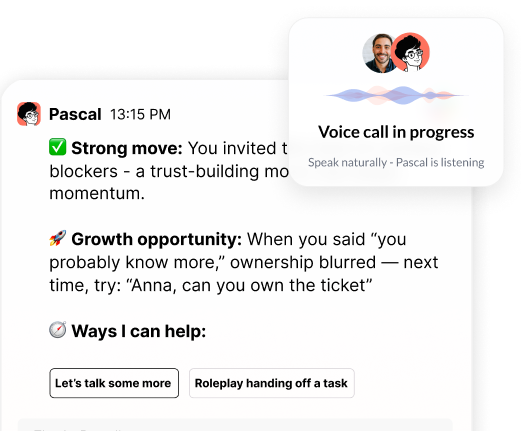
Workflow integration. Pascal joins Zoom meetings and monitors Slack channels (with explicit user permission), providing real-time coaching without requiring managers to context-switch. After a difficult 1:1, Pascal surfaces insights immediately. Before a performance review, Pascal offers guidance based on the employee's history and goals. Embedded tools require managers to open separate applications, re-explain situations, and remember to use the feature.
One mid-sized SaaS company (500 employees, Series C) tracked engagement across both approaches. Managers using Pascal in their Slack workspace engaged with coaching 4.2 times per week on average. Their previous LMS-embedded coaching feature saw 0.8 engagements per month per manager—a 20x difference in usage frequency.
Purpose-built platforms deliver measurable behavior change through specialized coaching expertise and contextual awareness but require dedicated budget allocation. Embedded features offer lower initial costs and faster deployment but lack the coaching-specific architecture needed to drive sustained manager effectiveness.
Purpose-built advantages. These platforms train on proven coaching frameworks, not generic conversational AI. Pascal builds structured records of your people, their goals, relationships, and behavioral patterns across platforms. The coach surfaces insights after meetings, reaches out with development suggestions, and flags issues before they escalate. SOC2 compliance and zero customer data used for model training protect your organization.
Purpose-built considerations. You need a dedicated budget line. Implementation takes 2–4 weeks for organizational customization. You manage a separate vendor relationship.
Embedded advantages. Bundled pricing within existing platform contracts eliminates new budget requests. Faster initial activation requires no new vendor procurement. Familiar interfaces within known systems reduce training needs. Single-vendor simplicity appeals to IT and procurement teams.
Embedded limitations. Generic guidance isn't grounded in coaching methodology—it's conversational AI with HR-adjacent prompts. Limited to data within the host platform, these tools lack cross-system context. They're reactive only, requiring managers to remember to use them. No coaching-specific safety architecture exists for sensitive workplace topics. Engagement drops dramatically after initial novelty—10–20% sustained usage is common across LMS and performance management platforms with embedded AI features.
The tradeoff is procurement simplicity versus sustained usage. Embedded features are easier to buy but harder to make stick.
HR leaders should evaluate AI coaching architecture based on three factors: whether the solution demonstrates coaching expertise (trained by certified coaches vs. general AI), whether it builds contextual awareness across your tech stack (not just within one platform), and whether it integrates into manager workflows (joins meetings, surfaces insights) rather than waiting to be accessed.
Test coaching foundation with real scenarios. Ask vendors: "Who trained your coaching models?" Purpose-built platforms name ICF-certified coaches and describe their involvement (conversation design, scenario curation, output validation). Embedded tools cite general AI capabilities. Present a sensitive scenario—a performance issue with potential discrimination concerns—and evaluate whether the system has escalation protocols. Request evidence of coaching methodology, not conversational capability.
Validate contextual awareness through integration depth. Ask: "What data sources inform your coaching?" Purpose-built platforms pull from performance systems, 360 feedback, personality assessments, goal frameworks, and meeting transcripts. Embedded features access only their parent platform's data. Test: "If I discuss a team member in Slack, then have a 1:1 with them in Zoom, does the coach connect these interactions?" Purpose-built systems maintain this context. Embedded tools don't.
Evaluate workflow integration through usage patterns. Ask: "Where does coaching happen?" Purpose-built coaches like Pascal live in Slack, Teams, and meetings—where managers work. Embedded features require navigating to separate platforms. Request usage data from current customers. Purpose-built platforms show 4+ engagements per week. Embedded features show less than 1 per month after the first quarter.
Examine guardrails for sensitive workplace topics. Present scenarios involving mental health, discrimination concerns, or potential legal issues. Purpose-built coaching platforms have escalation protocols developed for workplace coaching. Embedded tools rely on generic content moderation that may miss workplace dynamics.
Calculate total cost of ownership beyond sticker price. Embedded features appear cheaper (bundled pricing). But calculate cost per coaching interaction, not per license. If managers don't use the feature, the per-interaction cost is infinite. Purpose-built platforms cost more upfront but deliver higher engagement, making the cost per meaningful coaching moment lower.
Mid-sized tech and life sciences companies need solutions that integrate with existing HR systems (Workday, BambooHR, Lattice) without requiring wholesale platform replacement. You need coaching that understands your industry's challenges—technical leadership in engineering, cross-functional collaboration in product, compliance-aware management in regulated environments. You need vendors who can scale from 200 to 2,000 employees without architectural changes.
• Architecture determines adoption: Purpose-built AI coaches meet managers in their workflow (Slack, Teams, meetings) and maintain engagement (4+ interactions per week), while embedded features see engagement drop to 10–20% within months because they require leaving the flow of work.
• Coaching expertise drives outcomes: Platforms trained by ICF-certified coaches on behavioral frameworks deliver measurable direct report satisfaction improvements, compared to embedded tools that provide generic conversational AI without coaching methodology.
• Contextual awareness requires cross-platform integration: Purpose-built systems build structured records across performance data, 360 feedback, personality assessments, and meeting transcripts, while embedded features access only their parent platform's limited data.
• Guardrails protect your organization: Purpose-built coaching platforms include escalation protocols for sensitive workplace topics (discrimination, mental health, legal concerns) developed for coaching contexts, while embedded tools rely on generic content moderation.
• Total cost of ownership favors sustained engagement: Despite higher upfront costs, purpose-built platforms deliver higher engagement rates, making cost per meaningful coaching interaction lower than bundled embedded features that managers rarely use.
Pascal is the AI coach that lives where work happens—in your meetings, Slack channels, and Teams conversations. Trained by ICF-certified coaches and customized to your culture, Pascal delivers coaching that drives measurable manager effectiveness. Learn how Pascal scales coaching to every manager.
Header photo by Vitaly Gariev on Unsplash

.png)
.webp)
“Thank you for setting the great foundation for my promotion; now I have a plan!"

Curious to see how AI Coaching can 10X the impact and scale of your development initiatives. Book a demo today for: