

You're evaluating AI coaching tools. Some vendors offer coaches that are embedded in Slack, Teams, and meetings. Others bundle coaching features into an existing HR suite. The difference matters because it determines whether your managers get consistent, behavior-changing guidance in the flow of work.
This framework helps you evaluate both approaches honestly, including when coaching features inside an HR suite make sense.
Embedded AI coaches are built specifically for coaching and live where work already happens, in Slack, Teams, and meetings. They focus on leadership development, connect across your tech stack, and include frameworks from professional coaches. Coaching features inside an HR suite are add-ons to existing HR platforms (performance management systems, HRIS tools, learning platforms) that provide conversational AI from inside that system.
The distinction affects three things: training foundation, data access, and engagement model.
Training foundation determines quality. Embedded, purpose-built coaches are built around coaching methodology. Coaching features inside an HR suite typically adapt general-purpose AI. Neither approach guarantees quality, so evaluate the actual coaching frameworks along with the architecture.
Data access shapes relevance. Embedded coaches can work across Slack, Teams and Zoom and use context your team uploads, such as performance goals and 360 feedback. Coaching features inside an HR suite access their parent platform's data.
Engagement model affects adoption. Embedded coaches can join meetings and reach out when they spot coaching moments. Coaching features inside an HR suite typically wait for managers to open that system. Embedded coaches live where managers already work, in Slack, Teams, and meetings.
Architecture Comparison
Data Breakdown:
• Category: Coaching Foundation | Embedded: Professional coaching frameworks | HR-suite features: General AI adapted for coaching | What This Means: Quality and trust in guidance
• Category: Data Access | Embedded: Cross-platform context, including Slack, Teams and meetings | HR-suite features: Parent platform only | What This Means: Relevance of recommendations
• Category: Engagement | Embedded: Can be proactive | HR-suite features: Manager-initiated | What This Means: Usage rates over time
• Category: Implementation | Embedded: Lives in Slack, Teams and meetings, with a dedicated coaching setup | HR-suite features: Built into the HR platform | What This Means: Time to value
Coaching features inside an HR suite work when you want to consolidate vendors, have limited budget for new tools, or need basic coaching support for a small manager population. If your current HR platform adds coaching features, testing them costs nothing but time.
Embedded AI coaches make sense when coaching is a strategic priority, you need context from Slack, Teams and meetings, or you've seen low adoption of HR tools that require managers to log in separately. They require budget and implementation effort and can deliver higher engagement if managers need proactive support.
The honest answer: it depends on your organization's coaching maturity, existing tech stack, and whether you're solving for "some coaching is better than none" or "we need to measurably improve manager effectiveness."
Embedded coaches can build context from multiple sources: meeting transcripts, performance goals, 360 feedback and career goals. This creates a fuller understanding of each manager.
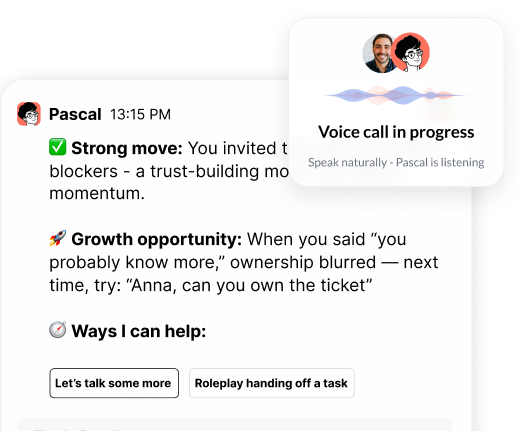
Pascal combines these signals so its coaching comes from what actually happened. When a manager avoids giving critical feedback in a meeting, Pascal notices and reaches out with a framework for the conversation. That requires being in the actual meeting.
A coaching tool inside your performance management system accesses goals, one-on-one notes and feedback within that system. Meeting dynamics and cross-functional communication sit outside it.
The context gap shows up in relevance. Coaching based on real meetings feels personalized.
Melinda Wolfe, former CHRO at Bloomberg, Pearson, and GLG, describes the value: "It makes it easier not to make mistakes. And it gives you frameworks to think through problems before you act." That preventive capability requires seeing problems as they emerge.
Behavior change requires consistent reinforcement in the flow of work. Proactive coaching reaches out at critical moments.
The adoption pattern is predictable: managers get busy and forget a tool they have to open themselves.
Proactive coaching creates environmental cues. Research on behavior change shows that environmental triggers drive habit formation more effectively than willpower. A coach that joins your Zoom meeting and messages you afterward creates that trigger.
The tradeoff: proactive systems feel intrusive if implemented poorly. Managers need control over when and how the AI engages. Pascal lets managers toggle it on or off for specific meetings, or set it to be off by default.
Coaching features inside an HR suite appear free if you already pay for the parent platform. Embedded coaches require new budget. The total cost also includes implementation effort, adoption rates and opportunity cost.
Implementation and customization: Embedded coaches need upfront setup work. Coaching features inside an HR suite follow the release cycle of your HR platform.
Adoption and change management: Proactive coaches can drive organic adoption by being present in workflow. On-demand features require sustained internal marketing to maintain usage. Low utilization means you're paying for a tool managers don't use.
Opportunity cost matters most. If your managers need coaching and your HR-suite feature sits mostly unused, the problem stays unsolved. Embedded coaches cost more upfront and can deliver measurable behavior change when adoption stays high.
The honest calculation: compare the cost of the embedded coach against the value of improved manager effectiveness and the cost of low-utilization HR-suite features that don't drive behavior change.
Both approaches should provide SOC 2 compliance, enterprise-grade data handling and a commitment to never train models on customer data. Coaching-specific protections are where they differ.
Embedded coaches treat coaching conversations as a distinct data category requiring specialized handling. With Pascal, only the user can see their chat transcripts, and administrators see aggregated, anonymized statistics. Pinnacle is SOC 2 compliant. Pinnacle never trains AI on your data.
Coaching features inside an HR suite inherit the security posture of their parent platform. Enterprise HR platforms often have mature security models, and coaching-specific privacy controls are worth checking. The question: can the system provide anonymized insights to leadership while protecting individual privacy?
Risk profile differs. A security incident in an embedded coaching platform affects coaching data. A breach in an HR-suite feature could expose performance reviews, compensation data, and coaching conversations together.
Ask vendors: "How do you isolate coaching data from other HR data?" and "Can you show me your data handling policies specific to coaching conversations?"
Five categories expose architectural differences that marketing obscures:
Foundational expertise: "Who built your coaching models, professional coaches or AI engineers?" and "Can you show me your coaching frameworks?" Purpose-built coaches that are embedded in the flow of work have clear answers grounded in coaching methodology.
Contextual awareness: "What systems do you integrate with?" and "How do you build understanding of team dynamics and individual goals?" Coaching features inside an HR suite typically cite only their parent platform.
Proactive engagement: "Do you join meetings, or do managers input context manually?" and "How do you identify coaching moments?" This reveals whether the system can be proactive.
Workflow integration: "Where does coaching happen, in Slack, Teams, and meetings, or in a separate portal?" This affects adoption.
Sensitive topic handling: "What guardrails detect when human expertise is needed?" and "How do you escalate situations beyond AI capability?" This reveals risk management maturity.
The answers distinguish vendors who built coaching systems from those who added AI features to existing platforms.
• Embedded coaches connect across your tech stack with professional coaching frameworks. Coaching features inside an HR suite access parent platform data with adapted general AI. The architecture determines context depth and guidance quality.
• Proactive engagement supports sustained adoption. Behavior change requires consistent reinforcement in the flow of work.
• Coaching features inside an HR suite make sense when you want to consolidate vendors or need basic support for a small manager population. Embedded coaches make sense when coaching is a strategic priority and you need measurable behavior change.
• Total cost includes implementation effort, adoption rates, and opportunity cost. Low-utilization HR-suite features delay manager development. Embedded coaches cost more upfront and can deliver higher ROI when adoption stays high.
• Both approaches should provide SOC 2 compliance and a commitment to never train on customer data. Embedded coaches offer coaching-specific privacy controls. Coaching features inside an HR suite inherit parent platform security.
The choice between embedded AI coaching and coaching features inside an HR suite depends on your organization's coaching maturity, existing tech stack, budget and how much you need to improve manager effectiveness. Evaluate both approaches honestly against your specific needs.
See how Pascal works inside Slack, Teams, and meetings to deliver coaching in the flow of work.
Header photo by Vitaly Gariev on Unsplash



“Thank you for setting the great foundation for my promotion; now I have a plan!"

Curious to see how AI Coaching can 10X the impact and scale of your development initiatives. Book a demo today for: