

Manager effectiveness programs will not work if they look nothing like a manager’s actual week. Most programs still center on workshops and slide decks, even though managers are making hard calls in Slack threads, Zoom calls, and quick 1:1s. That gap is where performance and engagement start to slip.
In this article, we walk through how to move from one-off training events to an embedded system for manager development. We look at what a modern manager effectiveness program is, why the old approach fails, how AI coaching changes what is possible, and how HR and L&D leaders can redesign their programs for real behavior change at scale.
A modern manager program works when it matches the reality of a manager’s week. Traditional manager programs are usually built around events such as:
These sessions can be helpful in the moment, but they do not live where the real work happens. Managers are juggling:
Those decisions rarely wait for the next training session on the calendar. They show up in Slack, in a quick message before a 1:1, or in a project channel that is moving fast.
So the core shift is this: stop thinking of manager development as an event, and start treating it as an embedded system that sits inside daily tools like Slack, email, 1:1s, and project boards. AI coaching is what makes that system practical at enterprise scale. Our focus for the rest of this piece is how to build that system so HR and L&D leaders can plan the next manager effectiveness program with a very different blueprint.
A modern manager effectiveness program is an always-on support system, not just a curriculum. It blends clear expectations, real-time data, and just-in-time coaching that shows up right where managers work.
Instead of asking, “What should managers know?” we ask, “What should managers do differently next week?” That applies to everyday actions like:
Think about a VP of Engineering with 12 direct reports. In a modern program, they might:
At Pinnacle, we use Pascal to turn leadership principles and competency models into thousands of small micro-interactions. Instead of a booklet on “how to lead,” the manager gets specific, timely help at the moment they are about to act.
Traditional training usually fights against a manager’s actual workload. It asks for big blocks of time and focus, right when the manager feels under the most pressure. We see three common failure points for HR and L&D teams.
First, low attendance and completion. When a workshop feels disconnected from what is on a manager’s plate that week, it is easy to cancel and “reschedule later.” For example, a Sales Director in Q4 may skip a coaching module to prep for renewals. By the time they return to the material, the scenarios feel old and the urgency is gone.
Second, weak behavior transfer. Workshop ratings look great, but six months later the same themes show up in engagement surveys and exit interviews: unclear expectations, weak feedback, limited growth conversations. The learning never made it into daily habits.
Third, almost no visibility into actual application. HR can see who showed up, but not who used the skills when it counted. Attendance and quiz scores do not tell you if managers used better language in performance conversations, or if 1:1s got more consistent.
Hybrid and distributed work make this even harder, especially for newer managers who have never watched strong leaders handle tough moments in person. AI coaching helps by making the training moment and the work moment the same thing, instead of two separate events that compete for time.
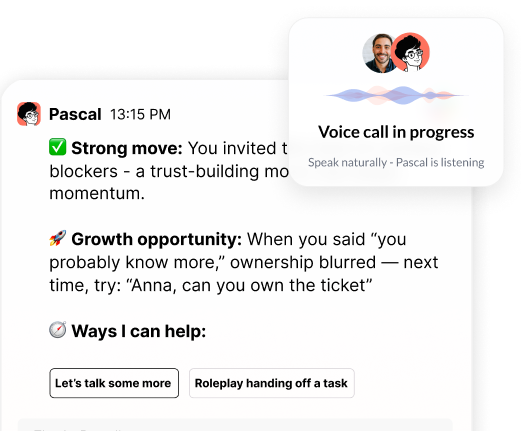
AI coaching lets organizations give every manager practical, contextual support at the moment they are about to act. With Pascal, that support can live inside Slack, right where decisions and conversations already happen.
“In the flow of work” becomes concrete when coaching appears directly in the channels and tools managers already use. For example, Pascal can:
Three capabilities make this especially useful at scale:
Think of a Customer Success Manager who is about to join a renewal call. Pascal can remind them to align on success metrics, offer key questions, and flag common traps to avoid. Human mentors, HR business partners, and executive coaches still matter. AI takes the repeatable, in-the-moment support so humans can focus on deeper, relationship-heavy work.
To redesign a manager effectiveness program for AI coaching, start with outcomes and real work moments, not tools. A simple way to do that is to move through four steps.
Step 1, define the non-negotiables. Pick 3 to 5 behaviors you are not willing to compromise on, such as:
Step 2, map the moments that matter. Identify situations where managers have outsized impact, for example:
Step 3, decide where AI shows up. For example, an organization might use Pascal in Slack for daily decisions, human-led cohort sessions once a month for reflection and practice, and quarterly manager roundtables for shared problem-solving.
Step 4, build feedback loops. Use data from coaching interactions like topics, frequency, and sentiment to refine your competency model and manager content. Share insights with HRBPs and senior leaders so they can support teams more precisely.
Picture a global company rolling out a new hybrid work policy as days start to stay warm and schedules get more flexible. Pascal can guide managers through building team agreements, meeting norms, and workload expectations, while HR sees which regions are leaning into the guidance and which need extra support.
Strong manager programs link behavior change to performance signals, not just training activity. That means tracking both leading and lagging indicators.
Leading indicators might include:
Lagging indicators might include:
AI coaching adds another layer of insight. You can see which topics managers are asking about, how usage changes by level or function, and where demand is growing. For example, HR might notice that new managers in Product lean heavily on conflict and prioritization coaching. That could lead to a targeted cohort experience and updates to new manager onboarding.
When setting expectations with executives, it helps to separate timelines. Behavior signals can shift within a couple of quarters if support is consistent. Broader impact on engagement and growth metrics usually shows up after that, once new habits have time to stick across teams.
The most effective move is to start small on one real business moment, prove behavior change, and then scale. A focused 90-day pilot can look like this:
As you roll this out, be clear that AI coaching is support, not surveillance. Managers should know where their data goes, what stays private, and how AI coaching fits with human support from HR and leaders.
At Pinnacle, we built Pascal to sit beside managers in every critical moment, not to replace the human side of leadership. When every manager has that kind of on-demand coach, HR and L&D leaders can spend less time chasing attendance and more time shaping the culture and capability the business really needs.
How Is AI Coaching Different From Traditional E-Learning?
AI coaching responds to specific situations in real time. Instead of asking managers to complete generic modules, it surfaces guidance inside tools like Slack, tied to the conversations and decisions already happening. That makes it easier for managers to apply concepts immediately.
Does AI Coaching Replace Human Coaches or HR Business Partners?
No. We see AI coaching as a complement to human support. AI handles repeatable, in-the-moment questions and drafts, while human coaches and HRBPs focus on context, judgment, and longer-term development.
What Data Should HR Expect From an AI Coaching Program?
HR and L&D can expect aggregated insights on topics, usage patterns, and behavior signals (such as more consistent 1:1s or increased use of structured feedback). Individual-level privacy should be protected, with clear communication to managers about what is and is not visible.
Where Is the Best Place to Start with AI Coaching for Managers?
Most organizations get traction by anchoring AI coaching to a specific business moment: an upcoming performance cycle, a new hybrid work policy, or a new manager onboarding wave. That focus makes it easier to define success metrics and compare outcomes before and after deployment.
If you are ready to turn everyday supervisors into confident, strategic leaders, our manager effectiveness program gives you a clear path forward. At Pinnacle AI, we use practical tools and AI-powered coaching to help managers build the skills that matter most. Start applying these approaches now so your team can see measurable gains in performance, engagement, and accountability. We are here to help you implement changes quickly and sustain them over time.
Author: Pascal

.png)
.webp)
“Thank you for setting the great foundation for my promotion; now I have a plan!"

Curious to see how AI Coaching can 10X the impact and scale of your development initiatives. Book a demo today for: