Blog article
Measuring AI ROI: how enterprise leaders evaluate impact
Leaders at the Section AI:ROI Conference shared how organizations move beyond pilots to measure the real business value of AI agents.


A recent Wall Street Journal report reveals that Mark Zuckerberg is building himself an AI agent to help him do his job better.. The tool, currently in development, helps him get to information faster, cutting through the organizational layers that slow even the most senior leaders down.
The most powerful executive at one of the world's largest companies still hits the same friction the rest of us do: information buried in layers, decisions delayed by the time it takes to surface the right context. That's a leadership problem, and it's been one for a long time.
Leaders tend to have strong instincts and sound judgment. The limiting factor, more often than not, is timely access to the right signal to put those instincts to work. A manager trying to coach someone through a difficult project doesn't need a management textbook. They need context right now: what's actually going on, what's been tried, and what's driving the behavior underneath the surface.
When leaders spend less time getting oriented, the quality of their judgment tends to improve alongside it. Decisions happen closer to the moment they're actually needed, managers arrive at team conversations more prepared, and the quality of those interactions rises as a result.
Zuckerberg told investors in January:
"We're investing in AI-native tooling so individuals at Meta can get more done. We're elevating individual contributors and flattening teams. If we do this, then I think that we're going to get a lot more done and I think it'll be a lot more fun."
At Meta, the spread of AI tools through the ranks hasn't happened by accident. It's accelerated, in part, because AI adoption is now a factor in employees' performance reviews.
This is a direction more organizations are heading, whether they've made it explicit yet or not. In a Pinnacle CHRO Working Group on AI and performance, senior people leaders from organizations ranging from a few thousand to over 100,000 employees were direct about the shift: performance criteria are moving up the stack. Pure output measures are giving way to something more nuanced, including quality of judgment, how well someone orchestrates AI-generated work into real decisions, and whether their actions reflect the company's values even when speed is easier than care.
The practical implication is that leaders now carry a dual responsibility. They need to model effective AI use themselves, and they need to create the conditions for their teams to build AI capability deliberately. Neither happens without intention.
Meta's CFO Susan Li put the pressure plainly at a recent conference:
"Making sure that we don't, for a company at the size and scale that we are, that we don't work any less efficiently than companies that are AI native from the start, that's something that I think about a lot."
That concern runs through every layer of the organization, including leadership. Organizations that use AI well tend to have leaders who model it well, and Zuckerberg building his own agent is less a product bet than a statement about what leadership looks like when the tools available to it change.
The most effective leaders have always known how to get to the right information, ask the right questions, and focus attention where it matters most. AI gives those instincts more surface area to work with.

.png)
.webp)
“Thank you for setting the great foundation for my promotion; now I have a plan!"

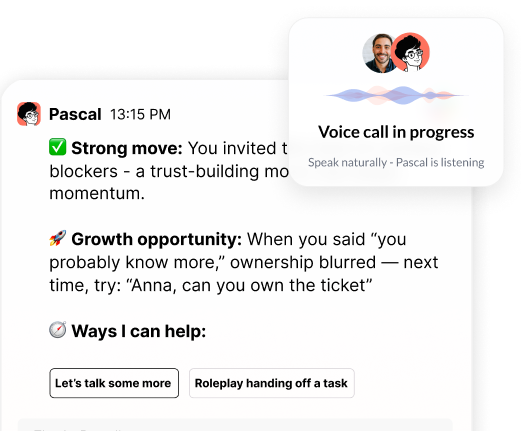
Curious to see how AI Coaching can 10X the impact and scale of your development initiatives. Book a demo today for: