Fixing Feedback Before Your Next Performance Cycle
Real-time coaching software closes the gap between when work happens and when feedback shows up. That gap is where performance actually changes or does not. If feedback only appears in 1:1s, reviews, and calibration meetings, you are coaching history, not behavior.
Most enterprises live with a broken feedback loop. People get feedback that is late, vague, inconsistent by manager, and separate from the real context of their day. By the time comments show up in a review, the project is over, the damage is done, and learning is mostly theoretical.
Late Q2 is when many HR and L&D leaders are running mid-year reviews, calibration sessions, and planning for second-half performance work. It is also the best moment to rewire how feedback actually flows. From our work building AI coaching inside everyday tools like Slack, we see the same pattern: you do not fix feedback with more workshops alone; you fix it by putting practical coaching inside the work itself.
In this article, we walk through how to spot broken feedback loops, what real-time coaching software really does, how it changes manager behavior, and how to pilot it without overwhelming already stretched teams.
How Do You Know Your Feedback Loops Are Broken?
A feedback loop is broken when people do not get timely, specific input they can act on, and when the system does not learn from what happens next. If you are an HR or L&D leader, you probably see the signs already.
Common red flags include things like:
- Engagement items about useful feedback lag behind other scores
- Promotion and rating decisions vary sharply across similar teams
- High performers say they are still surprised in reviews
- Managers say they are not sure what “good feedback” looks like in practice
A familiar scene: a VP of Sales hears in a talent review that a frontline manager is poor at coaching. Two strong reps have already left for better growth elsewhere. The comments are months old, filtered through multiple layers, and now sit in a formal forum where everyone feels defensive. The people who needed help did not get it when it mattered.
The causes are usually structural, not about effort or intent:
- Managers lack time and simple support in the moment
- Feedback is concentrated in cycles instead of spread across daily work
- HR and L&D cannot see or shape thousands of everyday interactions
Once you see that pattern, the real question becomes simple: how do you shrink the distance between work that is happening right now and coaching that usually arrives months later?
What Does Real-Time Coaching Software Actually Do?
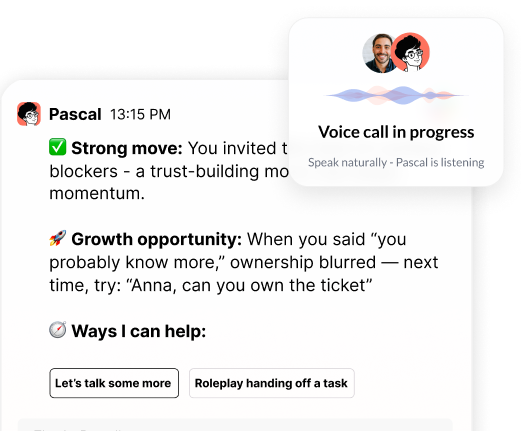
Real-time coaching software uses data from tools people already use, like Slack messages, meeting notes, or task updates, to offer in-the-moment coaching prompts. It focuses on decisions and conversations that are unfolding right now, not generic theory.
Just as important, it is not designed to replace your existing leadership programs or human coaching. It augments them.
In practice, it tends to do three simple things very well:
- Contextual Nudges: A manager is about to send sharp feedback in a Slack channel. The AI companion suggests a clearer, more balanced phrasing before they hit send, keeping the core message but lowering the risk of damage.
- Pattern Spotting: Over weeks, the system notices that stretch work always goes to the same two people. It prompts the manager to pause, reflect on fairness, and offers a short script to invite others into the next project.
- Just-in-Time Micro-Lessons: A manager schedules a tough performance talk. Right inside their workflow, they get a brief guide tailored to that kind of conversation, instead of a generic e-learning module.
The key principle: coaching does not live in a separate portal that people must remember to open. It appears in the flow of work, at the moment of choice, with low friction. HR, L&D, and senior leaders still define expectations and programs. The software carries that guidance into the chats, comments, and meetings where behavior actually shows up.
How Can Real-Time Coaching Change Manager Feedback Habits?
Technology alone does not make leaders better, but it can change habits by giving simple, better options at the exact right time.
Consider two common manager patterns.
Before real-time coaching:
- Praise is vague: “Nice job on that client deck.”
- Hard feedback is delayed until reviews because the manager worries about conflict.
With real-time coaching inside tools like Slack:
- The AI companion suggests adding one or two specific behaviors tied to team goals. That quick nudge turns “Nice job” into “Your clear story arc and sharp competitive points helped the client decide quickly.” Over time, specific feedback becomes the default.
- When a 1:1 is postponed twice, the system nudges the manager with a short script to address the open issue in the first 10 minutes of the rescheduled meeting. Follow-through becomes easier than avoidance.
Lasting habits form because managers get:
- Frequent reps: small prompts several times per week, not one big workshop
- Real context: examples written in their own words, with their own people
- Light reflection: quick prompts like “What went better this time?” that keep learning from fading
For HR and L&D, this means:
- Less pressure on big events to carry all the behavior change
- More consistent use of your feedback model or leadership framework
- A clearer view of where feedback breaks down, without reading private messages
If you embed these nudges around mid-year, you improve the quality of conversations that feed into end-of-year reviews instead of repeating the same old patterns.
How Do You Keep Real-Time Coaching Human and Trusted?
None of this works if people do not trust the tool. Managers and employees need to know why it exists, what it does, and what it will never do.
We see a few non-negotiables here:
- Transparency: Be clear about what signals are used, what is not analyzed, and how suggestions are created. No mystery.
- Boundaries: Keep the AI focused on work behavior and leadership skills, not people’s private lives.
- Choice and Control: Let managers accept, edit, or ignore prompts. They are not graded by the AI.
A simple policy might say that the AI can surface aggregate patterns, such as a tendency to give feedback only after issues escalate, but will not create individual scores for coaching quality.
Rollout also matters. A good approach is:
- Start with a small, willing pilot group of managers
- Share specific examples of what the tool will and will not do
- Run a short live session where HR or L&D show real Slack-style threads and how the AI companion can improve them
The frame should always be partnership. AI can act as an always-on coach sitting quietly in the background. Human leaders still handle judgment, relationships, and real career calls.
How Should You Pilot and Scale Real-Time Coaching Software?
Before turning on any tool, decide which broken loop you want to fix first. For example:
- Managers avoid timely constructive feedback
- Recognition is random and not tied to stated values
- New managers are unsure how to hold growth conversations
Then build a simple, phased pilot.
- Pilot: Pick three to five teams with supportive leaders and a mix of functions, such as sales, engineering, and customer success. Agree on what success will look like, like clearer feedback and faster follow-up on issues.
- Measure: Combine short surveys and interviews with simple behavioral signals like more regular 1:1s or quicker action after incidents.
- Adapt: Use what you learn to tune prompts, adjust guardrails, and align with your existing leadership content before scaling.
A 60-day window around late Q2 can work well:
- Weeks 1 to 2: Set up in Slack, run quick orientations, gather a baseline on how people rate feedback today.
- Weeks 3 to 6: Encourage active use, with light check-ins from HR and L&D and space to share stories of improved conversations.
- Weeks 7 to 8: Review the data and stories, then decide how to expand and how to link this support to your other leadership programs.
As you grow, connect the coaching prompts to existing systems:
- Tie scripts and nudges to your competency or values model
- Sync reminders with key calendar points like mid-year reviews and goal resets
- Make real-time coaching part of manager enablement plans, not a separate side project
At Pinnacle, we build our AI coaching companion to live inside everyday tools and support this kind of pilot-first approach, whether your teams are in a high-heat city or spread across cooler regions.
How Can Everyday Work Become a Coaching Opportunity?
Fixing broken feedback loops is less about tearing down your whole performance system and more about putting simple, practical coaching into the tools people already use all day. When coaching shows up inside Slack at the moment of choice, every message, meeting, and project can become a small chance to lead better.
The payoff is shared. HR and L&D get more consistent feedback tied to your standards, managers get less guesswork and more confidence in tough moments, and employees get fewer surprises and clearer paths to grow where they are. That is the outcome we design for at Pinnacle: an AI coaching companion that quietly upgrades conversations right where they happen, so your feedback loops finally start working for everyone.
Transform Your Team’s Performance With Real-Time Coaching
If you are ready to give your managers the tools they need to coach in the moment, our team at Pinnacle AI can help you take the next step. Explore our real-time coaching software to see exactly how it can fit into your existing workflows and accelerate results. We will work with you to identify the right rollout plan so your reps see value from day one. Start now so your next conversation with a customer becomes a measurable win for your business.





.png)
.webp)