

AI coaching and human coaching are effective at different jobs. Human coaches excel at deep, emotional work with senior leaders and at holding someone accountable over time. AI coaching reaches every manager, offers support at the moment it is needed and stays consistent with company frameworks. Many organizations now combine the two.
Any coaching program, human or AI, should be judged on whether people lead differently afterward. A good session feels useful, and the real test is whether the manager handles the next hard conversation, 1:1 or team decision better than the last one.
That standard suggests four questions to ask of any coaching approach:
Human coaching and AI coaching score differently on these questions, which is why the most useful comparison looks at each job separately.
Human coaching remains very valuable, especially for senior leaders. A skilled human coach can hold emotional space during a difficult period, read what goes unsaid and create a sense of accountability that comes from a real relationship. AI cannot yet replicate those strengths.
High quality human coaching also has limits. It is costly to provide and limited in scale, so most organizations reserve it for executives and a small group of high potential leaders. Sessions are scheduled in advance, which means the coach often hears about a hard conversation after it has already happened. The manager has to remember the details, and the moment to practice has passed.
AI coaching can be scaled to reach every leader in an organization, including the frontline and midline managers who rarely get a human coach. It offers immediate support when someone needs it, before a meeting or right after one, with no wait for the next scheduled session. A manager can rehearse a difficult conversation the evening before and get feedback on how it went the same afternoon.
It can also be customized with a company's frameworks, values and training content. That keeps coaching consistent across teams and connects it to what the company already teaches in its programs.
An AI coach that accompanies a manager in real meetings works from what actually happened in those meetings. It can surface patterns across many conversations, including blind spots that might never come up in a traditional coaching session.
The pattern we see across the market is extension. Organizations are using AI coaching to give everyone access to support, while keeping premium human coaching for select groups. Some now put out requests for proposals for joint human and AI coaching programs.
In practice, AI coaching complements human coaching programs. It can enhance the work of human coaches too, by giving them rich context about the situations a leader faces and the patterns that show up across their week.
AI coaching is also often compared with an LMS or a low usage e-learning subscription. Both aim to build skills at scale, and an AI coach has the advantage of working inside the manager's real workday.
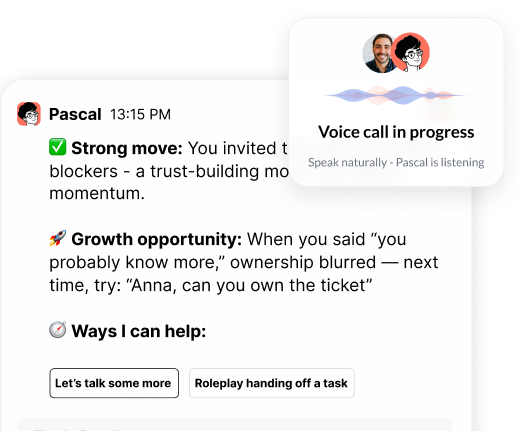
Pascal is an AI coach for every manager: a leadership companion who accompanies them in their meetings and work, and coaches from what actually happened. He sits in Slack or Microsoft Teams, connects to the manager's calendar and joins their meetings.
Pascal is designed to work alongside human coaches. He is customized to the company's competencies, values and training materials, and personalized to each manager through their role, goals and performance reviews. Because he remembers past conversations, his coaching builds on what came before. He can help a manager prepare for meetings, role-play hard conversations and send personalized feedback after meetings. A manager who also works with a human coach can bring those patterns into their next session.
Each person's coaching conversations with Pascal stay private. HR and leaders see aggregated, anonymized insights, and only for groups large enough to protect anonymity.
The most reliable evidence comes from measuring behavior in your own teams. Organizations can define the behaviors they care about and a rubric for each one, then track how those behaviors change over time and across cohorts.
For a coaching program, compare a group at the start and again after six months. This gives a continuous, behavior based measure of progress that complements engagement surveys and gives finance teams a concrete view of the program's value.
A simple way to decide where each approach belongs:



“Thank you for setting the great foundation for my promotion; now I have a plan!"

Curious to see how AI Coaching can 10X the impact and scale of your development initiatives. Book a demo today for: