
Blog article
Scaling Personalized Coaching for Enterprise-Level Managers
Learn how CHROs can deliver personalized coaching at scale with embedded, proactive guidance for managers inside daily workflows across the enterprise.


Enterprise manager training software is shifting from static courses to live coaching that shows up right where managers already work, inside tools like Slack and Teams. That shift matters because managers do not need more portals and long modules; they need help in the exact moment a hard conversation or decision lands in their lap.
Think about a typical manager’s day in late Q2. Performance reviews are wrapping up. Mid-year goals are being reset. Summer hiring is starting to ramp up. Questions pop up fast: How do I give mixed feedback? How do I reset expectations without hurting morale? Traditional training asks that manager to remember a slide deck from months ago. That is not realistic.
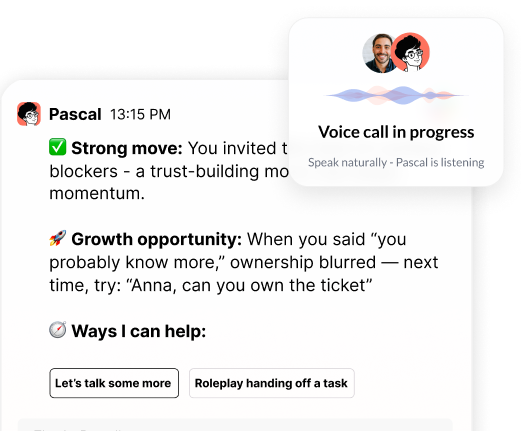
When we talk about coaching in the flow of work, we mean guidance that sits inside the channels, chats, and meetings managers already use. Instead of logging into a separate learning system, a manager can ask a quick question in Slack or Teams and get coaching in seconds. At Pinnacle Global, we built Pascal, our AI coach, to live inside those tools so it feels like a natural part of the workday, not another task.
In this article, we will walk through how this new type of enterprise manager training software actually works, what it looks like in real situations, and how HR and L&D leaders can apply it responsibly at scale for their people.
Modern enterprise manager training software is not just online courses. It is an intelligent layer that spots patterns, offers timely nudges, and guides managers as they practice new skills in real time.
Legacy approaches usually look like this:
• Multi-hour workshops pulled from a generic playbook
• Static LMS modules that sit outside of daily work
• One-off programs that feel inspiring, then fade
Modern coaching looks very different:
• Short, focused prompts tied to real events
• On-demand support right inside Slack or Teams
• Practice loops that help a manager try, learn, and adjust
For a busy manager, this shift is significant. Instead of thinking, "I should find that training on feedback," they can ask, "How do I say this to my direct report right now?" and get a usable answer without leaving the chat they are already in.
To operate as true enterprise software, though, this cannot just be a friendly chatbot. Larger organizations need:
• Strong security and data controls
• Admin settings that match company policies
• Integration with identity and access tools
• Reliable performance across regions and time zones
Modern training for managers blends all of that with in-the-moment coaching so HR and L&D can trust it at scale.
From a manager’s point of view, coaching inside Slack or Teams should feel simple. Open the app, ask a question in plain language, get clear guidance you can use right away.
Here is what that can look like with Pascal:
1. Before a 1:1, Pascal sends a short prompt: "Here are three questions to deepen feedback today."
2. During a stand-up, Pascal suggests: "Try asking about risks with this phrasing so people feel safe speaking up."
3. After a tense chat, Pascal offers: "Here is a way you could respond next time that is more direct but still respectful."
Now take a tougher case. A VP of Engineering needs to talk with a senior engineer about repeated missed deadlines. Inside Slack, the VP can say, "Help me practice a conversation about missed deadlines that are hurting the team." Pascal can:
• Role-play as the engineer and respond in a realistic way
• Suggest different openings for the talk, with tradeoffs
• Point out where the message might sound blaming or unclear
The VP can try several rounds in a few minutes, then head into the real meeting more prepared and calm.
We also tie micro-learning to real triggers. Calendar events, recurring 1:1s, performance review cycles, even set Slack channels can all cue the coach. Managers do not have to remember to "go do training." The coaching comes to them at the moment they are about to use it.
Crucially, all of this happens in the flow of work. Managers stay in Slack or Teams, during real 1:1s and meetings, rather than switching into another portal.
For years, deep coaching was usually reserved for a small group of senior leaders. Most frontline managers and new leads had to figure things out through trial and error. AI coaching changes that by making a capable coach available in Slack or Teams to anyone with a people leadership role.
The upside for HR and L&D is clear:
• Every manager, not just executives, can get real support
• Coaching is always on, across time zones and schedules
• New managers can ramp faster with help right in their tools
Instead of trying to clone a few expert coaches, People teams can encode core leadership standards directly into Pascal. For example, you might define what "great feedback" or "high psychological safety" looks like in your company. Then, whenever a manager asks about feedback, the answers line up with your culture.
Think about mid-year reviews in late May. Managers are:
• Drafting review comments
• Joining calibration meetings
• Preparing to give mixed feedback
• Trying to keep bias out of ratings
Inside Slack or Teams, Pascal can help a manager:
• Draft review language that is clear and fair
• Structure a calibration discussion with thoughtful prompts
• Plan how to share both praise and concerns in one talk
• Spot draft comments that might reflect bias and suggest better wording
This gives every manager a smarter starting point and keeps leadership behavior more consistent across the company.
It is important to be clear: AI coaching is not a replacement for human leaders or human coaches. It is a way to extend high-quality guidance into everyday moments, so managers are better prepared for the human conversations that still matter most.
When AI enters sensitive spaces like coaching, privacy and trust sit at the center. An AI coach has to be safe for tough conversations and still useful for leadership insights.
For Pascal, privacy is designed in from the start. We use enterprise-grade controls, and customer data is not used to train our models. Conversations inside Slack and Teams stay protected. Typical enterprise safeguards include:
• Strict data separation between customers
• Role-based access controls and logging
• Alignment with InfoSec standards and reviews
Just as important, managers need to trust that their practice chats are not being read line by line by HR. Pascal can be set up so that:
• Individual coaching conversations stay private
• Only trends at a group level are visible to leaders
• Sensitive content is not surfaced in reports
On the executive side, this still gives People teams meaningful insight. Our dashboards can show anonymized patterns, such as:
• New managers in one region struggling with delegation
• Senior IC managers across Engineering underusing 1:1s
• Teams in certain functions asking often about conflict
These executive dashboards highlight leadership strengths and risks across the organization, so HR and L&D can target support where it is needed without turning coaching into surveillance.
If you are an HR or L&D leader, picking the right enterprise manager training software in this new category starts with a simple question: does it live in the flow of work or in yet another portal?
Key things to check:
• Can a line manager use it during a real 1:1 with only a click or two?
• How many steps does it take to go from Slack or Teams to actual coaching?
• Does it feel like part of the conversation, or a separate task?
Coaching quality also matters. You want an AI that can handle real nuance, like:
• Performance improvement talks
• Upward feedback to senior leaders
• Cross-functional conflict between teams
Run sample scenarios from your own organization during pilots. Watch how the AI handles emotion, power dynamics, and tradeoffs in each case.
Finally, think about governance and change. Before rollout, HR and L&D should:
• Explain clearly what the AI will and will not do
• Set and share policies on data use and privacy
• Give managers a simple playbook for working the coach into weekly rhythms
Many teams are finding that a focused summer pilot works well. Start with a defined group, collect feedback for a couple of months, adjust your guardrails, then be ready to scale when planning season hits later in the year.
Manager training does not have to be a one-time event. It can live inside the daily conversations that already shape culture: 1:1s, standups, performance talks, hiring chats, and quick Slack threads that happen right before important decisions.
A simple way to start is to pick one or two high-impact moments, like mid-year reviews or new manager onboarding, and add an AI coach inside Slack or Teams just for those use cases. Keep the rollout small, partner with managers, and focus on two or three weekly habits, such as prepping 1:1s, giving feedback, or planning standups. Over time, those small, in-the-flow moments add up to a very different experience of being a manager at your company, which is exactly what we built Pascal at Pinnacle Global to support.
If you are ready to elevate how your leaders coach, decide, and execute, our team at Pinnacle AI can help you put the right tools in place. Start by exploring how our enterprise manager training software supports real-time feedback, structured development paths, and measurable performance gains. We will work with you to align the platform to your leadership competencies so managers actually apply what they learn on the job. Take the next step now so your managers gain the skills they need before the next big challenge hits.

.png)
.webp)
“Thank you for setting the great foundation for my promotion; now I have a plan!"

Curious to see how AI Coaching can 10X the impact and scale of your development initiatives. Book a demo today for:
