The pressure on managers has never felt heavier. Hybrid teams, shifting priorities, and constant change all land on the shoulders of people leaders who still have the same number of hours in a day. HR and people teams are asked to raise performance, protect engagement, and keep culture strong, all at the same time.
This is where personalized coaching at scale starts to matter. When coaching is built into daily workflows, not pushed to rare workshops, managers get real help in real moments. In this article, we will look at why old models are breaking, what scaled coaching should look like, and how embedded AI coaching platforms can turn leadership development into something that actually moves with your business.
Coaching That Moves at the Speed of Your Enterprise
People leadership now happens in shorter bursts. Quick syncs instead of long meetings. Chat messages instead of long chats. Managers are expected to deliver clarity and care, even when they are jumping between time zones and schedules.
Traditional leadership programs cannot keep up because:
• They are slow to schedule and slow to update
• They pull managers away from actual work
• They treat development as an event, not an ongoing habit
The gap is clear. Performance challenges show up every day in 1:1s, project updates, and review cycles. But help usually arrives late, if it arrives at all. Personalized coaching at scale means coaching that is:
• Timely, right before a key moment
• Contextual, based on each manager and team
• Embedded, inside tools managers already use
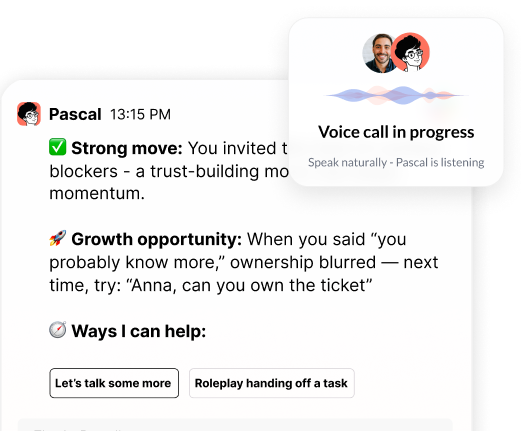
This is the promise of in-the-flow-of-work coaching platforms like Pascal from Pinnacle AI, built to help HR leaders turn leadership development from a slide deck into a living system inside the enterprise.
Why Traditional Coaching Models No Longer Scale
One-to-one executive coaching has its place. So do workshops and classrooms. But they were built for a world where only a small group of leaders were expected to carry most of the leadership weight.
Now, the expectations are different:
• Frontline and mid-level managers are culture carriers
• Many teams are hybrid or remote by default
• Review and planning cycles happen several times a year
The old models struggle because:
• Reach is limited, so only a fraction of managers get support
• Cost per leader is high, so programs stay narrow
• Sessions are booked weeks out, so feedback misses the moment of need
Timing is a real problem. Managers often get coaching after a hard performance conversation, not before it. They sit in a workshop long after a conflict, not right as tension is rising. HR teams feel this misalignment most when planning mid-year reviews and second-half performance cycles, which is when they pause and question if their current investments are actually changing behavior.
On top of that, coaching quality varies widely. When every coach brings a different style and message, it is hard for HR to keep everyone aligned with one set of values, one strategy, and one culture.
Making Personalized Coaching at Scale Actually Work
So what should personalized coaching at scale really mean? It is not just pushing the same content to everyone and calling it good. It is thoughtful and specific to each manager.
True personalization looks like:
• Guidance that fits a manager’s role and level
• Coaching that reflects team makeup and priorities
• Prompts that match timing, like ahead of reviews or promotion talks
AI can help here by reading signals that already exist in your systems, for example:
• Calendar patterns and recurring meetings
• Performance and review cycles
• Engagement pulse results
• Feedback and recognition trends
With these signals, AI can trigger short, relevant coaching nudges at the right moment. This does not replace HR or people leaders. It supports them by:
• Handling repeat questions at scale
• Pushing standard, aligned guidance
• Freeing HR partners to spend more time in real, human conversations
Of course, leaders have honest concerns about AI. That is healthy. Responsible systems need clear rules around data access, privacy, and fairness. Managers should know what is used, what is not, how recommendations are created, and where HR can or cannot see patterns. Trust grows when guardrails are explained in plain language and followed consistently.
Embedding Coaching Inside Daily Manager Workflows
For coaching at scale to work, it must live where managers actually spend their time. That usually means tools like email, chat, HR systems, and project platforms, not a separate portal they will forget to open
Think about a normal week for a manager:
• A weekly 1:1 with a direct report
• A calibration meeting with peers and HR
• A performance check-in or mid-year review
Now add embedded micro-coaching:
• Before the 1:1, the manager gets three tailored questions to ask, based on recent goals and engagement signals
• Ahead of the calibration, they see reminders on how to check bias and keep ratings fair
• Before a performance talk, they get example phrases to set expectations and handle pushback
Micro-coaching is short by design. It offers:
• Simple prompts, not long lessons
• Do-this-now guidance, not theory
• Language examples that are easy to adapt
During high-stakes moments like mid-year reviews, promotion decisions, and goal resets for the second half of the year, this kind of in-the-moment support can lower stress and raise quality. For global enterprises, embedded coaching also sets a consistent quality bar, while still allowing for local language, culture, and manager maturity.
Turning Manager Coaching Into a Measurable System
When coaching is scattered across vendors, workshops, and off-the-record conversations, it feels like a black box. Inputs go in, time passes, and HR is asked to prove impact with very little data to stand on.
A system view looks different. You can think of it as:
• Inputs: HR strategy, leadership models, policies, and values
• Signals: behavior data, engagement results, performance outcomes
• Outputs: targeted coaching nudges and learning moments
An embedded AI coaching platform like Pascal can make this system visible. It turns repeated patterns into insights, such as:
• Where managers struggle with 1:1 quality
• Which teams need more support during ramp-up
• How leadership expectations show up in real behavior
Key metrics might include:
• Manager effectiveness scores
• Quality and frequency of 1:1s
• Time to productivity for new managers
• Team engagement and sentiment
• Retention of high performers
• Inclusive leadership behaviors tied to DEI goals
With this view, HR and business leaders can refine content, sharpen leadership standards, and show a clear line from coaching to results as they prepare for new budget cycles and planning seasons.
A Practical Roadmap to Enterprise-Wide Personalized Coaching
Shifting to personalized coaching at scale does not need to be a sudden big bang. A phased approach works better for most enterprises, whether you are in a large city or a smaller hub.
A simple roadmap might look like this:
• Start with a pilot group in one function or region
• Focus on a natural cycle, like mid-year performance and engagement
• Track behavior change and manager feedback closely
• Adjust content and triggers before expanding
Success depends on more than just the technology. You also need:
• Clear alignment with HR strategy and leadership standards
• Executive sponsorship that treats this as a new way of working
• Strong onboarding so managers know what to expect
• Integrations with tools managers already use daily
Change management is where trust is built. Position AI coaching as support, not surveillance. Be clear about:
• What data is used and why
• What HR can see and what stays private
• How coaching helps managers grow their careers
Late spring can be a smart time to begin, since many organizations are midway through the year. There is still time to guide second-half performance and gather enough data to inform the next annual plan.
Unlocking a New Standard for Manager Excellence
Personalized coaching at scale is not just another learning program. It can become a new operating system for manager performance, one that blends people, process, and technology into daily work.
As HR and business leaders rethink their people strategies, the focus is moving toward in-the-moment support, clear behavior change, and proactive coaching that lives inside the tools everyone already uses. At Pinnacle AI, we built Pascal to give enterprises this kind of embedded coaching layer, tailored to each company’s leadership model and tech stack.
Organizations that make scaled, personalized coaching part of how they run managers, not just how they train them, will set a higher bar for manager effectiveness, employee experience, and long-term performance in the seasons ahead.
Unlock Personalized Coaching Results For Every Client
If you are ready to turn one-to-one breakthroughs into consistent outcomes for your entire client base, we can help you get there. At Pinnacle AI, we show you exactly how to design, implement, and manage personalized coaching at scale without losing your unique coaching style. Explore our approach to streamline your workflow, deepen engagement, and track measurable progress across all your programs. Start today and build a scalable coaching engine that still feels human for every client.




.png)
.webp)