

AI coaching supports managers before, during, and after difficult conversations—providing real-time guidance when it matters most. Instead of relying on workshops from three weeks ago, managers get structured support in the moment that transforms anxiety-inducing situations into development opportunities.
Most managers lack support when they need it: in the 30 minutes before a performance discussion. Qualtrics research across millions of employees shows that managers who regularly solicit feedback from their teams demonstrate the strongest correlation with overall effectiveness. Yet most managers receive no coaching on navigating these conversations when emotions run high.
The timing gap creates the problem. Traditional training happens weeks before the actual conversation. Workshop role-plays with strangers don't prepare managers for their specific team members. A manager practicing feedback delivery with a random colleague gains little insight into how their direct report will actually respond.
Cost limits access to quality coaching. Traditional executive coaching costs $5,000–15,000 per person annually, making it accessible only to senior leaders. This leaves 90% of managers without support during the moments that define their effectiveness.
AI coaching prepares managers by providing conversation-specific guidance and role-play simulations tailored to the situation. Pascal (Pinnacle's AI coaching platform) analyzes communication patterns from past meetings to simulate how a specific employee might respond, allowing managers to practice the actual conversation they're about to have.
The technical process: Pascal connects to meeting platforms (Zoom, Teams, Google Meet) and analyzes conversation patterns from the past 30-90 days of team interactions. It uses natural language processing to identify communication styles—does this employee ask clarifying questions when receiving feedback, or do they go silent? Do they deflect by pivoting to team problems, or do they take ownership immediately?
For new employees with limited data, Pascal relies on general coaching frameworks while building a profile over the first 4-6 weeks. The system learns from documents you provide (competency models, leadership principles), not from analyzing the content of your conversations.
Contextual preparation grounds the practice in reality. Instead of generic advice like "use the SBI model" (Situation-Behavior-Impact, a common feedback framework), managers receive guidance like "In your last three 1:1s, this employee deflected criticism by pivoting to team problems. Acknowledge their concern, then redirect to their specific behavior."
Realistic role-play mimics the employee's communication style based on observed patterns. Managers practice with an AI that responds the way their actual direct report would—defensive, silent, emotional, or analytical. This eliminates the awkwardness of practicing with colleagues who can't represent the person.
The difference shows in preparation confidence. Sarah Chen, an engineering manager at a 200-person SaaS company, describes her experience: "Before Pascal, I'd rehearse feedback conversations in my head and still freeze up when the person got defensive. Now I've already had the hard conversation once, in a safe environment where mistakes don't damage relationships. When I walk into the real meeting, I know what to expect."
During live conversations, AI coaching offers real-time prompts and emotional intelligence cues without disrupting the flow. Pascal joins Zoom or Teams meetings as a bot participant (visible in the participant list) and provides guidance through Slack when managers need redirection.
The manager experience: They're in a Zoom call with their direct report. On a second screen (or split-screen), they have Slack open. When the conversation shifts—the employee's language moves from engaged to monosyllabic, or the manager has been talking for three minutes straight—a Slack message appears: "Your report has gone quiet. Try: 'I'm noticing you've pulled back—what's coming up for you right now?'"
Real-time emotional intelligence detects when conversations become defensive or shut down by analyzing speech patterns (longer pauses, shorter responses, changes in word choice from specific to vague). If an employee's language shifts, AI prompts the manager to pause and recalibrate.
Proactive intervention prevents common mistakes before they derail the conversation. If a manager dominates the conversation, AI suggests open-ended questions to re-engage the employee. If the manager is about to solve the problem instead of coaching through it, AI reminds them to ask "What do you think would work?"
Cultural alignment reinforces organization-specific values in the moment. During onboarding, your HR team provides Pascal with your company's competency models and leadership principles (uploaded as documents or linked from your handbook). When a manager's approach conflicts with stated values—like jumping to solutions when the culture emphasizes employee autonomy—AI provides a nudge toward alignment.
The employee knows Pascal is present. The bot appears in the participant list, and managers introduce it during onboarding: "I'm using an AI coaching tool to help me become a better manager. It provides me with prompts during our conversations, but all our discussions remain confidential."
Privacy remains a valid concern. Pascal is SOC2 Type II compliant (meaning an independent auditor verifies security controls annually). The system does not use customer conversation data to train its underlying models. When sensitive topics arise (legal issues, harassment claims, mental health crises), Pascal flags them for human HR review. However, the system does analyze communication patterns to provide coaching—it learns how people communicate (tone, pace, response style), not what they say.
Marcus Rodriguez, VP of People at a 500-person fintech company, explains their evaluation process: "We brought in our legal team and data privacy officer to review Pascal before rolling it out. The key distinction: the AI learns communication patterns to provide better coaching, but it doesn't feed conversation content back into training the base model. That separation mattered for our privacy requirements."
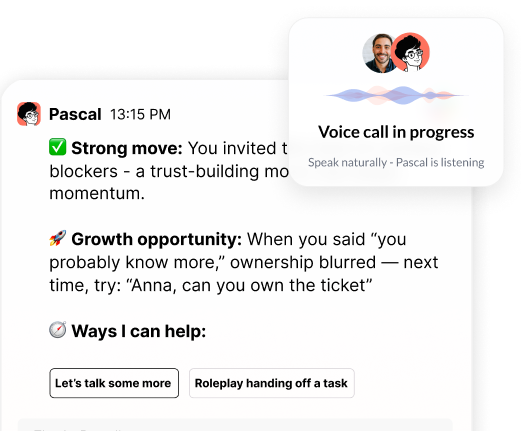
AI coaching synthesizes post-conversation feedback by analyzing what happened, identifying specific improvement opportunities, and creating personalized development plans. Unlike traditional coaching where insights disappear after the session, AI coaching creates a record over time that tracks manager growth.
Behavioral feedback highlights specific moments where the manager demonstrated effective techniques or missed opportunities. Instead of vague praise like "good job," managers receive concrete observations: "At 14:32, when your report became defensive, you paused and asked 'What am I missing?'—that de-escalated the tension and reopened dialogue."
Pattern recognition across multiple conversations identifies recurring blind spots. Over time, AI spots trends: "You tend to solve problems instead of coaching through them. In your last four 1:1s, you provided the solution within 90 seconds of hearing the issue."
Actionable next steps replace generic advice with specific micro-practices for the next similar conversation. Instead of "work on active listening," managers receive: "Next time this employee raises a concern, try staying silent for five seconds after they finish speaking—let them fill the space instead of jumping in with solutions."
Progress tracking shows measurable improvement across competencies. Managers see their growth in specific areas like feedback delivery, coaching mindset, or emotional intelligence. Each conversation builds on the last, creating continuous improvement that traditional training—with its long gaps between sessions—cannot match.
AI coaching delivers continuous, contextual support at a fraction of the cost of traditional executive coaching. The key difference: AI coaching happens in the flow of work, not as a separate event that managers must remember to apply weeks later.
Traditional executive coaching provides high personalization but limited access. Only senior leaders receive this level of support, and even they get it in scheduled sessions disconnected from actual work moments. The coach can't join meetings or observe real interactions. Cost: $5,000–15,000 per person annually.
Workshop training reaches more people but delivers generic content. Quarterly events teach frameworks in artificial scenarios, then send managers back to work hoping they'll remember the lessons. A 2023 study by the NeuroLeadership Institute found only 30% of workshop participants apply learnings consistently beyond the first month.
Learning management systems (LMS platforms like Workday Learning or Cornerstone) offer self-paced content at scale but suffer from low completion rates. According to a 2024 analysis by Training Industry, fewer than 20% of employees complete assigned courses, and even fewer apply the content to real situations.
AI coaching combines the personalization of executive coaching with the scale of digital learning and the timing of real-world application. A 2023 BCG study of 13,000 employees found that 79% of those receiving more than five hours of AI training became regular users—a dramatic improvement over traditional e-learning engagement (which hovers around 15-20% sustained usage). Note: This study measured AI training adoption generally, not AI coaching for managers specifically, but the engagement pattern suggests similar potential.
The cost difference enables universal access. At $50–150 per manager annually, organizations can provide AI coaching to every people leader, not just executives.
The limitations matter too. AI coaching can't replace human judgment in complex situations. It can't read body language in audio-only calls. It can't understand organizational politics or personal relationships that shape how feedback lands. And it can't guarantee that practicing with an AI simulation will prepare managers for every possible response from a real human.
Dr. Jennifer Park, an organizational psychologist who studies workplace AI adoption, offers this perspective: "AI coaching works best as a supplement to human development, not a replacement. It's excellent for building confidence and providing structure, but managers still need human mentors for navigating ambiguous situations where there's no clear right answer."
If you're evaluating AI coaching for your managers, focus on three questions:
First, does the platform integrate with your existing tools? Managers won't use a system that requires logging into a separate platform or manually uploading meeting recordings. Look for native integrations with your meeting and communication tools.
Second, how does the platform handle privacy and data security? Ask for independent audits (SOC2 Type II compliance is the baseline), clear documentation of what data gets analyzed versus what gets used for model training, and transparent policies on data retention and deletion.
Third, what does the implementation process look like? The most sophisticated AI coaching platform fails if managers don't adopt it. Ask about change management support, manager training, and how the vendor handles employee concerns about AI monitoring.
Start with a pilot group of 10-15 managers who are already open to development. Measure specific outcomes: manager confidence before difficult conversations, employee feedback on communication quality, and manager NPS scores (how likely employees are to recommend their manager to others). Run the pilot for 90 days—long enough for the AI to build useful patterns and for managers to integrate the tool into their workflow.
The goal isn't to replace human coaching or eliminate the need for manager training. The goal is to provide support in the moments when managers need it most—when they're about to have a difficult conversation and traditional training from three weeks ago feels useless.
Ready to transform how your managers handle difficult conversations? Pascal by Pinnacle provides AI coaching that supports managers before, during, and after critical interactions. Schedule a demo to see how real-time guidance can improve manager effectiveness across your organization.
Header photo by Vitaly Gariev on Unsplash

.png)
.webp)
“Thank you for setting the great foundation for my promotion; now I have a plan!"

Curious to see how AI Coaching can 10X the impact and scale of your development initiatives. Book a demo today for: