

Pascal provides managers with personalized preparation 24 hours before difficult conversations, analyzes communication patterns during meetings, and delivers specific behavioral feedback within minutes afterward.
Managers attend workshops weeks before they need the skills. When anxiety spikes (right before a difficult conversation), the workshop content feels abstract. Post-conversation reflection rarely happens. Managers move to the next meeting without processing what worked.
Result: managers default to instinct, replicating the same mistakes across multiple conversations.
Pascal analyzes the specific employee's communication style, past interactions, and current performance context. The system reviews email tone, meeting participation patterns, and previous feedback responses. If the employee becomes defensive when receiving critical feedback, Pascal flags this pattern and suggests opening strategies that reduce defensiveness.
Managers practice with simulations that mirror how their actual team member responds. One simulation tests a direct, data-focused approach. Another tests an empathetic, story-based framework. After each iteration, managers receive specific feedback: "Your tone shifted to frustration at the 3-minute mark when discussing missed deadlines" or "You acknowledged their contributions before addressing the performance gap."
Managers can run unlimited iterations until they feel prepared.
Managers focus on the human connection while Pascal observes silently. The system joins the meeting (appearing as "Pascal - AI Coach"), analyzes communication patterns, and delivers feedback afterward. It doesn't interrupt or provide real-time coaching.
Pascal tracks speaking time ratios, interruption frequency, question types, emotional tone shifts, and engagement indicators (response length, speaking pace). The technology identifies critical moments: when the employee's tone shifted from engaged to withdrawn, when the manager successfully reframed a defensive response, or when an opportunity for deeper exploration was missed.
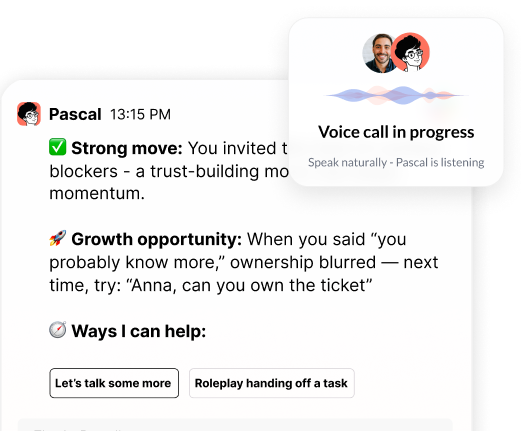
Pascal delivers personalized behavioral feedback with timestamped examples. Instead of "work on active listening," managers receive: "At 12:34, when Sarah mentioned feeling overwhelmed, you immediately jumped to solutions rather than exploring the root cause. Consider asking 'Tell me more about what's contributing to that feeling' before problem-solving."
Managers can review the exact moment, understand the missed opportunity, and practice alternative responses.
Pascal tracks patterns over time. After ten feedback conversations, a manager might discover they consistently interrupt certain team members more than others, or that their feedback conversations average eight minutes (research from Harvard Business Review's 2023 study on feedback effectiveness suggests 20-25 minutes creates better outcomes). These patterns become clear over time.
Traditional executive coaching costs $300-500 per hour, limiting access to senior leaders. Sessions are scheduled weeks in advance and can't observe actual work. Manager training workshops are one-time events with generic scenarios and no follow-up.
Pascal is available 24/7, personalized to individual managers, and embedded in daily tools (Slack, Teams, Zoom). It learns from actual interactions rather than hypothetical scenarios.
A company with 200 managers spending $50,000 annually on manager training might reach 30 managers with executive coaching and deliver two workshops to the full population. The same investment in Pascal provides personalized support for all 200 managers across hundreds of conversations throughout the year.
Traditional coaching excels at deep, complex leadership challenges (career transitions, organizational politics, personal leadership philosophy). Pascal excels at daily micro-moments: the quick feedback conversation, the project check-in, the minor course correction. These moments happen dozens of times per week.
The ideal model combines both. Executive coaches work with managers on strategic leadership development while Pascal handles the tactical, high-frequency support that makes strategy actionable.
Pascal creates a continuous feedback loop, turning every difficult conversation into data that improves the next one. The system builds a knowledge graph of team interactions, communication patterns, and relationship dynamics.
This shifts culture from "feedback as event" to "feedback as continuous development." Managers stop dreading quarterly performance reviews because they're having smaller, more frequent conversations.
Pascal identifies patterns across the organization that individual managers can't see. At one Series B SaaS company with 150 employees, Pascal's aggregate data revealed that 60% of managers avoided giving negative feedback to high performers, allowing small issues to compound. At a 300-person fintech company, Pascal found that managers in technical roles consistently under-communicated context and strategy, leaving their teams feeling disconnected from company goals.
The system accelerates new manager development. First-time managers receive immediate, specific feedback on every conversation rather than waiting for annual reviews or occasional coaching sessions.
Start with a focused pilot targeting managers who handle the most difficult conversations: those managing underperformers, delivering critical feedback, or navigating team conflicts. Measure baseline metrics before implementation: manager confidence scores, feedback frequency, and direct report satisfaction with feedback quality.
Pascal integrates with existing communication tools (Slack, Teams, Zoom) rather than requiring managers to adopt another standalone application.
Establish guardrails for sensitive topics that require human HR intervention. Performance improvement plans, legal concerns, or mental health discussions escalate to qualified professionals.
Successful implementations follow three phases:
Phase one: 10-15 volunteer managers who are already strong communicators and open to experimentation. These early adopters provide feedback on the user experience and become internal champions.
Phase two: 50-75 managers, including a mix of experience levels and departments. This phase tests scalability and reveals department-specific needs.
Phase three: Full manager population with a robust support system (office hours, a Slack channel for questions, clear escalation paths).
Frame Pascal as a development tool, not a monitoring system. Share aggregate insights ("managers who use preparation report 40% higher confidence entering difficult conversations" per internal Pinnacle data from Q4 2024 across 12 customer deployments) rather than individual performance data. Make participation voluntary initially.
Address privacy concerns transparently. Employees should know when Pascal is observing conversations and have the option to request human-only meetings for sensitive topics. Clear communication about data usage, storage, and access prevents trust erosion.
Pascal maintains SOC2 compliance (a security certification that ensures customer data is protected through audited controls). Customer data never trains external AI models.
• Pascal provides personalized preparation 24 hours before conversations, silent observation during meetings, and immediate post-conversation analysis.
• Managers practice with simulations of specific employees, building confidence through repetition.
• Post-conversation behavioral feedback delivered within minutes creates documented learning moments.
• The system reaches all managers at a fraction of traditional coaching costs while integrating into existing workflows.
Ready to turn every difficult conversation into a development opportunity for your managers? See how Pascal works inside Slack and Teams at heypinnacle.com.
Header photo by Vitaly Gariev on Unsplash

.png)
.webp)
“Thank you for setting the great foundation for my promotion; now I have a plan!"

Curious to see how AI Coaching can 10X the impact and scale of your development initiatives. Book a demo today for: