

To support a newly promoted manager, give them help inside the workday. Agree on one or two skills to build first, hold regular 1:1s, make HR easy to reach for hard cases, and give them practice right before the conversations that test them. A development plan only works when something drives it every week.
A newly promoted manager is usually someone who did their previous job very well. They are often technically excellent, trusted by their peers and used to solving problems on their own. On the day of the promotion, the job becomes getting work done through other people.
That shift creates a few common struggles. A capable new manager may hold on to tasks because they know how to do them faster. They may avoid a hard conversation with someone who was a peer last month. They may hesitate to ask HR for help because HR looks busy, and the question feels too small to raise.
Newly promoted managers also tend to want support. Frontline and midline leaders in moments of transition show some of the highest engagement with coaching, because they feel the gap between the old job and the new one every day.
A new manager cannot work on everything at once. The most useful first step is a short conversation between the new manager and their own boss about where to focus.
Common starting points include delegation, giving specific feedback, running a useful 1:1 and handling a first difficult conversation. Performance data and recent reviews can help point to the right ones.
The new manager should own the choice. Development that someone chooses for themselves feels like growth, and they can see evidence of their own progress over time. The company can still set the broader direction, such as a new set of leadership principles that every manager is expected to practice.
Many companies already help new managers write a development plan. The harder part is what happens next. Once the plan is written, nothing in the workday pushes it forward, and it quickly goes stale.
A plan needs a vehicle that connects it to real meetings and real decisions. That can be a boss who brings it up in every 1:1, a mentor who checks in, or a coach who works from the manager's actual week. The key is regular contact with the moments where the new skills get used.
Mandatory moments help too. Performance reviews involve every manager, and they are a natural point to practice feedback and to revisit the focus areas in the plan.
The new manager's boss and HR partner carry much of the early support. These habits help most during the first months.
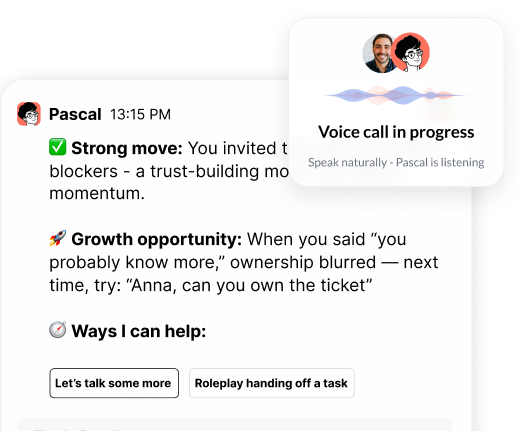
Pascal is an AI coach for every manager: a leadership companion who accompanies them in their meetings and work, and coaches from what actually happened. He sits in Slack or Microsoft Teams, connects to the manager's calendar and joins their meetings.
For a newly promoted manager, Pascal can build a development plan with focus areas and activities drawn from performance data, then sustain progress with weekly coaching. He is customized to the company's competencies, values and training materials, so his coaching reinforces what the company already teaches.
Before a hard conversation, the manager can role-play the conversation with Pascal. He offers specific talking points, plays the other person and gives feedback afterward on how the conversation went. When a topic such as termination, a medical issue, a grievance or harassment comes up, he raises the HR or EAP boundary and then helps the manager plan the outreach.
Pascal also starts the day with a preview of the calendar and preparation suggestions, and he closes the day with patterns across the day's meetings. Each manager chooses which of these updates they receive.
Each person's coaching conversations with Pascal stay private. HR and leaders see aggregated, anonymized insights, and only for groups large enough to protect anonymity.
Support for a new manager should show up in their behavior over the following months. A few signals are worth watching in regular check-ins.



“Thank you for setting the great foundation for my promotion; now I have a plan!"

Curious to see how AI Coaching can 10X the impact and scale of your development initiatives. Book a demo today for: