

Leadership development platforms with engagement metrics track whether managers apply new skills and how those behaviors impact team performance. Traditional training platforms measure completions. Modern platforms measure behavioral change, giving CHROs data to prove ROI and identify where development investments work.
This guide helps CHROs evaluate leadership development platforms by comparing capabilities, pricing models, and implementation approaches. You'll learn what separates a $50/user/year platform from a $500/user/year platform, what questions expose vendor weaknesses, and how to measure whether your investment drives behavioral change.
Key Takeaways:
• Platforms split into three tiers: basic content delivery ($50–$150/user/year), mid-tier behavioral assessment ($150–$350/user/year), and advanced in-workflow coaching ($350–$600/user/year)
• Effective platforms integrate with existing tools (Slack, Teams, calendar) and surface coaching at the moment managers need it
• Demand 90-day engagement benchmarks and correlation data between coaching usage and team performance before signing
• Implementation speed ranges from 5–7 months (basic platforms) to 4–6 weeks (advanced platforms)
• Executive sponsorship drives adoption more than features—without CEO/COO endorsement, platforms fail
Before evaluating vendors, determine whether your organization needs this category of tool. Three signals indicate you're ready:
Your manager population exceeds 50 people. Below 50 managers, quarterly training sessions and one-on-one coaching from HR can work. Above 50, you need scalable infrastructure to ensure consistent development.
Manager quality directly impacts business metrics you care about. If you track retention, engagement scores, or promotion velocity by team, and you see wide variance between managers, a platform can help identify and close skill gaps. If you don't measure these outcomes or don't see manager-driven variance, training content alone may suffice.
You're spending $200+ per manager per year on leadership development with no behavioral data. If you're already investing in training programs, conferences, or coaching but can't answer "did manager behavior change?" or "did team performance improve?", you're flying blind. A platform converts that spending into measurable outcomes.
If none of these apply, you don't need a platform yet. Invest in building manager competency frameworks and defining what good leadership looks like at your company first. Platforms amplify existing frameworks—they don't create them.
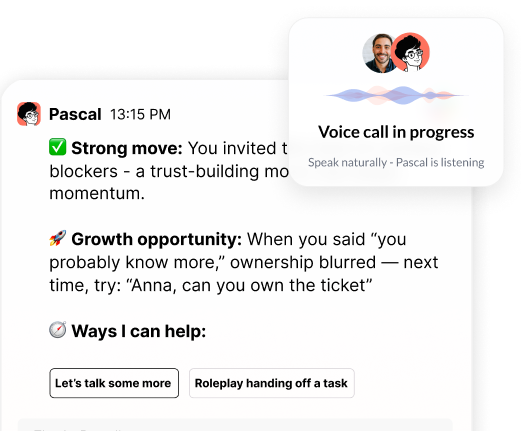
A manager opens Slack at 8:47 AM. Before her 9:00 1:1 with a struggling team member, a message appears: "Your 1:1 with Sarah is in 13 minutes. Last week you discussed her project timeline concerns. Here are three coaching approaches for today's conversation." She taps one, reads a 90-second framework, and enters the meeting prepared.
After the 1:1, the platform asks two questions: "Did you use the coaching framework?" and "How did the conversation go?" These responses become behavioral data.
This is in-workflow coaching. The platform integrates with tools managers already use, surfaces coaching moments based on upcoming meetings or recent interactions, and tracks whether managers engage with the guidance. Traditional learning management systems require managers to log in, complete modules, and pass quizzes. In-workflow platforms meet managers where they work and measure application, not completion.
The difference matters. Research from Gallup (https://www.gallup.com/workplace/231593/why-great-managers-rare.aspx) shows managers account for 70% of the variance in team engagement. Knowing a manager completed a feedback training module tells you nothing about whether they give better feedback. Knowing they used a feedback framework in three conversations this week and their direct reports rated those conversations as helpful tells you everything.
The market splits into three tiers based on underlying technology, not just price. Basic platforms deliver content. Advanced platforms deliver contextual coaching at the moment managers need it.
Data Breakdown:
• Platform Tier: Basic | Price Range: $50–$150/user/year | Core Technology: Content libraries, completion tracking, basic analytics | What They Measure: Logins and module completions | Implementation Time: 3–6 months
• Platform Tier: Mid-tier | Price Range: $150–$350/user/year | Core Technology: Behavioral assessments, peer feedback tools, cohort-based learning, some Slack/Teams integration | What They Measure: 360 feedback scores, self-reported behavior change | Implementation Time: 6–12 weeks
• Platform Tier: Advanced | Price Range: $350–$600/user/year | Core Technology: In-workflow coaching, real-time behavioral tracking, team outcome correlation, native tech stack integration, SSO/directory sync | What They Measure: Skill application, coaching engagement frequency, correlation with team performance | Implementation Time: 4–6 weeks
The platform surfaces coaching based on observed interactions: upcoming 1:1s, recent feedback requests, calendar patterns showing back-to-back meetings. It sends timely nudges when managers need them and tracks engagement frequency to identify disengaged managers early.
This requires native integration with Slack, Microsoft Teams, Zoom, Google Meet, and calendar systems. Platforms requiring manual data entry or separate logins fail because managers won't use them.
If your company prioritizes "direct feedback" as a core value, the platform should reinforce that in coaching moments. If your new managers struggle with delegation while senior managers need executive presence coaching, the platform should recognize these patterns and adapt.
This requires the platform to understand your competency frameworks and leadership values. Generic advice fails because it ignores your organizational context. During vendor demos, ask: "How does your platform learn our leadership competencies?" Strong vendors describe a configuration process where you define competencies and the platform adapts coaching to match. Weak vendors show you their standard content library and suggest you'll find something relevant.
If the dashboard only shows logins and completions, you're looking at a basic platform. Effective analytics include:
• Active user rates by department, level, and tenure (which groups engage and which don't)
• Behavioral competency scores across key skills (delegation, feedback quality, communication effectiveness)
• Correlation analysis between coaching usage and team performance
• Skill gap identification at the organizational level
• Trend analysis showing improvement over time
Demand to see a sample dashboard with real customer data during vendor evaluations. Demo dashboards with fake data tell you nothing about what you'll actually see.
Platforms must recognize when conversations exceed AI capabilities and require human intervention. Essential escalation triggers include performance issues requiring formal documentation, potential legal concerns (discrimination, harassment, retaliation), mental health disclosures suggesting crisis, reports of workplace safety issues, and discussions of termination or disciplinary action.
The platform should immediately route these conversations to designated HR or legal contacts with appropriate context while maintaining confidentiality. Test this during vendor demos by asking: "If a manager mentions that a direct report disclosed suicidal thoughts, what happens?" The answer reveals whether the vendor understands the stakes.
Security requirements start with SOC2 Type II compliance. Verify the audit report date—certifications older than 12 months are stale. Platforms need data encryption in transit (TLS 1.2+) and at rest (AES-256), role-based permissions, multi-factor authentication, audit logs, and clear data retention policies.
For regulated industries, demand zero-day data retention options where coaching interaction data is deleted immediately after each session. For global operations, verify GDPR and CCPA compliance and data residency options (EU, US, and other regional hosting).
Demand 90-day proof points tied to business outcomes, not vanity metrics like logins or module completions. Effective vendors provide baseline engagement benchmarks, demonstrate how their platform tracks behavioral change, and show correlation between coaching usage and team performance improvements.
What's your 30/60/90-day active usage rate across customers? Strong vendors provide specific numbers: "70% of managers engage weekly by day 30, 75% by day 60, 80% by day 90." Weak vendors say "it varies by customer" or "we see high engagement" without data.
How do you define active engagement? Strong vendors specify measurable behaviors: "A manager who interacts with coaching content at least twice per week, measured by message responses, framework usage, or reflection submissions." Weak vendors define engagement as "logging in" or "opening the app."
Can you show me a sample engagement dashboard with real customer data? Strong vendors show anonymized dashboards with cohort breakdowns, trend lines, and outcome correlations. Weak vendors show demo dashboards with fake data or decline to share.
How do you measure whether managers apply new skills? Strong vendors describe specific tracking: "We track behaviors like giving feedback within 24 hours of a triggering event, running structured 1:1s using our framework, and delegating tasks with clear success criteria. We measure frequency and quality through manager self-reports and direct report feedback." Weak vendors say "we survey managers quarterly" or "we track course completions."
What behavioral competencies can you track and score? Strong vendors list 8–12 specific competencies (delegation, feedback quality, communication clarity, conflict resolution, goal-setting, coaching, decision-making, accountability) with definitions and measurement approaches. Weak vendors offer generic categories like "leadership" or "communication" without specifics.
How do you correlate coaching usage with team performance outcomes? Strong vendors explain integration: "We integrate with your HRIS and performance management system to correlate coaching engagement with retention rates, promotion velocity, and performance ratings." They provide case studies showing managers in the top quartile of coaching engagement had measurably better team outcomes. Weak vendors say "we don't have access to that data" or "customers tell us it works."
What percentage of customers renew, and why do some not renew? Strong vendors share renewal rates and explain non-renewals: "92% renewal rate. Non-renewals happen when executive sponsors leave, budgets get cut, or customers didn't integrate the tool into workflows and saw low engagement." Weak vendors say "we don't share that" or "almost everyone renews."
Can you provide references from CHROs who've measured ROI? Strong vendors connect you with 2–3 CHROs who implemented the platform, measured outcomes, and can speak to results. Weak vendors offer to send case studies written by marketing or claim "our customers are confidential."
If a manager discusses a product launch timeline or competitive strategy in a coaching conversation, how do you ensure that information doesn't leak into models serving our competitors? Strong vendors provide written guarantees that your company's coaching conversations, manager interactions, and behavioral data will never be used to train AI models for other customers. They explain technical safeguards (isolated model instances, data segregation) and contractual protections.
Weak vendors give vague assurances about "privacy protections" without specifics. This is non-negotiable. Your competitive insights and organizational challenges must remain confidential.
Every vendor makes trade-offs between speed, customization, cost, and features. Your job is to decide which trade-offs match your organization's priorities.
High engagement rates vs. deep customization. Platforms with 80%+ weekly engagement rates achieve this through simplicity and standardization. They offer limited customization because every configuration option reduces ease of use. Platforms with deep customization (tailored competency frameworks, custom coaching content, branded experiences) typically see lower engagement because complexity creates friction.
If your priority is getting managers to engage consistently, choose simplicity. If your priority is aligning the platform precisely with your unique leadership model, accept that customization will slow adoption.
Fast deployment vs. extensive integration. Platforms that deploy in days use pre-built connectors and standard configurations. Platforms that integrate deeply with your HRIS, performance management system, and custom tools require weeks or months of API work and testing.
If your priority is speed to value, choose platforms with standard integrations and accept limited data flow between systems. If your priority is a unified data ecosystem where coaching metrics feed into performance reviews and succession planning, accept longer implementation timelines.
Low cost vs. advanced analytics. Platforms at $50–$150/user/year deliver content and track completions. Platforms at $350–$600/user/year correlate coaching usage with team performance outcomes and identify skill gaps across your organization.
If your priority is cost containment and you're satisfied with completion metrics, basic platforms work. If your priority is proving ROI and optimizing development investments, advanced analytics justify higher costs.
Implementation speed separates modern platforms from legacy systems. Advanced platforms deploy in 4–6 weeks through SSO integration and directory sync. Basic platforms require 5–7 months of configuration, content customization, and user onboarding.
Data Breakdown:
• Implementation Phase: Technical setup | Basic Platform: 4–6 weeks (manual user imports, custom SSO configuration) | Mid-tier Platform: 2–3 weeks (semi-automated sync, standard SSO) | Advanced Platform: 2–3 days (automated directory sync, pre-built SSO)
• Implementation Phase: Content configuration | Basic Platform: 6–8 weeks (customizing modules, building learning paths) | Mid-tier Platform: 3–4 weeks (selecting content, light customization) | Advanced Platform: 1 week (AI adapts to your competency framework)
• Implementation Phase: Pilot program | Basic Platform: 8–12 weeks (training cohort, gathering feedback, adjustments) | Mid-tier Platform: 4–6 weeks (smaller pilot, faster iteration) | Advanced Platform: 2–3 weeks (in-workflow adoption requires minimal training)
• Implementation Phase: Full rollout | Basic Platform: 4–6 weeks (phased deployment, ongoing training) | Mid-tier Platform: 2–3 weeks (faster adoption with better UX) | Advanced Platform: 1 week (push notification, immediate availability)
• Implementation Phase: Total time to value | Basic Platform: 5–7 months | Mid-tier Platform: 3–4 months | Advanced Platform: 4–6 weeks
Executive sponsorship matters more than features. When the CEO or COO sends a message saying "I'm using this platform for my own leadership development, and I expect all managers to engage," adoption jumps 40–60%. Without executive sponsorship, even the best platform struggles.
Secure CEO/COO endorsement before launch. Have them record a 2-minute video explaining why leadership development is a priority and how the platform supports it. Send this video company-wide on launch day.
Integrate into existing workflows. Platforms that require managers to log into a separate system fail. Platforms that surface coaching in Slack, Teams, or email succeed. The best adoption strategy is making the platform invisible—managers receive coaching where they already work.
Measure and celebrate early wins. Identify 5–10 managers who engage heavily in the first 30 days. Ask them to share specific examples of how the coaching helped in team meetings or company channels. Social proof drives adoption faster than any training program.
Tie usage to manager performance reviews. If leadership development is a stated priority but doesn't appear in performance evaluations, managers won't prioritize it. Add a simple metric: "Engages with leadership development coaching at least twice per week" as a behavioral expectation.
Run a 30-day pilot with 20–30 managers across different departments and levels before full rollout. Measure three things:
Engagement rate. What percentage of pilot managers engage at least twice per week? If this number is below 60%, investigate why before expanding. Common issues: platform isn't integrated with daily tools, coaching content doesn't match your culture, managers don't understand the value.
Behavioral application. Ask pilot managers: "Did you apply a coaching framework from the platform in a real conversation this week?" If fewer than 50% say yes, the platform isn't delivering practical value.
Manager feedback. Run a 10-minute survey asking: "Would you recommend this platform to other managers?" and "What would make this more useful?" Net Promoter Score below 30 indicates fundamental problems.
Use pilot feedback to adjust configuration, communication, and rollout strategy before expanding to all managers.
Published per-user pricing rarely reflects actual costs. Factor in implementation fees, integration costs, ongoing support, and the hidden cost of low adoption.
Data Breakdown:
• Cost Component: Per-user annual fee | Basic Platform: $50–$150 | Mid-tier Platform: $150–$350 | Advanced Platform: $350–$600
• Cost Component: Implementation fee | Basic Platform: $15,000–$50,000 (heavy customization required) | Mid-tier Platform: $10,000–$25,000 (moderate setup) | Advanced Platform: $5,000–$15,000 (mostly automated)
• Cost Component: Integration costs | Basic Platform: $10,000–$30,000 (custom API work) | Mid-tier Platform: $5,000–$15,000 (semi-automated) | Advanced Platform: $0–$5,000 (pre-built connectors)
• Cost Component: Training and change management | Basic Platform: $20,000–$40,000 (extensive training needed) | Mid-tier Platform: $10,000–$20,000 (moderate training) | Advanced Platform: $5,000–$10,000 (minimal training)
• Cost Component: Annual support | Basic Platform: Included | Mid-tier Platform: Included | Advanced Platform: Included
• Cost Component: Total first-year cost (200 managers) | Basic Platform: $65,000–$150,000 | Mid-tier Platform: $55,000–$105,000 | Advanced Platform: $80,000–$145,000
The hidden cost is low adoption. A $50/user platform with 30% engagement delivers less value than a $350/user platform with 80% engagement. Calculate cost per engaged manager, not cost per licensed seat.
Example: 200 managers, basic platform at $100/user ($
Header photo by Priscilla Du Preez 🇨🇦 on Unsplash

.png)
.webp)
“Thank you for setting the great foundation for my promotion; now I have a plan!"

Curious to see how AI Coaching can 10X the impact and scale of your development initiatives. Book a demo today for: