

Most organizations reserve professional coaching for executives. This creates a gap: mid-level managers and first-time leaders handle the majority of people decisions but receive minimal development support. Scaling coaching means closing that gap by making personalized guidance accessible at all management levels.
Scaling coaching means first-time managers and mid-level leaders get access to professional development, not just executives. In most organizations, coaching is allocated to the top 2–5% of leaders. Everyone else gets a two-day training session and occasional HRBP check-ins.
The economics don't work. Executive coaching costs $200–$500 per hour. Extending this to 100+ managers in a mid-sized company isn't financially viable.
The need is greatest at mid-levels. Gallup research shows 70% of the variance in team engagement comes down to the manager. Yet most managers receive minimal development support while being expected to deliver results, develop people, and lead through volatility.
Several approaches can help scale coaching:
• Internal coaching pools: Train senior leaders to coach others, creating a multiplier effect
• Manager-as-coach programs: Equip managers to coach their own teams through structured frameworks
• Peer coaching circles: Facilitate small groups of managers coaching each other
• AI coaching platforms: Provide 24/7 access to personalized guidance at lower cost
• Hybrid models: Combine human coaching for complex situations with AI for day-to-day support
Each approach has tradeoffs. Internal pools require significant time investment from senior leaders. Peer coaching works well for some populations but lacks expertise for complex situations. AI platforms offer cost advantages but require careful evaluation of quality and fit.
Scale means both breadth and depth. Reaching more people matters, but so does providing contextual guidance that adapts to each individual's role, challenges, and organizational context.
Organizations that extend coaching to all managers see measurable improvements in retention, engagement, and manager effectiveness. The cost of not scaling (disengaged teams, poor manager decisions, preventable turnover) often exceeds the investment in scalable solutions.
Melinda Wolfe, former CHRO at Bloomberg, Pearson, and GLG, notes: "We're asking more of managers with fewer resources. That's not sustainable without better support."
Turnover costs are staggering. Replacing a manager costs 100–200% of their annual salary. SHRM research identifies poor management as the top reason employees leave. When managers can't handle difficult conversations, provide meaningful feedback, or develop their teams, the entire organization pays the price.
The ROI timeline matters. Traditional development programs take 6–12 months to show results. Scalable approaches can demonstrate behavior change within 90 days, making it easier to prove value to executive stakeholders who expect quick wins.
Jeff Diana, former CHRO at Calendly and Atlassian, observes: "HR leaders have an opportunity to shape how AI transforms work rather than waiting for others to decide it for us."
Three primary barriers prevent most organizations from scaling coaching: cost constraints, inconsistent quality, and low engagement.
Cost barrier: Traditional executive coaching at $200–$500 per hour makes it impossible to serve 100+ managers. Even if budget allowed, the logistics of scheduling, matching coaches to coachees, and managing relationships across that many people becomes unmanageable.
Quality consistency: Human coaches vary in expertise and approach. One manager might get a coach who specializes in communication while another gets someone focused on strategic thinking. This creates uneven development experiences across the organization.
Engagement challenge: Scheduled coaching sessions miss the moments that matter. A manager preparing for a difficult conversation at 3 PM on Tuesday can't wait until their Thursday coaching session. The gap between when support is needed and when it's available reduces effectiveness.
Different solutions address these barriers in different ways:
Data Breakdown:
• Challenge: Cost | Traditional Coaching: $200–$500/hour | Internal Coaching Pool: Time investment from senior leaders | AI Coaching Platform: Subscription model, lower per-user cost
• Challenge: Quality | Traditional Coaching: Varies by coach | Internal Coaching Pool: Depends on internal expertise | AI Coaching Platform: Consistent if well-designed
• Challenge: Engagement | Traditional Coaching: Scheduled sessions | Internal Coaching Pool: Limited availability | AI Coaching Platform: 24/7 access
• Challenge: Customization | Traditional Coaching: Coach learns company over time | Internal Coaching Pool: Deep company knowledge | AI Coaching Platform: Requires configuration
Customization adds complexity. Generic coaching doesn't address company-specific challenges. Any scaled solution needs to incorporate your competencies, frameworks, and cultural context.
Data privacy concerns are especially critical for regulated industries. Healthcare, life sciences, and financial services companies need robust security and clear policies about how coaching conversations are stored and used.
Success in scaling coaching is measured through three lenses: adoption metrics (are managers actually using it?), behavior change indicators (are managers improving?), and business outcomes (are teams performing better?).
Adoption metrics matter first. Track weekly active users, session frequency, and depth of engagement. If managers aren't using the tool, nothing else matters. Victor Arguelles, VP of Learning Design at Marriott, emphasizes: "We only scale once employee satisfaction reaches defined thresholds."
Behavior change indicators show whether coaching is working. Monitor 360 feedback improvements, direct report satisfaction scores, and specific skill development in areas like giving feedback, handling difficult conversations, and delegation. These leading indicators predict business outcomes before they show up in quarterly surveys.
Track real-time engagement data (conversations initiated, topics explored, action items completed) as leading indicators before waiting for quarterly engagement surveys. This allows you to course-correct quickly if adoption stalls in specific departments or levels.
Business outcomes take longer to materialize but validate the approach. Look for improvements in retention rates, engagement survey scores, and team performance metrics within six months.
Organizational insights surface patterns. Aggregated, anonymized data can reveal what managers are struggling with across departments. When you see 40% of first-time managers asking about delegation in the same month, you know where to focus your next training initiative.
First-time managers and mid-level leaders deliver the fastest ROI from scaled coaching. They face the highest volume of people decisions with the least experience, making guidance immediately valuable.
First-time managers are ideal early adopters. Center for Creative Leadership research shows new managers report feeling unprepared 60% of the time. They're wrestling with delegation, giving feedback, and handling difficult conversations for the first time.
Mid-level managers (directors, senior managers) show strong early adoption because they're caught between strategic demands from above and execution pressures from below. They need support on influencing without authority, managing up, and developing their own teams while delivering results.
High-potential individual contributors benefit from coaching as they prepare for leadership roles. Technical experts moving into management need support navigating the shift from individual contributor to people leader.
Distributed teams see outsized value because they lack the informal coaching that happens in office hallways. Remote managers can't casually ask a peer how to handle a situation—they need accessible support that works across time zones.
Start with one high-impact population, prove value within 90 days, then expand. This build-momentum approach is more effective than company-wide rollouts that dilute focus and make it harder to measure impact.
Coaching aligns with company culture through customization at both the organizational and individual level. This applies whether you're building an internal coaching pool, implementing peer coaching, or evaluating AI platforms.
Organizational-level customization is foundational. Any scaled coaching approach should incorporate your leadership competencies, values documentation, cultural frameworks, and specific policies. If your company uses SBI (Situation-Behavior-Impact) for feedback, coaching should reinforce that model. If you have specific escalation pathways for HR issues, coaches need to know them.
Individual-level personalization ensures relevance. Incorporating performance reviews, 360 feedback, and individual development plans allows coaching to adapt to each person's development areas, communication style, and career goals.
Guardrails protect your culture. Build clear protocols for when conversations touch on potential legal issues, accommodation requests, or serious interpersonal conflicts. These situations require escalation to HR rather than coaching through complex situations without proper expertise.
Anonymous aggregated insights respect privacy while providing organizational visibility. HR should see themes and patterns across the organization without accessing individual conversation content. This balance allows you to identify systemic issues while maintaining confidentiality.
The depth of customization separates purpose-built solutions from generic approaches. Using general-purpose AI tools means every manager gets the same generic advice. Purpose-built platforms can deliver coaching that reflects your company, your values, and your specific challenges.
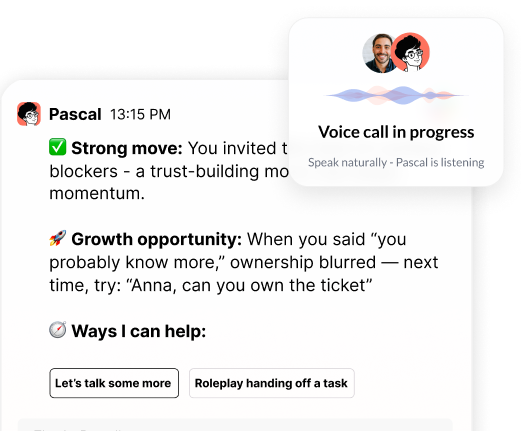
At Pinnacle, we've built Pascal to handle this customization. Pascal can be trained on your leadership competencies, values documentation, and cultural frameworks. The platform includes moderation flags, sensitive topic escalation, and organization-specific controls. We're SOC2 compliant and never train on customer data.
In the first 90 days, expect 60%+ active adoption among target populations, measurable improvements in manager confidence and skill application, and early indicators of team impact through direct report feedback. The timeline compresses compared to traditional development programs that take 6–12 months to show results.
Week 1–4: Adoption and exploration. Managers discover the platform, experiment with different use cases, and begin incorporating it into their workflow. Track weekly active users and conversation frequency. Successful deployments see 40–50% of managers engaging in the first month.
Week 5–8: Habit formation. Usage patterns stabilize as managers identify their highest-value use cases. Some use it for meeting prep, others for feedback conversations, others for career development discussions. Depth of engagement matters more than breadth—look for managers returning multiple times per week.
Week 9–12: Behavior change emerges. Direct reports begin noticing differences in their manager's approach. 360 feedback scores improve. Managers report higher confidence in handling difficult situations.
Leading indicators to track: conversation topics (what are managers asking about?), action item completion rates, return usage patterns, and qualitative feedback from early adopters. These predict business outcomes before they appear in engagement surveys.
Lagging indicators appear after 90 days: retention improvements, engagement survey lifts, and performance metric changes. These take longer to materialize but validate the early leading indicators.
Set realistic expectations with stakeholders. Scaled coaching isn't magic—it's a tool that accelerates development when managers engage with it consistently. Organizations seeing the best results treat the first 90 days as a learning period, gathering feedback and adjusting their approach before scaling more broadly.
• Scaling coaching requires new economics: Traditional coaching at $200–$500 per hour can't reach all managers; scaled approaches (internal pools, peer coaching, AI platforms) make coaching accessible at lower cost
• Start with high-impact populations: First-time managers and mid-level leaders see the fastest ROI because they face high-volume people decisions with the least experience—prove value here first, then expand
• Measure across three dimensions: Track adoption metrics (are people using it?), behavior change indicators (are managers improving?), and business outcomes (are teams performing better?) to build a complete ROI picture
• Customization drives alignment: Generic approaches can't reinforce your culture; any scaled solution should embed your competencies, frameworks, and values into coaching interactions
• Expect compressed timelines: Scaled coaching can deliver measurable behavior change within 90 days compared to 6–12 months for traditional programs, with 60%+ active adoption in successful deployments
Pascal delivers personalized, real-time coaching to every manager in your organization. We customize the platform with your competencies, culture, and frameworks. Explore Pascal's approach to AI coaching or schedule a demo.
Header photo by Memento Media on Unsplash

.png)
.webp)
“Thank you for setting the great foundation for my promotion; now I have a plan!"

Curious to see how AI Coaching can 10X the impact and scale of your development initiatives. Book a demo today for: