

Proving AI coaching effectiveness requires tracking three interconnected measurement levels: adoption patterns that predict sustained engagement, behavioral change metrics showing skill development, and business outcomes that justify continued investment. Organizations using AI coaching platforms integrated into daily workflow report that 83% of direct reports see measurable manager improvement (Pascal internal data, 2024) and 20% average lift in Manager Net Promoter Score among engaged users (Pascal internal data, 2024).
AI coaching works when three conditions align: managers consistently engage with the platform, they apply new behaviors in real workplace situations, and their teams report measurable improvement. Define these success criteria before deployment, not after.
Establish baseline metrics across three levels. Level 1 tracks adoption: weekly active users (target 60% of enrolled managers within 90 days), repeat usage rate (managers returning 3+ times per week), conversation depth (average exchanges per session, target 5+ turns), and proactive engagement (percentage of coaching triggered by AI observation versus manager-initiated).
Level 2 measures behavioral change through direct report feedback on specific manager behaviors using 360-degree assessments, Manager Net Promoter Score (asking direct reports "How likely are you to recommend your manager to a colleague?") tracked quarterly with a target of 20% improvement, quality of feedback conversations measured through meeting analysis, and application of learned skills in real situations tracked through follow-up coaching.
Level 3 captures business outcomes: time-to-productivity for new managers (target 30% reduction), employee engagement scores for coached managers' teams, retention rates among direct reports of coached managers, and performance review quality improvements.
Create a measurement scorecard before launch:
Data Breakdown:
• Metric Category: Adoption | Specific Metric: Weekly Active Users | Baseline: 0% | 30-Day Target: 40% | 90-Day Target: 60% | Data Source: Platform analytics
• Metric Category: Behavior | Specific Metric: Manager NPS | Baseline: Current score | 30-Day Target: +10% | 90-Day Target: +20% | Data Source: Quarterly survey
• Metric Category: Business | Specific Metric: Team Engagement | Baseline: Current score | 30-Day Target: +5% | 90-Day Target: +10% | Data Source: Engagement survey
CHROs face pressure to justify every technology investment. Without clear proof points, your AI coaching initiative becomes another underutilized tool that fails at renewal.
The challenge isn't whether AI coaching works—it's proving it works in your organizational context. Traditional L&D metrics like completion rates and satisfaction scores don't capture behavior change or business impact. CFOs demand ROI data, business leaders want performance improvements, and your credibility as a strategic partner depends on demonstrating measurable outcomes.
Adoption metrics reveal whether your AI coaching platform becomes a trusted daily resource or another forgotten login. Track engagement frequency, conversation depth, and proactive usage patterns—not just total sessions or registered users.
Monitor engagement frequency weekly. Daily active users (DAU) and weekly active users (WAU) provide the foundation. The DAU/WAU ratio should target 0.4 or higher, indicating habit formation. Time between coaching sessions should decrease as trust grows.
Conversation quality matters more than quantity. Average conversation length should target 5+ exchanges per session (where an exchange equals one manager message and one AI response). Topic diversity shows managers exploring multiple coaching areas, not just one. Follow-up rate measures the percentage of managers returning to previous topics, indicating sustained development focus.
Proactive engagement separates transformative platforms from reactive chatbots. Track the percentage of coaching triggered by AI observation of meetings and Slack conversations. Real-time feedback requests during or immediately after key moments signal trust. Unsolicited check-ins where managers seek guidance without prompting demonstrate adoption.
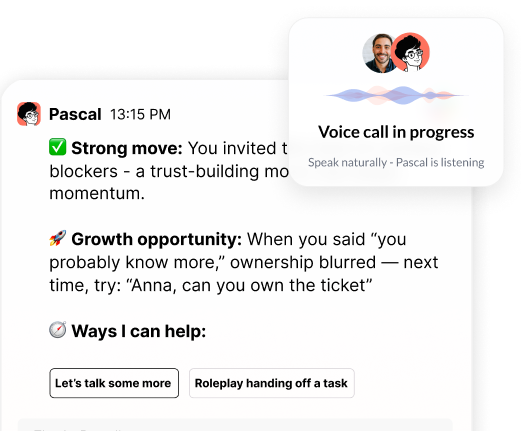
Platforms that integrate into existing workflow (Slack, Teams, meetings) drive higher sustained engagement than standalone tools. When coaching meets managers in their workflow rather than requiring them to seek it out, adoption compounds over time. Pascal joins meetings and observes Slack conversations, offering real-time feedback where work happens.
Red flags indicating adoption problems include declining weekly active users after initial spike, high percentage of single-session users who never return, coaching concentrated among early adopters only, and low engagement from target populations like first-time managers or specific departments.
Behavioral change is the bridge between platform usage and business outcomes. Measure whether managers apply learned skills in real situations through direct report feedback, 360-degree assessments, and observation-based scoring.
Implement quarterly pulse surveys asking direct reports: "Has your manager improved in [specific behavior] over the past 90 days?" Use behavior-specific questions tied to coaching focus areas like feedback quality, delegation, and conflict resolution. Example questions: "My manager provides specific, actionable feedback within 24 hours of observing my work," "My manager delegates tasks with clear context and success criteria," "My manager addresses team conflicts directly rather than avoiding them."
Integrate 360-degree feedback with pre-deployment baseline assessment of manager competencies. Conduct 90-day and 180-day follow-up assessments measuring the same competencies. Focus on behaviors the AI coach addresses, not generic leadership traits.
Real-time behavioral observation provides compelling evidence. Meeting analysis shows improved feedback delivery, active listening, and conflict de-escalation. Slack conversation analysis reveals whether managers apply coaching in written communication. Follow-up coaching sessions track whether managers implement suggested approaches.
Compare behavioral metrics against control groups. Identify managers not using AI coaching and compare their direct report feedback scores, team engagement, and performance outcomes against coached managers. Use statistical tests (t-tests for comparing means, regression analysis to control for confounding variables like tenure or team size) to isolate AI coaching impact from other variables. Account for selection bias by tracking whether high-performing managers disproportionately opt into coaching.
Business outcomes justify continued investment and prove AI coaching delivers measurable ROI. Connect coaching interventions to organizational metrics your CFO and business leaders already track.
Track time-to-productivity for new managers. Measure how quickly first-time managers reach performance benchmarks compared to historical averages. Target 30% reduction in ramp time. Calculate cost savings by multiplying reduced ramp time by average manager salary.
Monitor employee engagement scores for teams led by coached managers. Compare engagement trends between coached and non-coached manager teams. Track retention rates among direct reports, as manager quality directly impacts turnover. Calculate retention cost savings using your organization's average cost-per-hire.
Measure performance review quality and consistency improvements. Analyze review completion rates, timeliness, and quality scores (measured by HR review of specificity, actionability, and fairness) before and after AI coaching deployment. Track reduction in HR escalations related to performance management issues.
Connect coaching topics to business priorities. If your organization focuses on sales performance, track whether sales managers using AI coaching see improved team quota attainment. If innovation matters, measure whether coached managers' teams submit more ideas or patents.
Pascal provides custom dashboards showing engagement metrics, usage trends by level and function, conversation topics people are working on, and skill development patterns. The dashboards are built for each client and can be customized based on the organization's data needs.
CFOs and business leaders expect proof of value quickly. Structure your measurement approach to demonstrate ROI within the first 90 days, not after a full year.
Establish clear baseline metrics before launch across all three measurement levels. Document current manager effectiveness scores, team engagement levels, and business outcomes you plan to improve. Without baselines, you cannot prove change.
Set realistic 30-day, 60-day, and 90-day milestones. Month one focuses on adoption: 40% weekly active users, average conversation depth of 4+ exchanges. Month two adds early behavioral indicators: 10% improvement in Manager NPS, positive direct report feedback trends. Month three delivers business outcomes: measurable engagement lift, reduced HR escalations, faster new manager ramp time.
Calculate cost savings and efficiency gains. Multiply the number of coaching conversations by traditional coaching hourly rates ($200-500 per hour) to show cost avoidance. Add time savings from faster performance review prep, reduced HR support tickets, and improved manager productivity.
Present results in business language, not HR metrics. Instead of "80% platform adoption," say "320 managers now receive real-time coaching on critical moments, preventing escalations that previously consumed 15 HR hours per week." Instead of "improved Manager NPS," say "teams led by coached managers show 12% higher engagement, reducing turnover by 3 percentage points."
Avoid measuring only platform logins and session counts. These vanity metrics don't prove behavior change or business impact. A manager can log in daily without applying any coaching insights. Focus on conversation depth, topic diversity, and follow-up patterns.
Don't wait until annual engagement surveys to measure impact. Quarterly pulse surveys specific to coached managers' teams provide faster feedback loops. Real-time meeting analysis and Slack conversation scoring offer continuous measurement rather than point-in-time snapshots.
Never measure AI coaching in isolation from other initiatives. Account for confounding variables like new training programs, organizational restructuring, or market conditions. Use control groups and statistical analysis to isolate AI coaching impact.
Avoid generic competency assessments disconnected from coaching focus areas. If your AI coach emphasizes feedback quality and delegation, measure those specific behaviors through direct report surveys and 360-degree assessments. Generic leadership scores dilute signal.
Don't ignore qualitative feedback. Quantitative metrics prove ROI, but manager testimonials and direct report stories demonstrate real-world impact. Collect both to build a compelling narrative for stakeholders.
• Effective AI coaching measurement requires three levels: adoption patterns (60% weekly active users, 5+ conversation exchanges), behavioral change metrics (20% Manager NPS improvement, measurable direct report feedback), and business outcomes (30% faster manager ramp time, improved team engagement)
• Track proactive engagement patterns—coaching triggered by AI observation of meetings and Slack conversations—not just reactive usage, as this predicts sustained adoption and habit formation
• Demonstrate ROI within 90 days by establishing clear baselines before launch, setting monthly milestones, and translating HR metrics into business language CFOs understand (cost savings, efficiency gains, retention impact)
• Avoid vanity metrics like login counts and focus on conversation depth, topic diversity, behavioral application in real situations, and direct report assessments of manager improvement
• AI coaching platforms that integrate into workflow (Slack, Teams, meetings) drive higher sustained engagement than standalone tools requiring managers to leave their workflow
Pascal by Pinnacle provides the measurement framework CHROs need to prove AI coaching ROI. With real-time adoption dashboards, behavioral change tracking, and business outcome reporting built into the platform, you can demonstrate value within 90 days. See how Pascal works inside Slack and delivers coaching where your managers work.

.png)
.webp)
“Thank you for setting the great foundation for my promotion; now I have a plan!"

Curious to see how AI Coaching can 10X the impact and scale of your development initiatives. Book a demo today for: