

AI coaching proves its value through three measurement levels: adoption patterns that predict sustained use, behavioral changes managers apply, and business outcomes like retention and team performance.
Proving AI coaching effectiveness requires tracking three distinct measurement levels: adoption indicators that predict sustained engagement, behavioral change metrics that show skill development, and business outcomes that justify continued investment.
Level 1: Adoption Indicators
Repeat usage rate measures the percentage of managers returning to the coach within 7 days of first use. Conversation depth tracks average exchanges per coaching session—more than 5 back-and-forth exchanges indicates problem-solving, not quick answers. Proactive engagement response shows how often managers engage when the AI coach reaches out after meetings or Slack conversations. Time-to-value measures days from first login to first meaningful coaching conversation.
Level 2: Behavioral Change Metrics
Direct report perception comes from 360 feedback or pulse surveys asking "Has your manager's [specific skill] improved in the past 90 days?" Manager Net Promoter Score (NPS) tracks "Would you recommend your manager to others?" on a 0-10 scale quarterly, with 9-10 being promoters. Skill application frequency measures how often managers apply specific frameworks (difficult conversations, delegation, feedback) in real situations. Behavior consistency shows variance in management quality across teams decreasing as coaching standardizes approaches.
Level 3: Business Outcomes
Manager ramp time measures time for new managers to reach effectiveness benchmarks. Voluntary turnover compares retention rates for teams with engaged managers vs. non-engaged. Performance review quality tracks consistency and completeness of reviews, reduction in HR escalations. Time saved calculates hours previously spent on 1:1 coaching, training delivery, or manager support.
What NOT to measure as primary success indicators: Login frequency without conversation depth, satisfaction scores without behavior change evidence, feature usage without business impact, or completion rates (AI coaching is continuous, not course-based).
Data Breakdown:
• Measurement Level: Adoption | Surface Metric: Weekly active users | Meaningful Metric: Repeat usage rate + conversation depth
• Measurement Level: Behavioral Change | Surface Metric: Satisfaction scores | Meaningful Metric: Direct report perception + Manager NPS
• Measurement Level: Business Outcomes | Surface Metric: Feature usage stats | Meaningful Metric: Manager ramp time + voluntary turnover
Establish baseline metrics and measurement infrastructure before deploying AI coaching—you can't prove improvement without knowing where you started. The most successful implementations define success criteria with finance and business leaders upfront.
Baseline data collection (4-6 weeks pre-launch): Capture current Manager NPS or direct report satisfaction scores. Document existing 360 feedback results on key competencies (communication, delegation, feedback quality). Record voluntary turnover rates by team and manager tenure. Measure average time-to-productivity for new managers. Track HR team hours spent on manager coaching and support.
Stakeholder alignment on success definition: Meet with CFO, business unit leaders, and executive team to define what ROI looks like in their language. Agree on measurement timeline (30-day check-in, 90-day formal review, 6-month business impact assessment). Identify 2-3 "lighthouse" teams or departments for focused measurement and storytelling.
Technical measurement setup: Integrate AI coaching platform analytics with your HRIS and performance management systems. Configure automated reporting dashboards for weekly adoption metrics and quarterly outcome metrics. Establish privacy-protected aggregation for sensitive behavioral data. Set up control groups (teams without AI coaching access) for comparative analysis where possible.
Communication framework: Create monthly "proof point" updates for executive stakeholders highlighting early wins. Develop manager-facing transparency about what's measured and why (builds trust and adoption). Plan quarterly business reviews with detailed ROI analysis.
As Taylor Malmsheimer from Section notes, measurement frameworks should enable fast learning, not slow you down. The goal is proving value quickly, not creating perfect attribution models.
AI coaching provides real-time, quantifiable behavioral data that traditional coaching and training programs cannot capture at scale. Human coaching relies on self-reported progress and coach observations from limited interactions. Training programs measure completion and satisfaction rather than application.
Traditional Human Coaching Limitations: Coaches see only what participants choose to share in sessions. No systematic measurement of behavior change between sessions. ROI based on participant self-assessment and anecdotal evidence. Expensive and limited to executives.
Learning Management System Gaps: Completion rates don't measure application. Satisfaction surveys don't predict behavior change. No visibility into whether managers apply frameworks in real situations. Quarterly engagement surveys provide only periodic snapshots, missing real-time shifts.
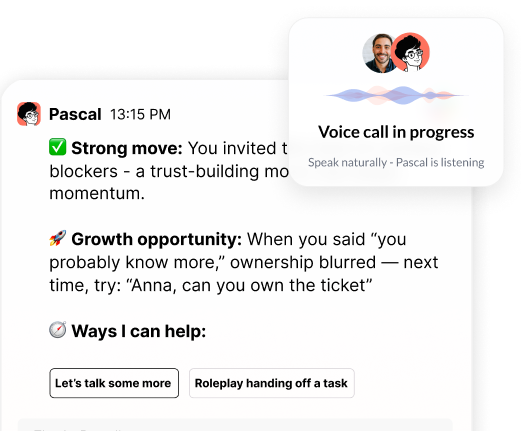
AI Coaching Advantages: Observes actual behavior in meetings, Slack conversations, and daily work. Generates objective evidence of skill application and improvement. Provides continuous performance data rather than infrequent survey results. Scales to every manager at a fraction of traditional coaching costs. Pascal joins meetings and sits in Slack, creating a knowledge graph of interactions (a map of how managers communicate and make decisions) that enables personalized, contextual coaching.
The difference is fundamental: traditional methods ask managers if they learned something. AI coaching platforms observe whether they changed behavior.
The first 90 days determine whether your AI coaching investment survives its first renewal. Expect adoption patterns to emerge within 30 days, behavioral change signals by 60 days, and early business impact indicators by 90 days.
30-Day Adoption Benchmarks: Majority of managers complete initial setup and first coaching conversation. Managers returning within 7 days of first use. Average conversation depth exceeds 5 exchanges. Proactive engagement response rate showing managers engage when the AI reaches out.
60-Day Behavioral Change Signals: Managers applying specific frameworks in real situations (trackable through meeting observation where the AI has access). Direct reports beginning to notice improvement in targeted competencies. Variance in management quality across teams starting to decrease. Reduced HR escalations for common management challenges.
90-Day Business Impact Indicators: Direct reports reporting measurable manager improvement. Lift in Manager Net Promoter Score among engaged users. Measurable reduction in new manager ramp time. Early retention improvements in teams with engaged managers.
Organizations that don't see these patterns by 90 days have adoption problems, not effectiveness problems. Embedding the coach in existing workflow (Slack, Teams, Zoom) matters more than feature lists.
• Measure three levels at once: Adoption indicators predict sustained engagement, behavioral change metrics show skill development, and business outcomes justify continued investment. Surface metrics like weekly active users mean nothing without behavior change evidence.
• Establish baselines before launch: You can't prove improvement without knowing where you started. Capture current Manager NPS, 360 feedback results, turnover rates, and manager ramp time 4-6 weeks before deployment.
• AI coaching generates provable ROI that traditional programs can't: Platforms that observe actual behavior in meetings and conversations provide objective evidence of skill application. Traditional coaching relies on self-reported progress.
• Expect clear signals within 90 days: Manager adoption, repeat usage, behavioral change visible to direct reports, and early business impact indicators. If you don't see these patterns, you have an adoption problem, not an effectiveness problem.
• Embedding matters more than features: Coaches that live in Slack, Teams, and meetings generate higher adoption than standalone portals. Where your coach lives determines whether it becomes a daily habit or another underused tool.
Ready to see how measurement-driven AI coaching works in practice? Explore how Pascal delivers real-time coaching embedded in your team's existing workflow—with the data to prove it's working.
Header photo by Bluestonex on Unsplash

.png)
.webp)
“Thank you for setting the great foundation for my promotion; now I have a plan!"

Curious to see how AI Coaching can 10X the impact and scale of your development initiatives. Book a demo today for: