

AI coaching proves its value through three measurement levels: adoption signals that predict sustained engagement, behavioral change metrics that show skill development, and business outcomes that justify continued investment.
AI coaching works when managers apply new behaviors in real situations, their direct reports notice improvement, and organizational outcomes shift.
The bar is higher than traditional training because the technology enables new measurement. Purpose-built platforms observe whether managers delegate differently after coaching, not whether they can define delegation in a quiz.
Track three things:
Behavior change, not knowledge transfer: Analyze meeting transcripts and communication patterns to score specific leadership behaviors (delegation quality, feedback effectiveness, inclusive communication). Track whether new behaviors persist across weeks and months.
Direct report validation: Survey direct reports at 30, 60, and 90 days with specific questions: "Has your manager's feedback become more actionable?" "Do you have clearer priorities after 1-on-1s?" "Does your manager delegate with appropriate context?"
Business outcome correlation: Connect coaching to retention and engagement. Track Manager Net Promoter Score (the likelihood that team members would recommend their manager to others) among coached populations.
Track active usage rates (percentage of licensed users engaging weekly), conversation depth (average exchanges per session), and repeat usage patterns (users returning within 7 days of first interaction).
A manager who asks one question and never returns won't see value. A manager who engages in multi-turn conversations and returns multiple times per week is building a coaching habit that compounds over time.
Active usage threshold: Target 60% of licensed managers engaging at least weekly within the first 30 days. This benchmark separates platforms that become daily resources from those that collect digital dust.
Conversation quality signals: Multi-turn conversations (4+ exchanges) indicate managers are working through real problems, not just testing the tool. Surface-level questions generate surface-level value.
Repeat engagement patterns: Track how many users return within 7 days of first use. This metric reveals whether the platform delivers enough value to become habit-forming. Compare this to traditional learning platforms where return rates fall below 20% after initial exploration.
Time-to-value metrics: Measure how quickly new users move from initial login to their first substantive coaching conversation (defined as 4+ exchanges addressing a specific management challenge). Platforms that create value in the first session see higher long-term adoption.
Purpose-built AI coaching platforms observe manager behavior in actual work contexts (meetings, Slack conversations, decision-making moments) and track whether specific leadership behaviors improve over time.
Score manager interactions against defined behavioral competencies by analyzing meeting transcripts and communication patterns. This isn't self-reported improvement—it's observed behavior change in the flow of work.
Competency-based scoring: Track improvement in specific leadership behaviors (giving actionable feedback, running effective 1-on-1s, delegating with context) rather than generic "leadership effectiveness." For example, instead of measuring "communication skills," track whether managers provide feedback that includes specific examples, clear expectations, and actionable next steps.
Before/after comparison: Establish baseline behavior patterns in the first 30 days, then measure change at 60 and 90-day intervals. This longitudinal view reveals whether coaching creates sustained improvement or temporary compliance.
Contextual application: Measure whether managers apply coaching in the right situations. For example, using coached delegation techniques when workload is high, or giving feedback within 24 hours of observing behavior. Generic behavior change doesn't prove effectiveness; situationally appropriate application does.
Skill sustainment: Track whether behavioral improvements plateau, continue to grow, or regress over time. Sustained improvement indicates that coaching has created genuine habit change rather than temporary performance.
Business outcome metrics translate coaching effectiveness into financial impact. The most compelling proof points connect AI coaching to retention, productivity, team performance, and leadership pipeline strength—outcomes that already appear in your executive dashboards.
Manager retention and promotion readiness: Track whether coached managers stay longer and advance faster than their peers. High-potential managers who receive consistent coaching are more likely to see clear career progression, reducing regrettable attrition in your leadership pipeline. Calculate the cost of replacing a manager (recruitment, onboarding, and productivity loss) and multiply by the number of managers retained.
Team performance metrics: Monitor whether teams led by coached managers show improved productivity, quality, or customer satisfaction scores. The coaching impact should cascade to team-level outcomes, not just individual manager development. Track whether teams with coached managers show higher sprint completion rates, lower defect rates, improved customer satisfaction scores, or higher sales attainment.
Cost displacement: Calculate savings from reduced need for external coaching programs, lower HR business partner ratios, and decreased reliance on underused learning platforms. If AI coaching enables 200 managers to receive ongoing developmental support at $200 per manager annually, you're delivering $40,000 in value while displacing what would have cost significantly more through traditional executive coaching.
Time-to-productivity for new managers: Measure whether managers who receive AI coaching ramp faster than historical cohorts. Compare time from promotion to first positive direct report survey, or time to first successful project delivery. Reducing the time from promotion to effective leadership impacts business results and team stability.
Engagement and retention correlation: Track whether teams with highly engaged AI coaching users show better retention and engagement scores. Run a cohort analysis: compare 90-day team retention rates for managers who engage with coaching weekly versus those who don't.
Data Breakdown:
• Metric Category: Adoption Metrics | Specific KPIs: Active usage rate | Target Benchmarks: 60%+ weekly engagement within 30 days | Measurement Frequency: Weekly
• Metric Category: Behavioral Change Metrics | Specific KPIs: Competency scores | Target Benchmarks: 15-20% improvement in 2+ competencies by day 60 | Measurement Frequency: 30, 60, 90 days
• Metric Category: Business Outcomes | Specific KPIs: Manager retention | Target Benchmarks: 3-5% improvement vs. uncoached cohort | Measurement Frequency: Quarterly
This framework connects leading indicators (adoption) to behavioral change to business outcomes, creating a clear line of sight from platform engagement to financial impact.
• AI coaching proves value through three measurement levels: adoption leading indicators, behavioral change metrics, and business outcomes—not satisfaction scores
• Direct report validation is the proof point: survey them at 30, 60, and 90 days with specific questions about manager behavior change
• Active usage rates above 60% within 30 days, multi-turn conversations (4+ exchanges), and repeat engagement within 7 days predict sustained adoption
• Behavioral change metrics must track specific competencies (delegation, feedback quality, inclusive communication) through observed behavior, not self-reported assessments
• Business outcomes that justify continued investment include manager and team retention rates, time-to-productivity for new managers, and team performance metrics
• The measurement framework should connect leading indicators to behavioral change to business outcomes, creating clear line of sight to ROI
• Start with a pilot group to prove impact, then use that evidence to secure budget for enterprise-wide deployment
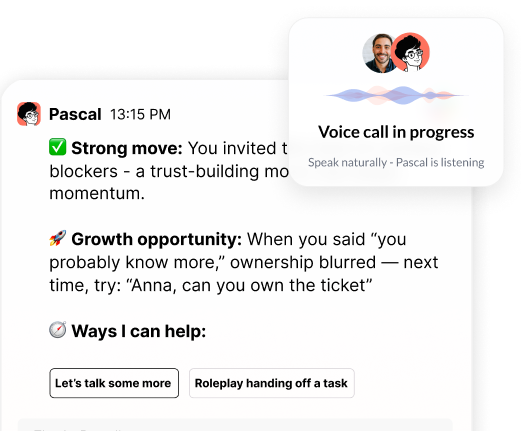
Ready to see how AI coaching delivers measurable ROI in your organization? See how Pascal works inside Slack to transform manager effectiveness with coaching that happens in the flow of work.
Header photo by Bluestonex on Unsplash

.png)
.webp)
“Thank you for setting the great foundation for my promotion; now I have a plan!"

Curious to see how AI Coaching can 10X the impact and scale of your development initiatives. Book a demo today for: