

Organizations preparing for AI-enabled management must build psychological safety, redefine leadership competencies, and establish transparent governance before deploying technology. Cultural readiness predicts adoption success more than technology selection.
A culture ready for AI-enabled management shows three characteristics: managers view AI as a development partner (not surveillance), employees understand how AI augments human judgment, and leadership has established transparent governance that protects privacy while enabling learning.
This readiness appears in daily behaviors. Managers seek AI coaching before difficult conversations. Teams discuss AI-assisted decisions openly. HR provides clear escalation pathways when AI guidance reaches its limits.
Psychological safety foundation: Employees must trust that AI coaching conversations remain confidential and won't appear in performance reviews. Without this foundation, adoption stalls.
Competency redefinition: Gail Fierstein, former CHRO at Goldman Sachs and Pearson, notes: "We need to define what performance and potential mean in the context of human-AI collaboration." This requires updating job descriptions, performance frameworks, and promotion criteria.
Transparent governance: Clear policies on data usage, AI decision boundaries, and human override protocols build trust. Organizations must answer: What data does the AI access? Who sees coaching conversations? When must humans make final decisions?
Behavioral indicators: Daily usage, managers sharing AI coaching insights with peers, and leadership citing AI-assisted decisions openly signal cultural readiness.
Cultural readiness predicts AI management adoption success more than technology capabilities. Organizations that invest in cultural preparation before deployment see higher improvement rates from direct reports and increased Manager Net Promoter Scores. Those prioritizing technology first experience stalled adoption and manager resistance.
The trust gap explains most failures. Managers won't use AI coaching tools they perceive as surveillance systems. When employees believe AI tracks performance for punitive purposes, adoption rates plummet.
The competency shift compounds the challenge. Traditional leadership skills must evolve to include managing hybrid human-AI teams, not just managing people. Salesforce CEO Marc Benioff noted at Davos that today's executives are "the last generation of CEOs to manage all-human workforces."
Industry variation creates complexity. Tech companies show higher AI comfort levels, while regulated industries like life sciences and financial services lag by 18-24 months because of compliance concerns.
CHROs should follow a four-phase model: establish psychological safety and transparent governance first, pilot with high-trust manager populations while gathering feedback, expand to broader audiences with culture-specific customization, and integrate AI coaching into performance rituals and organizational rhythms. This sequence prevents deploying technology before trust exists.
Phase 1 (Months 1-2): Build trust infrastructure through transparent communication about data usage, privacy protections, and clear boundaries on AI versus human decision-making. Publish governance frameworks before any pilot begins.
Phase 2 (Months 2-4): Pilot with first-time managers or high-performing teams who demonstrate openness to experimentation. These populations show the fastest return and become internal champions. Mid-level management and first-line managers are ideal for initial rollouts.
Phase 3 (Months 4-8): Customize AI coaching to reflect organization-specific leadership frameworks, competency models, and cultural values.
Phase 4 (Months 8+): Integrate into performance review cycles, goal-setting seasons, and critical transition moments (new manager onboarding, role changes, organizational restructuring). Make AI coaching part of your organizational rhythm, not a standalone initiative.
Jeff Diana, former CHRO at SuccessFactors and Calendly, emphasizes: "Connections have to come before content. People teams need to understand how AI connects to business goals, personal benefits, and cultural values before they engage with the technology."
Leaders managing hybrid human-AI teams require four new competency clusters: AI orchestration (delegating tasks between human and AI team members), judgment calibration (knowing when to override AI recommendations), contextual prompting (extracting value from AI tools through effective questioning), and ethical governance (ensuring AI decisions align with organizational values and legal requirements).
AI orchestration: Deciding which tasks to delegate to AI agents versus human team members based on complexity, stakes, and learning opportunities. As individuals manage multiple AI agents for different functions, leadership skills that were once reserved for managers become essential for everyone.
Judgment calibration: Critical thinking skills to evaluate AI recommendations, particularly when multiple AI agents provide conflicting guidance. When you have AI agents for different roles that may disagree, you need strong judgment to coordinate between them.
Contextual prompting: Ability to provide sufficient context to AI tools to receive relevant, actionable guidance. The more context from sources like inbox, calendar, meetings, and workplace communication tools, the more relevant and impactful the AI assistance becomes.
Ethical governance: Ensuring AI-assisted decisions reflect organizational values, avoid bias, and maintain human dignity. This competency becomes critical as AI takes on more decision-support roles.
Fierstein's framework emphasizes: "Critical thinking, creativity, and ethical judgment are the sustainable skills that define success in an AI-enabled world."
Tech companies adopt an experimentation-first approach with rapid pilot cycles, while life sciences and financial services firms prioritize compliance frameworks and phased rollouts that can extend 18-24 months longer. These differences stem from regulatory environments, risk tolerance, and workforce demographics.
Tech company characteristics: Faster adoption cycles (2-4 months from pilot to full deployment), higher baseline AI literacy, comfort with "learn by doing" approaches, and willingness to iterate based on user feedback. Professional services companies and technology firms move faster than regulated industries.
Regulated industry characteristics: Extended governance review periods, legal and compliance sign-offs before pilots begin, emphasis on data residency and privacy certifications (SOC2, HIPAA, GDPR), and preference for proven solutions over cutting-edge technology. Healthcare, life sciences, and financial services remain more cautious about AI adoption.
Common ground: Both segments prioritize psychological safety and transparent communication. The difference lies in sequencing—tech companies often pilot first and refine governance later, while regulated industries establish governance frameworks before any deployment.
Adaptation strategy: Organizations in regulated industries should use tech company learnings while building compliance-first frameworks. Start with non-regulated use cases (leadership development, communication coaching) before expanding to areas requiring strict data controls.
Psychological safety is the foundation for AI coaching adoption. Employees won't use a coach they believe shares individual-level data with HR or leadership. Organizations that skip this step see adoption rates collapse within weeks of launch.
Trust indicators: Daily usage, managers voluntarily sharing AI coaching insights with peers, and employees asking for expanded access signal strong psychological safety. Low engagement, privacy concerns raised in surveys, and managers avoiding the tool indicate trust deficits.
Building psychological safety: Publish clear data usage policies before deployment. Explain what data the AI accesses, who sees coaching conversations, and how information flows. Make opt-out mechanisms visible and easy to use. Never tie AI coaching data to performance reviews or compensation decisions.
Measuring psychological safety: Track usage patterns, conduct anonymous surveys about trust levels, and monitor whether managers discuss AI coaching openly in team meetings. Declining usage after initial adoption signals eroding trust.
• Cultural readiness predicts AI management success more than technology capabilities—most AI failures stem from human factors, not technical limitations
• Psychological safety is non-negotiable: employees won't use AI coaches they perceive as surveillance systems, making transparent governance and privacy protection essential before deployment
• Sequence matters: establish trust infrastructure and governance frameworks (Months 1-2), pilot with high-trust populations (Months 2-4), customize for culture (Months 4-8), then integrate into organizational rhythms (Months 8+)
• Leaders need four new competency clusters for hybrid human-AI teams: AI orchestration, judgment calibration, contextual prompting, and ethical governance
• Industry context shapes adoption timelines: tech companies move in 2-4 months, while regulated industries require 18-24 months longer because of compliance requirements
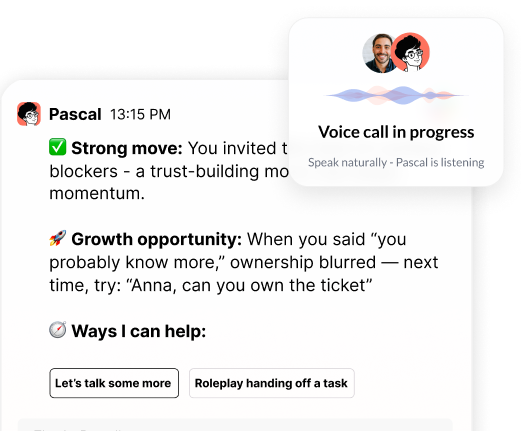
Pascal by Pinnacle delivers real-time coaching inside Slack that reinforces your culture and develops your managers. Visit heypinnacle.com to learn more.
Header photo by Vitaly Gariev on Unsplash

.png)
.webp)
“Thank you for setting the great foundation for my promotion; now I have a plan!"

Curious to see how AI Coaching can 10X the impact and scale of your development initiatives. Book a demo today for: