

Preparing your culture for AI-enabled management requires three foundational shifts: establishing psychological safety around AI experimentation, redefining manager roles from decision-makers to orchestrators of human-AI collaboration, and embedding continuous learning into daily workflows. The challenge isn't technology acceptance—it's reshaping how your organization defines performance, collaboration, and leadership itself.
AI-enabled management means managers use AI tools to prepare for difficult conversations, develop their teams, and make decisions. Instead of spending hours searching for coaching resources before a performance review, a manager asks an AI coach for guidance. Instead of winging a difficult conversation, they rehearse it with AI first. Instead of relying solely on their own judgment, they combine human insight with AI analysis.
This isn't AI replacing managers. It's AI helping managers do their jobs better.
Three markers signal your organization is ready. First, psychological safety exists for experimentation—employees feel safe testing AI tools without fear of replacement or judgment. Second, leadership roles are evolving—managers understand they're shifting from sole decision-makers to orchestrators of human-AI teams. Third, learning is continuous—development happens in workflow moments, not just training sessions.
Helen Russell, Chief People Officer at HubSpot, demonstrated this when HubSpot declared itself "an AI company" with high trust and adoption expectations. The result: 98% of employees used AI tools and 84% felt comfortable doing so. The difference? Leadership created clarity around AI's role before deployment, not after resistance emerged.
Traditional change management treats technology adoption as a linear process: announce, train, deploy, measure. AI-enabled management requires a different approach because the technology learns and evolves alongside your people, making static training obsolete within weeks.
The failure pattern is predictable. Top-down mandates create resistance—forcing AI adoption without addressing "what's in it for me" triggers defensive behaviors. One-time training becomes obsolete—AI capabilities evolve faster than annual training cycles. Generic rollouts ignore context—what works for sales doesn't work for engineering; what works for new managers doesn't work for senior leaders.
Jeff Diana, former CHRO at Calendly and Atlassian, emphasizes: "Connections have to come before content. People teams need to understand how AI connects to business goals, personal benefits, and cultural values before they engage with the technology itself."
Organizations that succeed start with task-based adoption, not tool-based mandates. They identify specific pain points—difficult conversations, performance feedback, career development discussions—and introduce AI coaching as a solution to those problems.
Your first 30 days should focus on building trust, not deploying technology. Begin by addressing the elephant in the room: job security.
Your employees have already read predictions about AI eliminating jobs. Your response must be direct and evidence-based, not dismissive.
Host small-group listening sessions (8-12 people) where employees voice AI concerns without executives present. Synthesize themes and respond publicly within one week. Create an AI principles document that states what AI will do, what AI won't do, how decisions about AI adoption will be made, and how employee input shapes implementation.
Identify and empower AI champions across departments—not just early adopters, but respected skeptics who can credibly evaluate tools. Establish a feedback loop where employees can report AI tool failures, frustrations, or unexpected benefits without repercussion.
Psychological safety indicators:
Data Breakdown:
• Indicator: Questions about AI | Low Safety: Silence in meetings | High Safety: Open discussion of concerns
• Indicator: Tool experimentation | Low Safety: Waiting for permission | High Safety: Proactive testing and sharing
• Indicator: Failure response | Low Safety: Blame or hiding mistakes | High Safety: Learning from what didn't work
• Indicator: Leadership messaging | Low Safety: "AI will transform everything" | High Safety: "We're figuring this out together"
Managers must shift from being sole decision-makers to orchestrators of hybrid human-AI teams. This isn't a subtle adjustment—it's a fundamental reimagining of what management means.
Gail Fierstein, former CHRO at CaaStle and Goldman Sachs, states it clearly: "What companies and HR need to do is define what is performance and potential in the context of the human-AI collaborative. It's different."
The managers who thrived in a pre-AI world may struggle if their value proposition was information control rather than judgment, synthesis, and team development.
Redefine these core expectations:
From information holder to context provider—managers curate and interpret AI outputs rather than generating all answers themselves. From scheduled coaching to continuous development—leadership development shifts from quarterly reviews to daily micro-moments. From individual expertise to collaborative intelligence—success means knowing when to use AI, when to consult humans, and when to combine both.
Update job descriptions and competency frameworks to include "AI collaboration" as a core skill. What does this look like in practice? A manager who effectively uses AI collaboration:
• Prepares for difficult conversations by rehearsing with AI coaching tools
• Uses AI to analyze team performance data, then applies human judgment to interpret context
• Shares AI-generated insights with their team and invites discussion
• Knows when AI guidance is generic and when it's contextually relevant
Revise performance criteria to reward managers who effectively combine human judgment with AI insights. Create "AI collaboration scorecards" that track how managers use tools to prepare for difficult conversations, develop their teams, and make decisions.
Continuous learning requires infrastructure that delivers development in the flow of work, not as interruptions to work. Traditional learning management systems and quarterly training sessions won't work.
Build three layers. First, just-in-time coaching that surfaces before critical moments—performance reviews, difficult conversations, team meetings. Second, reflection prompts that help managers extract lessons from real interactions. Third, peer learning networks where managers share what's working and what isn't with AI tools.
The goal isn't to replace human coaching—it's to make expert guidance accessible at the moment of need.
Integrate AI coaching into existing tools managers already use. If your team lives in Slack, coaching should happen there. If meetings drive your culture, AI should provide feedback afterward. Friction kills adoption—meet managers where they work.
Here's what this looks like: A manager opens Slack 30 minutes before a difficult performance conversation. They type: "I need to tell Sarah her work quality has declined. She's been with us three years and this is new. How do I approach this?" The AI coach asks clarifying questions, helps the manager prepare talking points, and suggests how to balance directness with empathy. The manager enters the conversation prepared, not winging it.
Cultural readiness isn't binary—it's a spectrum. Track leading indicators that predict successful AI adoption, not just lagging metrics like usage rates.
Leading indicators to track:
Manager confidence scores—survey managers monthly on their comfort using AI tools for specific tasks (preparing for 1:1s, giving feedback, career development conversations). Track trends, not absolute numbers.
Experimentation rates—measure how many managers are actively testing AI tools, sharing learnings, and iterating on their approach.
Psychological safety metrics—use anonymous pulse surveys to assess whether employees feel safe experimenting with AI without fear of judgment or replacement.
Lagging indicators to validate impact:
• Manager effectiveness scores from direct reports
• Time saved on administrative tasks
• Quality of performance conversations (measured through follow-up surveys)
• Retention rates for high-performers
Resistance to AI-enabled management follows predictable patterns. Anticipating them allows you to design interventions before they derail adoption.
The "AI will replace me" fear: Middle managers see AI coaching as a threat to their value. Address this by showing concrete examples of managers using AI to have better conversations, not fewer conversations. At HubSpot, managers who used AI coaching tools reported feeling more confident, not more replaceable, because they had better preparation for difficult moments.
The "not invented here" skepticism: Managers dismiss AI guidance as generic or irrelevant. Combat this by customizing AI coaching with your organization's specific frameworks, values, and competencies. Generic advice gets ignored; contextual guidance gets applied.
The "too busy to learn" excuse: Managers claim they don't have time to experiment with new tools. Solve this by embedding AI coaching into existing workflows rather than adding new tasks. If AI saves time on meeting prep, managers will adopt it. If it creates extra work, they won't.
Jeff Diana's approach at Calendly: start with task-based adoption. Identify the most painful, time-consuming management tasks—performance reviews, difficult conversations, career development planning—and introduce AI as a solution to those specific problems. Adoption follows value, not mandates.
Executives who don't use AI tools themselves cannot credibly ask their organizations to adopt them. Leadership modeling isn't optional—it's the foundation of cultural change.
At HubSpot, Chief People Officer Helen Russell and the executive team publicly shared how they used AI tools, including failures and lessons learned. This transparency created permission for experimentation throughout the organization.
Leadership modeling in practice:
Share specific examples of how you use AI coaching in executive team meetings. Discuss what worked, what didn't, and what you're still figuring out. Invite managers to share their AI experiments in all-hands meetings—celebrate both successes and productive failures. Create executive office hours where leaders demo how they use AI tools and answer questions.
The message: "We're learning together, and it's okay not to have all the answers." This approach builds trust faster than any top-down mandate.
• AI-enabled management means managers use AI tools to prepare for difficult conversations, develop teams, and make decisions—not AI replacing managers
• Start with task-based adoption: identify specific management pain points (performance reviews, difficult conversations) and introduce AI as a solution
• Build psychological safety first through listening sessions, transparent communication about job security, and permission to experiment without fear
• Redefine manager roles from information holders to orchestrators of human-AI collaboration, updating competency frameworks to include "AI collaboration" as a core skill
• Embed learning into workflow tools managers already use (Slack, Teams) rather than creating separate training programs
• Leadership modeling is required: executives must visibly use AI tools and share their learning journey to create organizational permission for experimentation
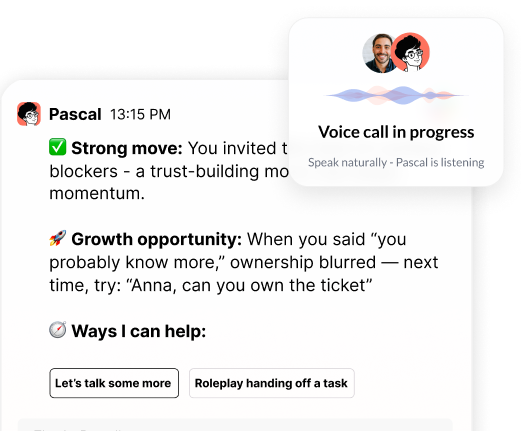
Pascal delivers 24/7 coaching that adapts to your organization's values, competencies, and culture—embedded directly into Slack, Teams, and the tools your managers already use. See how Pascal works at heypinnacle.com.
Header photo by Vitaly Gariev on Unsplash

.png)
.webp)
“Thank you for setting the great foundation for my promotion; now I have a plan!"

Curious to see how AI Coaching can 10X the impact and scale of your development initiatives. Book a demo today for: