

Lead Summary: AI coaching delivers better results when it reflects your organization's culture instead of generic leadership theory. This guide shows how to configure AI systems to deliver guidance based on your specific competency frameworks, values, and leadership principles—so managers get advice that matches how work actually gets done in your company.
Time to implement: 4-6 weeks for initial setup, with quarterly reviews to maintain alignment.
Disclosure: This guide draws on implementation patterns from Pascal by Pinnacle, where I work as a content strategist. The approach described here reflects our platform's methodology, though the principles apply to any AI coaching system that allows custom content integration.
Personalizing AI coaching means configuring the system to prioritize your organization's leadership frameworks, behavioral expectations, and cultural norms over generic coaching principles.
A competency framework is a structured document that defines the skills, behaviors, and knowledge required for success in specific roles. Most organizations have these for leadership positions, though they're often scattered across HR systems, training decks, and performance management tools.
Example: A technology company defines "strategic thinking" as "making build-versus-buy decisions that balance technical debt against feature velocity." Their AI coach references that definition during conversations about project prioritization—not textbook frameworks about market positioning.
Without this customization, AI coaching becomes another forgotten tool. A sales manager at a consultative-selling organization gets tactics for transactional deals. An engineering leader at a quality-first company receives speed-over-everything advice. Managers stop using systems that contradict how their company works.
Traditional coaching reaches only senior executives. The cost (typically $200-500 per hour) makes scaling impossible.
Annual training sessions and manager workshops happen too infrequently to change behavior. Performance reviews come too late to influence daily decisions. Learning management systems deliver passive content that managers can't apply to specific situations.
AI coaching provides guidance in the moments that matter: during the meeting where a manager needs to give difficult feedback, during the Slack conversation where team dynamics are breaking down, during the project kickoff where priorities need clarification.
When customized to your culture, AI coaching becomes the connective tissue between what your organization teaches and what managers do.
Start by documenting what already exists. Gather everything that defines "good leadership" in your organization:
• Competency frameworks by role and level
• Culture decks and values statements
• Leadership development curricula
• Performance review rubrics
• Internal coaching or feedback methodologies
Most companies have these materials. The challenge is consolidating them into a coherent picture.
Common gaps to identify:
Vague values without behavioral anchors. "Innovation" means nothing without examples. Does it mean "ship fast and iterate" or "research thoroughly before building"? Define it.
Competencies that aren't measured or rewarded. If "collaboration" appears in your values but individual performance drives promotions, that's a gap.
Frameworks that contradict each other across departments. Sales might reward aggressive negotiation while Customer Success emphasizes relationship preservation. Flag these conflicts.
Quality check: Can a new manager read these materials and understand what behaviors your company expects? If not, clarify before moving forward.
Reality check: If your company lacks documented frameworks, you can still implement AI coaching. Start with your mission statement and any existing performance review criteria. Build from there. The system improves as you add specificity.
Generic coaching treats all managers the same. Effective coaching recognizes that a VP of Sales needs different guidance than an entry-level engineering manager.
Function-specific customization:
Sales managers need coaching on pipeline conversations and deal strategy. Engineering managers need guidance on technical tradeoffs and sprint planning. HR managers need support with employee relations and policy interpretation.
Level-based differentiation:
New managers focus on delegation and feedback basics. Mid-level managers receive coaching on cross-functional influence. Senior leaders get strategic decision-making support.
Example: "Strategic thinking" for a senior leader means making build-versus-buy decisions that balance technical debt against feature velocity. For a new manager it means prioritizing team projects based on quarterly OKRs.
Create a matrix: roles on one axis, competencies on the other. Fill in what each competency looks like for each role. This becomes your configuration map.
AI coaching platforms allow you to upload company-specific documents through an admin portal. The interface typically includes a content library where you add files and a tagging system to control when each document surfaces.
What to upload:
• Values statements
• Competency frameworks
• Training materials
• Policies and escalation pathways
• Templates or resources managers should reference
How tagging works:
Each document gets metadata tags (department, function, level, topic). When a sales manager asks about pipeline management, the system retrieves documents tagged for sales and management. When an engineering lead asks about feedback, it pulls engineering-specific examples.
Example tagging structure:
Company-wide: Core values, universal competencies, company policies
Department-specific: Sales methodologies, engineering practices, customer success frameworks
Level-specific: New manager onboarding, senior leadership expectations, executive coaching content
Technical note: Most AI coaching systems use retrieval-augmented generation (RAG). The AI searches your uploaded documents for relevant context, then generates responses that incorporate that context. Your content doesn't replace the AI's base knowledge—it adds a layer that takes priority during response generation.
Content hierarchy: Configure the system so your organizational frameworks supersede generic coaching knowledge. Your definitions take priority. The AI should cite your documents and link back to them during coaching conversations.
Set a quarterly review schedule. Assign someone to update content as your frameworks evolve. Without this, the system drifts out of alignment with reality.
The interface varies by platform, but the typical workflow:
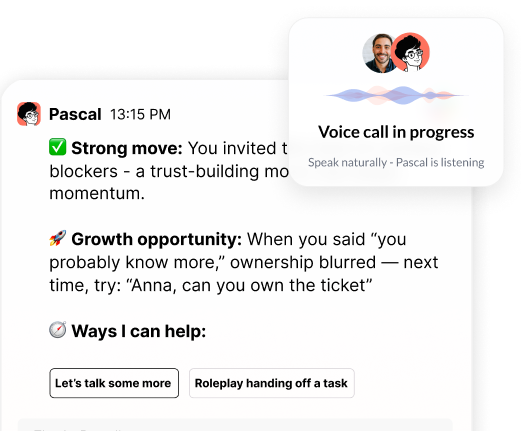
A manager opens the coaching app (web, mobile, or Slack integration) and describes their situation: "I need to give feedback to a team member who missed a deadline."
The AI asks clarifying questions: "What's the context? Is this a pattern or a one-time issue? What's your relationship with this person?"
Based on the manager's role, level, and department (pulled from your HRIS integration), the system retrieves relevant company frameworks. For a sales manager, it might reference your feedback methodology and sales competency model. For an engineering manager, it pulls engineering-specific examples.
The AI generates a response that incorporates your company's approach to feedback, suggests specific language aligned with your culture, and links to relevant internal resources (your feedback guide, your values statement, your escalation policy).
The manager can ask follow-up questions, request alternative approaches, or save the conversation for later reference.
This happens in real-time, during the workday, when the manager needs it.
Uploading documents without behavioral specificity. Values like "innovation" or "collaboration" mean nothing without concrete examples. Define what "innovation" means at your company with specific, observable actions. "Innovation means shipping a prototype within two weeks of identifying a customer problem" is specific. "Innovation means thinking creatively" is useless.
Failing to update content as frameworks evolve. Set a quarterly review schedule. Assign ownership. Without this, the AI coaches based on outdated expectations.
Poor tagging that surfaces irrelevant content. Test your tagging structure with real scenarios before full rollout. Ask: Would a sales manager in this situation receive the right guidance? Adjust based on testing.
No feedback mechanism. Build ways for managers to flag when coaching doesn't align with reality. Use this feedback to refine your content and tagging. Add a "this doesn't match how we work" button to every response.
Assuming managers will adopt without training. Run onboarding sessions. Show managers how to ask good questions. Demonstrate the difference between generic and personalized responses. Low adoption usually means poor onboarding, not poor personalization.
Adoption metrics: Track weekly active users, session frequency, and which features get used most. Low adoption signals your personalization isn't resonating or your onboarding failed.
Behavioral change: Measure through 360-degree feedback, manager effectiveness scores, and direct report engagement surveys. Compare pre- and post-implementation data.
In our customer base (47 organizations using Pascal for 6+ months), 83% of direct reports report improvement in their manager's effectiveness. This is self-reported survey data from paying customers, not independent research, but it suggests the approach works when implemented well.
Efficiency gains: Track time saved on coaching conversations, performance review preparation, and meeting effectiveness. Our customers report managers save an average of 150+ hours annually, based on time-tracking data. The question is whether managers redirect that time to higher-value work or just fill it with other tasks. Track what they do with the saved time.
Cultural alignment: Ask managers: Does the coaching reflect how we work here? Does it reinforce our values? Run quarterly pulse surveys. If the answer is no, your personalization needs refinement.
Months 1-3: Monitor adoption closely. Identify which teams engage and which don't. Interview low-adoption teams to understand barriers. Common issues: poor onboarding, irrelevant content surfacing, managers don't trust AI guidance.
Months 4-6: Review behavioral change data. Are manager effectiveness scores improving? Adjust content based on what's working. If managers aren't using certain frameworks, either improve the tagging or remove the content.
Quarterly: Update frameworks as your organization evolves. Add new competencies, retire outdated ones, refine behavioral examples based on manager feedback. This is not optional—skipping updates creates drift.
Annually: Conduct a comprehensive audit. Are your frameworks still aligned with business strategy? Has your culture shifted? Update accordingly.
• Personalization means uploading your competency frameworks, values, and leadership principles so the AI prioritizes your definitions over generic coaching theory
• Role-specific and level-specific customization ensures a VP of Sales receives different coaching than an entry-level engineering manager, with priorities tailored to each context
• Effective implementation requires behavioral specificity—vague values like "innovation" need concrete examples of what those behaviors look like at your company
• The manager experience is conversational: they describe a situation, the AI asks clarifying questions, then generates guidance that incorporates your company's frameworks and links to internal resources
• Measurement focuses on adoption, behavioral change, and cultural alignment, with quarterly content reviews to maintain alignment as your organization evolves
• Ongoing iteration is required—plan for quarterly updates and annual audits to keep the system aligned with reality
Ready to see how personalized AI coaching works in practice? Explore how Pascal integrates with your existing tools to deliver culture-aligned coaching at scale.
Header photo by Medienstürmer on Unsplash

.png)
.webp)
“Thank you for setting the great foundation for my promotion; now I have a plan!"

Curious to see how AI Coaching can 10X the impact and scale of your development initiatives. Book a demo today for: