
AI coaching embedded in meetings delivers feedback on actual leadership moments (delegation, communication, team dynamics) immediately after they happen. Managers get specific guidance within minutes of each interaction, when context is fresh and behavior change is achievable. This eliminates the adoption gap that kills traditional coaching: managers don't need to remember to seek help separately.
Before implementing meeting-integrated AI coaching, you need executive sponsorship with clear success metrics, technical infrastructure that supports meeting bot integration, and a change management plan that addresses privacy concerns. Start with a 30-60 day pilot among 20-50 volunteer managers who can become internal champions.
Executive alignment and budget ownership:
• Identify budget owner (L&D, HR Operations, or Talent Development)
• Define success metrics: 70% weekly active usage, 15-20% manager NPS lift, 80% direct reports reporting observable improvement
• Secure 12-month commitment (90 days is insufficient to measure behavior change)
Technical infrastructure assessment:
• Confirm primary meeting platforms (Zoom, Teams, Google Meet)
• Verify meeting bot permissions and IT security review process
• Ensure Slack or Teams integration for coaching delivery
• Validate SSO/SAML capabilities
Data and privacy framework:
• Establish what meeting data will be processed (transcripts, participation patterns, communication dynamics)
• Confirm SOC2 compliance and data residency requirements
• Create transparent opt-in/opt-out mechanisms
• Define aggregated reporting boundaries (what leadership sees vs. individual privacy)
Organizational readiness:
• Identify 20-50 pilot participants (mix of high-performers and those needing support)
• Prepare internal communications addressing "Is AI listening to my meetings?" concerns
• Train HR business partners on positioning and handling resistance
• Establish escalation protocols for sensitive topics (performance issues, interpersonal conflict, legal concerns)
Example pilot structure from a 500-person tech company:
• Week 1-2: Onboarding with individual goal-setting (each manager identifies 2-3 development areas)
• Week 3-8: Active usage with weekly check-ins from HR
• Week 9-10: Collect feedback, measure adoption metrics, identify champions
• Week 11-12: Refine approach and plan broader rollout
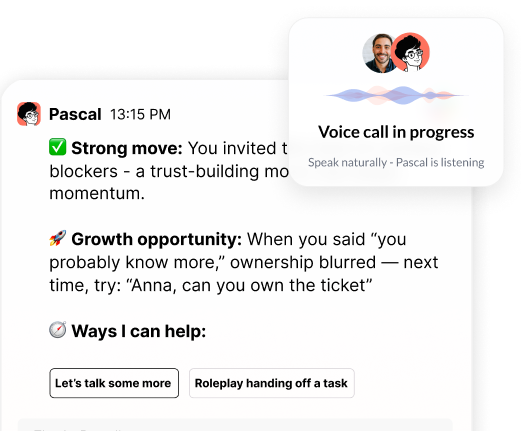
Meetings are where leadership happens (delegation decisions, feedback conversations, team dynamics, conflict resolution). Traditional coaching requires managers to remember to seek help separately. Meeting-integrated AI coaching observes real leadership moments and delivers specific feedback immediately afterward.
Meeting-integrated approaches drive higher adoption because the coach becomes an automatic part of workflow rather than another tool to remember. The AI observes actual team dynamics and communication patterns rather than relying on self-reported scenarios. Managers receive specific coaching within minutes of the interaction.
According to Melinda Wolfe, former CHRO at Bloomberg, Pearson, and GLG: "If we can finally democratize coaching—make it specific, timely, and integrated into real workflows—we solve one of the most chronic issues in the modern workplace."
Comparison to traditional approaches:
Data Breakdown:
• Approach: Human Executive Coaching | Timing: Scheduled sessions | Context: Self-reported scenarios | Scalability: Limited to senior leaders | Cost per Manager: $15,000-$50,000/year
• Approach: LMS Training Modules | Timing: Asynchronous, self-paced | Context: Generic case studies | Scalability: Unlimited | Cost per Manager: $500-$2,000/year
• Approach: Meeting-Integrated AI Coaching | Timing: Real-time + immediate post-meeting | Context: Observed actual behavior | Scalability: Unlimited | Cost per Manager: Varies by vendor
The AI builds a knowledge base of working relationships, communication patterns, and team dynamics over time, enabling increasingly personalized guidance.
Technical implementation connects your AI coaching platform to your meeting infrastructure (Zoom, Teams, Google Meet), your communication tools (Slack, Teams), and your HRIS for organizational context. The AI coach operates as a meeting bot that joins sessions with explicit consent, analyzes meeting dynamics, and delivers feedback through your existing communication channels within 5-10 minutes of meeting conclusion.
Meeting platform connection (Week 1):
• Install the AI coaching app in your Zoom, Teams, or Google Meet admin console
• Configure meeting bot permissions (requires IT security review)
• Set default opt-in/opt-out policies (recommend opt-in for pilot, then expand)
• Test bot joining, recording permissions, and transcription accuracy
Communication platform integration (Week 1):
• Add the AI coach to your Slack workspace or Teams tenant
• Configure direct message permissions for coaching delivery
• Set up notification preferences (immediate post-meeting feedback, weekly rollups, goal reminders)
• Test message delivery and user interaction flows
HRIS and organizational context (Week 2):
• Connect your HRIS (Workday, BambooHR, Rippling) via API or CSV upload
• Import organizational structure (reporting relationships, team hierarchies)
• Load company competencies, values, and leadership frameworks
• Configure role-based coaching priorities (new managers vs. senior leaders)
Individual onboarding (Week 2-3):
• Each pilot participant completes a 15-minute onboarding session
• They identify 2-3 development goals (delegation, feedback quality, meeting facilitation, communication clarity)
• The AI coach asks contextual questions to understand their current challenges
• Participants grant explicit consent for meeting observation
Meeting-integrated AI coaching raises immediate privacy questions that require transparent, proactive communication. Address three core concerns: what data is collected, how it's used, and who can access it. Provide clear opt-in mechanisms and escalation protocols for sensitive topics that require human HR expertise.
Data collection transparency:
• Communicate exactly what the AI observes (meeting transcripts, participation patterns, communication dynamics) and what it doesn't (personal conversations outside work, non-work meetings)
• Provide explicit opt-in/opt-out mechanisms for each meeting
• Ensure managers can exclude specific meetings (compensation discussions, performance improvement plans, sensitive HR matters)
SOC2 compliance and data residency:
• Verify your vendor maintains SOC2 Type II certification
• Confirm customer data is never used to train AI models
• Establish data residency requirements (US, EU, specific regions)
• Define data retention policies (how long meeting data is stored, when it's deleted)
Aggregated reporting boundaries:
• Define what gets aggregated (common skill gaps, coaching topic frequency, adoption metrics) and what remains confidential (individual meeting content, specific feedback conversations)
• Establish human QA oversight for any aggregated reports
Sensitive topic escalation:
• Build guardrails that recognize when conversations require human HR expertise
• Topics like performance improvement plans, interpersonal conflict, legal concerns, or mental health discussions should trigger escalation protocols
• The AI should acknowledge its limitations and connect the manager with appropriate HR support
Scaling from 50 managers to 500 requires a different playbook. Successful rollouts use pilot champions as internal advocates, create visible executive sponsorship, integrate coaching into existing rituals (performance reviews, goal-setting, 1:1s), and measure leading indicators (weekly active usage, coaching session frequency) alongside lagging outcomes (manager NPS, direct report feedback improvement).
Champion network activation:
• Identify your top 5-10 pilot participants who saw measurable improvement
• Have them share specific examples in all-hands meetings, leadership forums, and internal communications
• Create a Slack channel where champions answer questions from new users
• Record short video testimonials showing real coaching scenarios
Executive sponsorship visibility:
• Your CHRO or Chief People Officer should use the AI coach publicly and share their own development journey
• Have executives mention specific coaching moments in leadership meetings
• Include AI coaching adoption as a metric in quarterly business reviews
Ritual integration:
• Embed coaching into existing workflows rather than creating new ones
• Before performance review season, have the AI offer help writing reviews or preparing for difficult conversations
• During goal-setting cycles, use the coach to help managers translate company objectives into team goals
• In 1:1 preparation, suggest the coach as a resource for feedback conversation planning
Measurement framework:
• Track weekly active usage (target: 70% of enrolled managers)
• Average coaching sessions per week (target: 3-5 interactions)
• Topic diversity (are managers exploring multiple development areas or just one?)
• Manager NPS quarterly (target: 15-20% lift)
• Survey direct reports on observable behavior changes (target: 80% report improvement in specific areas like delegation, feedback quality, or communication clarity)
The first 90 days determine whether your AI coaching investment survives its first renewal. Most AI initiatives fail because organizations invest in tools but fail to drive actual behavior change.
Adoption metrics (30-day checkpoint):
• Target 60% of pilot participants using the coach weekly
• Track average sessions per manager (target: 2-3 per week)
• Identify non-adopters early and understand barriers (privacy concerns, unclear value proposition, technical friction)
Leading indicators (60-day checkpoint):
• Measure coaching topic diversity (are managers exploring multiple development areas?)
• Track post-meeting feedback engagement (do managers read and discuss the feedback?)
• Survey pilot participants on perceived value (Net Promoter Score for the tool itself)
Behavioral outcomes (90-day checkpoint):
• Survey direct reports on observable changes in manager behavior
• Target: 70% report improvement in at least one specific area (delegation, feedback quality, communication clarity, meeting facilitation)
• Measure manager confidence in handling difficult conversations (pre/post survey)
• Track reduction in HR escalations for common management challenges
Business impact (90-day checkpoint):
• Calculate time saved on performance review writing, 1:1 preparation, and feedback conversation planning
• Measure manager NPS lift (target: 10-15% increase)
• Track employee engagement scores for teams with highly engaged manager-users vs. control groups
Measure both adoption (are managers using it?) and impact (is it changing behavior?) from day one. Organizations that wait until day 90 to check metrics often discover they've lost momentum.
• Meeting-integrated AI coaching drives higher adoption than standalone portals by eliminating the "remembering to ask for help" problem—the coach observes real leadership moments and delivers feedback automatically
• Successful implementations require executive sponsorship with clear metrics (70% weekly usage, 15-20% manager NPS lift, 80% observable improvement), technical infrastructure supporting meeting bots across Zoom/Teams/Meet, and transparent privacy frameworks addressing data collection and sensitive topic escalation
• Start with a 30-60 day pilot among 20-50 volunteer managers who can become internal champions, rather than mandating adoption across the entire organization immediately
• Technical integration connects meeting platforms (Zoom, Teams, Google Meet), communication tools (Slack, Teams), and HRIS systems to create contextual awareness—the AI delivers feedback within 5-10 minutes of meeting conclusion
• Expect measurable results in 90 days: 60% weekly active usage, 70% direct reports observing behavior improvement, and 10-15% manager NPS lift among engaged users
Pascal is an AI coach that joins your Zoom, Teams, or Google Meet sessions to observe team dynamics and deliver personalized feedback immediately after meetings end. Built with SOC2 compliance and enterprise-grade security, Pascal helps managers develop delegation skills, improve feedback quality, and build psychological safety through real-time coaching in the flow of work.
See how Pascal integrates into your workflow
Header photo by Bluestonex on Unsplash

.png)
.webp)
“Thank you for setting the great foundation for my promotion; now I have a plan!"

Curious to see how AI Coaching can 10X the impact and scale of your development initiatives. Book a demo today for: