

AI coaching works best when embedded directly into meetings—where managers face their toughest leadership moments. When coaching happens inside the tools managers already use (Zoom, Teams, Google Meet), it becomes automatic rather than optional.
This guide explains what meeting-integrated AI coaching is, how it differs from standalone platforms, and what HR leaders should consider before deployment.
Meeting-integrated AI coaching means the AI attends virtual meetings as a participant (with explicit consent), observes team interactions, analyzes communication patterns, and delivers personalized feedback within minutes of the meeting ending.
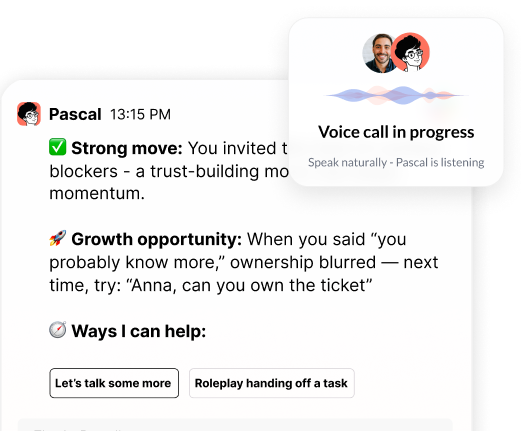
Before meetings, the AI reviews your calendar and suggests talking points based on previous interactions. During meetings, it silently observes (never interrupts) to track delegation clarity, question-asking patterns, and speaking time distribution. Within 5–10 minutes after meetings end, managers receive feedback tagged to their development areas.
Pattern recognition across meetings identifies behavioral trends that single-meeting feedback misses. Weekly summaries might reveal: "You interrupted team members 40% more this week than your baseline."
Standalone coaching platforms require managers to remember to use them, explain context manually, and carve out separate time. Meeting-integrated coaching solves the "remembering" problem by observing actual behavior rather than relying on self-reported scenarios.
Real-time context drives relevance. An AI coach that witnessed how you handled a difficult team conversation can reference specific moments: "When Sarah pushed back on the timeline, you immediately defended the decision rather than asking what concerns she had."
Traditional coaching platforms face adoption challenges because they live outside the workflow. Meeting-integrated tools become part of the existing routine.
AI coaching observes and improves six core areas:
Delegation clarity: AI identifies when managers assign tasks without clear ownership, success criteria, or decision-making authority—then coaches better handoffs.
Psychological safety: The AI tracks whether managers ask open-ended questions, acknowledge uncertainty, and create space for dissenting opinions.
Feedback quality: Analysis examines whether feedback is specific, actionable, and balanced (not just critical or only positive).
Speaking time distribution: The system flags when managers dominate conversations, preventing team members from contributing.
Question-asking effectiveness: AI measures how often managers ask questions versus making statements, and whether questions are open-ended or leading.
Systems thinking: The AI identifies when managers teach frameworks versus just assigning tasks, helping develop strategic thinking in direct reports.
Manager trust builds through transparency, control, and demonstrated value—not through forced adoption.
Start with explicit consent: Every participant opts in before AI joins any meeting. Make AI presence visible through clear indicators, similar to recording notifications.
Give managers full control over their data: Managers should be able to review what the AI observed, delete specific meetings from analysis, and pause AI observation at any time.
Share exactly what the AI tracks: Communication patterns, speaking time, delegation clarity. Share what it doesn't track: personal conversations, sensitive HR matters.
Demonstrate value quickly: When a manager receives coaching like "In your 1:1 with Marcus, you assigned the Q2 roadmap but didn't clarify decision-making authority—consider following up to define what he can decide independently," they see immediate applicability.
Start with volunteer pilot groups: Let managers who want coaching experience the value first, then expand based on their advocacy.
Address privacy concerns proactively: Individual meeting insights remain private to the manager unless they choose to share. Aggregated, anonymized insights can inform organizational development, but no individual is identifiable in company-wide reports.
As Melinda Wolfe, Former CHRO at Bloomberg and Pearson, notes: "Managers rarely need help in a workshop—they need it when preparing for a tough 1:1 or in the middle of a team conflict."
Technical integration requires calendar access, meeting platform connections, communication tool APIs, and HRIS data synchronization. Modern platforms handle most complexity through pre-built integrations.
Calendar integration allows AI to understand meeting context: who's attending, what the meeting is about, and how it fits into broader team dynamics.
Meeting platform connections (Zoom, Teams, Google Meet) enable AI to join as a participant and access transcripts.
Communication tool APIs (Slack, Microsoft Teams) let AI deliver feedback where managers already work.
HRIS synchronization provides organizational context: reporting structures, roles, performance review data, and development goals.
IT teams need to approve the platform, configure single sign-on (SSO), and establish data handling agreements. HR teams need to upload organizational competencies, leadership frameworks, and any custom coaching content. Managers complete a brief onboarding (around 15 minutes) to set development goals and notification preferences.
Security requirements vary by industry. Financial services and healthcare companies often require additional compliance reviews. Look for SOC2 Type II certification and custom data residency support. Verify that the platform never trains AI models on customer data—a critical distinction from general-purpose AI tools.
Measuring impact requires tracking both leading indicators (adoption, engagement) and lagging indicators (manager effectiveness, team performance, business outcomes).
Adoption metrics: Percentage of managers actively using the platform, meetings observed per manager per week, and feedback response rates.
Engagement metrics: How often do managers ask follow-up questions? Do they implement suggested improvements?
Behavior changes: Track specific improvements the AI is coaching—delegation clarity scores, speaking time balance, question-asking frequency. Compare these metrics to baseline measurements taken before deployment.
Manager effectiveness: Direct reports report better 1:1s, clearer expectations, and more actionable feedback. Measure through pulse surveys and 360 feedback.
Team performance: Project delivery speed, quality indicators, and team engagement scores.
Business outcomes: Retention rates, promotion readiness, and time-to-productivity for new managers.
Establish clear metrics before deployment and track them monthly, not waiting for annual reviews.
This approach requires a strong virtual meeting culture: If your managers work primarily in-person or async, meeting-integrated AI coaching won't capture enough interactions to be useful.
Consent models matter: Decide whether one person opting out blocks the AI from the entire meeting, or whether the AI can observe consenting participants only. Both approaches have tradeoffs.
Cost and vendor lock-in: Meeting-integrated platforms typically charge per manager per month. Understand pricing tiers and what happens to your data if you switch vendors.
Platform compatibility: Verify the tool works with your specific meeting and communication platforms. Not all tools support every combination of Zoom/Teams/Meet and Slack/Teams chat.
Change management is critical: Even the best AI coaching tool fails without proper manager onboarding, clear communication about privacy, and ongoing support.
• Meeting integration eliminates adoption friction by embedding coaching in tools managers already use daily
• AI should observe silently during meetings and deliver feedback afterward when managers can reflect
• Context drives relevance—AI coaches that witness actual team interactions provide specific guidance
• Trust requires transparency, explicit consent, and full manager control over their data
• Measure both adoption metrics (meetings observed, feedback response rates) and outcomes (behavior changes, team performance)
Tools like Pascal by Pinnacle demonstrate how meeting-integrated AI coaching can work at scale, but this approach isn't universal. Evaluate whether your organization's meeting culture, technical infrastructure, and manager readiness align with this model before committing.
Ready to explore meeting-integrated AI coaching? Learn more about Pascal or contact your HR technology vendor to discuss integration options.
Header photo by Dmitrii E. on Unsplash

.png)
.webp)
“Thank you for setting the great foundation for my promotion; now I have a plan!"

Curious to see how AI Coaching can 10X the impact and scale of your development initiatives. Book a demo today for: