

AI role-play lets managers practice difficult conversations before the real interaction, reducing anxiety and improving outcomes. Unlike traditional training, it adapts to your organizational context, provides immediate feedback, and is available 24/7 when managers need it most.
AI role-play is simulation technology that lets managers practice challenging workplace discussions (performance issues, terminations, conflict resolution, sensitive feedback) with an AI system that responds dynamically. The AI takes on the role of the employee, using information about working relationships and recent interactions to create realistic practice scenarios.
Traditional role-play requires scheduling, facilitators, and generic scenarios. AI role-play happens in the flow of work, adapts to your company's values and communication frameworks, and provides immediate, private feedback.
Key capabilities:
• Contextual awareness: The AI understands the manager's communication style, the employee's tendencies, and recent interactions
• Company customization: Incorporates your competencies, values, feedback frameworks (like SBI), and policies
• Real-time availability: Accessible when managers need it—often at 11 PM before a difficult morning conversation
• Privacy protection: Managers can practice sensitive scenarios without fear of judgment
Traditional training creates a knowledge gap, not a performance gap. Managers attend workshops, watch videos, or complete LMS modules about difficult conversations—then freeze when facing the actual moment. The problem isn't lack of information; it's lack of contextualized practice in a safe environment.
Qualtrics research shows that manager feedback frequency is the strongest predictor of manager effectiveness across millions of employees. Yet most managers avoid tough conversations because they lack confidence and fear making mistakes.
Traditional training doesn't solve this because workshops happen weeks before (or after) the critical conversation, role-play exercises use fictional situations that don't match the manager's actual challenge, managers feel exposed practicing in front of peers, and there's no follow-up after the workshop ends.
Comparison: Traditional Training vs. AI Role-Play
Data Breakdown:
• Dimension: Availability | Traditional Training: Scheduled workshops | AI Role-Play: 24/7, on-demand
• Dimension: Context | Traditional Training: Generic scenarios | AI Role-Play: Specific to actual employee relationships
• Dimension: Privacy | Traditional Training: Public practice with peers | AI Role-Play: Private, judgment-free environment
• Dimension: Customization | Traditional Training: One-size-fits-all | AI Role-Play: Adapts to company values, competencies, policies
• Dimension: Feedback timing | Traditional Training: During workshop only | AI Role-Play: Before, during, and after real conversations
AI role-play complements human coaching but solves the access and scalability problem that has limited coaching to executives. Human coaches provide strategic guidance and emotional support; AI role-play provides unlimited practice reps and immediate feedback for specific scenarios.
Traditional executive coaching costs $200–$500 per hour and is reserved for senior leaders. AI coaching platforms democratize this support, making it available to every manager in your organization. This matters because frontline managers (who have the greatest impact on employee engagement and retention) historically receive the least development support.
When to use AI role-play vs. human coaching:
• AI role-play excels at: Practicing specific conversations, getting immediate feedback on communication style, reinforcing company frameworks, preparing talking points, building confidence through repetition
• Human coaching excels at: Complex career transitions, executive presence development, strategic thinking, emotional processing of leadership challenges, navigating organizational politics
Melinda Wolfe, former CHRO at Bloomberg, Pearson, and GLG, notes: "Managers rarely need help in a workshop—they need it when preparing for a tough 1:1 or in the middle of a team conflict."
Start by identifying the 3–5 most common difficult conversations your managers avoid or handle poorly. Don't try to solve everything at once—focus on scenarios with measurable business impact.
High-ROI use cases for AI role-play:
• Performance improvement conversations: Managers delay addressing underperformance, hoping it will self-correct
• Delivering critical feedback: Managers soften messages to avoid discomfort, creating confusion about expectations
• Accountability discussions: Managers toggle between being too soft and too harsh (mastering the accountability dial)
• Termination preparation: Managers lack confidence in handling legal and emotional complexity
• Conflict mediation: Managers avoid stepping into team conflicts until they escalate
Define success metrics before launch:
• Manager confidence scores (pre/post practice sessions)
• Frequency of difficult conversations (tracked through AI meeting observation)
• Direct report feedback on manager communication (pulse surveys)
• Time-to-resolution for performance issues
• Manager NPS or engagement scores
Set your baseline metrics now so you can demonstrate ROI in 90 days.
Generic AI role-play tools produce generic results. The most effective implementations integrate your organization's specific competencies, values, communication frameworks, and policies into the AI's coaching model.
Essential customization elements:
• Leadership competencies: Upload your competency model so the AI reinforces your specific expectations (e.g., "inclusive leadership," "data-driven decision-making")
• Communication frameworks: Integrate frameworks like SBI (Situation-Behavior-Impact), Radical Candor, or your proprietary feedback model
• Company values: Ensure the AI's guidance aligns with how your culture defines "tough but fair" or "direct but respectful"
• Policies and guardrails: Build in escalation triggers for legal issues, harassment claims, or situations requiring HR involvement
• Industry context: Customize scenarios for your specific business environment and compliance requirements
This customization ensures managers receive guidance that aligns with how your organization operates, not generic best practices.
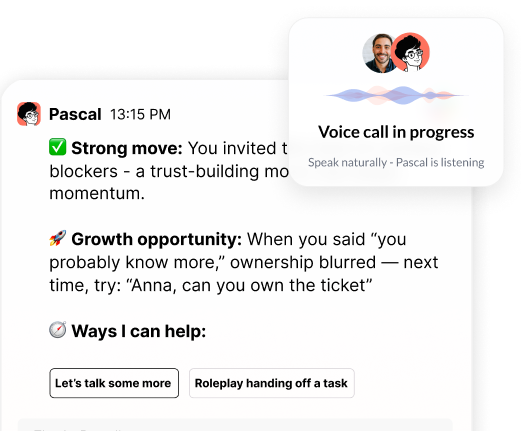
AI role-play fails when it requires managers to leave their workflow and visit a separate platform. The most successful implementations meet managers where they already work—in Slack, Teams, or right before a scheduled 1:1.
Integration points that drive adoption:
• Pre-meeting preparation: AI suggests role-play practice 30 minutes before a scheduled difficult conversation
• Slack/Teams availability: Managers can initiate practice sessions directly in their communication tools
• Post-meeting reflection: AI follows up after tough conversations to reinforce learning and identify improvement areas
• Performance review cycles: Trigger role-play opportunities during review season when managers need the most support
The timing matters more than the technology. Managers don't need help in a workshop—they need it at 11 PM when they're preparing for a difficult conversation the next morning. Make AI role-play accessible in those moments.
Managers should expect a realistic, contextual practice conversation that adapts to their specific situation. The AI takes on the role of the employee they need to talk to, using information about past interactions, communication patterns, and relationship dynamics.
Typical AI role-play session flow:
• Context setting: Manager provides situation details (performance issue, feedback topic, conflict)
• Practice conversation: AI responds as the employee would, including realistic reactions and pushback
• Real-time coaching: AI offers guidance during the conversation if the manager gets stuck
• Immediate feedback: After the practice session, AI provides specific feedback on communication effectiveness, tone, and approach
• Talking points: AI generates specific phrases and frameworks the manager can use in the real conversation
The AI can adjust difficulty levels—starting with a cooperative employee response and progressing to more challenging scenarios with defensiveness or emotion. This graduated practice builds manager confidence systematically.
Measure ROI through behavior change metrics, not engagement scores. The goal isn't how many managers use the tool—it's whether difficult conversations happen more frequently and with better outcomes.
Primary ROI metrics:
• Conversation frequency: Track whether managers are having tough conversations sooner rather than delaying them
• Direct report feedback: Measure changes in manager effectiveness scores from team members
• Time-to-resolution: Monitor how quickly performance issues get addressed after implementation
• Manager confidence: Survey managers on their preparedness before difficult conversations
• Retention impact: Track whether improved conversations reduce regrettable attrition
Secondary indicators:
• Practice session completion rates before actual conversations
• Manager NPS or engagement score changes
• HR escalation reduction for situations managers can now handle independently
Define clear success metrics before launch and track them rigorously to avoid the common pitfall of AI projects that fail to deliver expected results.
The biggest implementation challenge isn't technical—it's trust. Managers worry about privacy, judgment, and whether practicing with AI will help them in real conversations.
Challenge 1: Privacy concerns
Managers fear their practice sessions will be monitored or used in performance evaluations. Solution: Implement clear policies that practice sessions are private and never shared with leadership or HR unless the manager requests feedback.
Challenge 2: Skepticism about AI effectiveness
Managers question whether AI can simulate realistic employee responses. Solution: Start with pilot groups who test the system and share their experiences. Peer testimonials from respected managers drive broader adoption.
Challenge 3: Competing priorities
Managers claim they don't have time for practice sessions. Solution: Position AI role-play as time-saving, not time-consuming. Fifteen minutes of practice prevents hours of cleanup from a conversation gone wrong.
Challenge 4: Lack of executive sponsorship
Without visible leadership support, adoption stalls. Solution: Secure a senior leader to share their own AI role-play experience and mandate usage during performance review cycles.
Successful pilots convert to company-wide adoption when you demonstrate clear value to both individuals and the organization. Focus on solving real problems for managers and setting leadership expectations.
Scaling strategy:
• Start with performance review season: Launch during a high-stakes period when managers need support
• Identify champion managers: Find early adopters who will evangelize the tool to their peers
• Create usage expectations: Make AI role-play practice a standard part of performance management processes
• Share success stories: Publicize specific examples of managers who improved difficult conversation outcomes
• Integrate with existing programs: Connect AI role-play to leadership development curricula and manager training
The goal is making AI role-play a normal part of manager workflow, not a special initiative. When managers practice before tough conversations the way they prepare meeting agendas, you've achieved sustainable adoption.
• AI role-play enables managers to practice difficult conversations in a safe, contextual environment with immediate feedback, available 24/7 when they need it most
• Traditional training fails because it creates knowledge gaps, not performance gaps—managers need contextualized practice, not more workshops
• Effective AI role-play integrates your company's specific competencies, values, communication frameworks, and policies rather than providing generic guidance
• Measure ROI through behavior change metrics like conversation frequency, direct report feedback, and time-to-resolution, not engagement scores
• Scale adoption by starting during performance review season, identifying champion managers, and making AI role-play a standard part of performance management processes
Ready to give your managers the practice they need before tough conversations? See how Pascal works inside Slack to deliver contextual AI role-play when managers need it most.
Header photo by Vitaly Gariev on Unsplash

.png)
.webp)
“Thank you for setting the great foundation for my promotion; now I have a plan!"

Curious to see how AI Coaching can 10X the impact and scale of your development initiatives. Book a demo today for: