

AI coaching embeds guidance into Slack, Teams, and Zoom. Instead of scheduled training sessions, managers get support during actual decisions—a difficult conversation, a team conflict, a performance review.
A manager opens Slack to message an underperforming team member. Before sending, a notification appears: "This message might come across as critical without context. Consider starting with a specific example of good work, then addressing the gap."
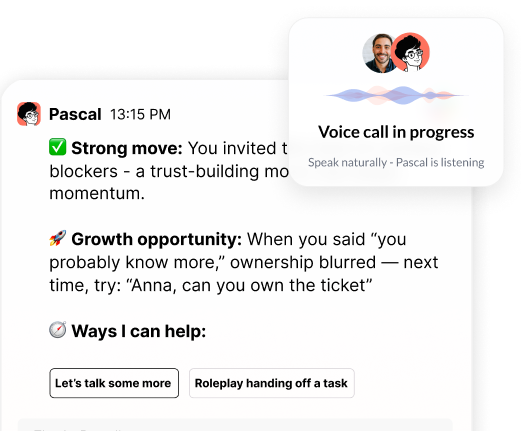
The manager is in a Zoom one-on-one. Afterward, they receive a summary: "You spoke for 18 of 30 minutes. Sarah mentioned workload concerns twice but you moved to other topics. Consider following up on her capacity."
That's in-flow coaching. The AI watches meetings (with permission), reads messages managers choose to share, and surfaces guidance at decision points. Not real-time interruption—that would be chaos. Post-interaction analysis with suggestions for next time.
How the AI observes work:
You grant permission once during setup. The AI then accesses meeting transcripts (Zoom, Teams, Meet), messages in designated Slack channels, and emails you forward to it. You control what it sees. It doesn't listen to everything—you choose which meetings to share, which conversations to analyze.
The AI builds context over time. After three months, it knows your team dynamics, communication patterns, and recurring challenges. When you face a situation similar to one from last month, it references what worked then.
Traditional coaching: You meet with a coach monthly. You describe a situation from memory. The coach asks questions. You commit to trying something new. A month passes before you discuss results.
AI coaching: You're about to have a difficult conversation. You ask the AI, "How should I approach this?" It suggests an opening, references your company's feedback framework, and reminds you that this team member responds better to questions than directives (based on past interactions).
The difference is context and timing. Human coaches rely on what you remember to share. AI coaches see the actual interaction. Human coaches respond days later. AI coaches respond within minutes of you asking.
The cost structure:
Traditional coaching runs $3,000-15,000 per person annually for monthly sessions. AI coaching costs $30-150 per person annually for continuous access. But that's subscription price, not total cost. Add integration work ($10,000-20,000 one-time), change management, and IT support. Still cheaper than traditional coaching at scale, but not 100x cheaper.
Human coaches remain critical for career transitions, political navigation, and emotionally complex situations. AI handles routine needs—preparing for one-on-ones, practicing feedback, interpreting team dynamics.
Data Breakdown:
• Dimension: Availability | Traditional Coaching: Monthly sessions | AI Coaching: On-demand
• Dimension: Context | Traditional Coaching: Your summary | AI Coaching: Full interaction history
• Dimension: Cost per person | Traditional Coaching: $3,000-15,000/year | AI Coaching: $30-150/year (plus implementation)
• Dimension: Scale | Traditional Coaching: 5-10 leaders | AI Coaching: All managers
• Dimension: Best for | Traditional Coaching: Career transitions, politics | AI Coaching: Daily decisions, skill practice
Start with where managers struggle most. Audit your HRBP tickets from the past quarter. Common patterns: performance conversations, team conflict, delegation breakdowns.
Pick three workflow moments to target:
• Performance one-on-ones (Zoom integration)
• Difficult feedback messages (Slack integration)
• Team meeting facilitation (Teams integration)
Don't try to embed coaching everywhere at once. Focus creates adoption. Sprawl creates confusion.
Establish baselines before launch:
• Manager Net Promoter Score (survey direct reports)
• HRBP ticket volume for manager support
• Time managers report spending on "figuring out how to handle situations"
• 360 feedback scores on specific competencies
Without baselines, you can't prove impact. With them, you can show a 20-point NPS increase or 40% reduction in HRBP tickets.
Generic management advice fails because culture varies. "Radical candor" at a startup means different behavior than "collaborative decision-making" at a pharmaceutical company.
Upload your materials:
• Leadership competency frameworks with behavioral examples
• Company values with real scenarios (not poster language)
• Performance review templates
• Training content you've already created
• Examples of good feedback from your top managers
The AI learns your language. If your culture values "disagree and commit," the AI reinforces that norm. If your culture values consensus-building, it suggests different approaches.
Privacy controls matter:
Managers worry about surveillance. Address this directly in your launch communication: "The AI sees only meetings and messages you choose to share. It doesn't monitor everything. You control access. Insights shared with leadership are anonymous and aggregated—no individual manager is identified."
SOC2 certification means independent auditors verify security controls. Your data doesn't train the AI models (critical difference from ChatGPT).
Pilot with 10-15 managers across functions. Ask: Does this feel like our culture or like generic advice? Adjust before broader rollout.
Find 15-20 managers who are struggling with visible challenges. They're motivated to try new approaches because current methods aren't working.
Onboarding takes 15 minutes: "Here's how to share a meeting for feedback. Here's how to ask for guidance before a difficult conversation. Here's how to review your communication patterns."
First-week experience:
Day 1: Manager shares a one-on-one meeting. Receives feedback within an hour: "You asked three closed questions and one open question. Try reversing that ratio—open questions surface concerns you might miss."
Day 3: Manager asks, "I need to tell Jordan his work quality is slipping. How do I start that conversation?" AI suggests an opening based on your company's feedback framework and Jordan's past responses to feedback.
Day 5: Manager reviews a summary of their week's communication patterns: "You interrupted team members 12 times in Monday's meeting. Consider letting people finish before responding."
Immediate, practical value drives adoption. Abstract training modules don't.
Weeks 1-4:
Adoption climbs to 60-70% of pilot group. Managers use the AI for meeting prep and post-meeting reflection. Efficiency gains appear—managers get answers in minutes instead of waiting days for HRBP responses or coach availability.
Weeks 5-8:
Behavior changes become visible. Direct reports notice improvements in one-on-one quality and feedback clarity. 360 scores trend upward. Managers report feeling more confident in difficult conversations.
Weeks 9-12:
Business impact emerges. Team performance improves. Retention stabilizes. HRBP ticket volume drops as managers handle routine situations independently.
Organizations using Pascal report that 83% of direct reports notice improvement in manager effectiveness within 90 days (based on surveys of 2,400 direct reports across 180 managers in 12 companies, measured through pulse surveys comparing pre- and post-implementation scores).
Managers save time by getting instant guidance instead of searching for resources. Estimate 2-3 hours per week—100+ hours annually.
Track three dimensions:
Behavior change (validated by direct reports):
• 360 feedback scores on specific competencies, measured quarterly
• Direct report satisfaction with manager effectiveness, pulse surveys
• Skill application rates (are managers using frameworks they learned?)
Business outcomes:
• Team performance against goals
• Retention rates, especially high performers
• Time to productivity for new team members
• Promotion readiness of direct reports
Efficiency gains:
• HRBP ticket volume for manager support
• Time managers spend seeking guidance
• Speed of decision-making in critical situations
Traditional training metrics (completion rates, satisfaction scores) don't predict effectiveness improvements. Usage patterns and outcome metrics do.
When teams with AI-coached managers outperform others by 15-20% on key metrics, budget conversations get easier.
"This sounds like surveillance."
It is, if implemented badly. Managers must opt in to sharing each meeting or conversation. The AI doesn't monitor everything—managers choose what to share. Make this control visible and explicit.
"What if the AI gives bad advice?"
It will sometimes. Human oversight matters. Train managers to evaluate AI suggestions, not follow them blindly. Provide a feedback mechanism: "This suggestion didn't fit my situation because..." The AI learns from corrections.
"Our managers won't trust a machine for people decisions."
Correct. Position AI coaching as a practice tool and thinking partner, not a decision-maker. The manager still makes the call. The AI surfaces options and considerations they might miss.
• AI coaching works by analyzing meetings and messages managers choose to share, then surfacing guidance within minutes (not real-time interruption, but fast enough to inform next steps)
• Start with three high-impact integration points where managers struggle most, establish baseline metrics, and pilot with 15-20 motivated early adopters
• Customize the AI with your leadership competencies and culture examples so it reinforces your norms instead of generic management advice
• Expect behavior changes within 60 days and business impact within 90 days, measured through direct report feedback and team performance (not training completion rates)
• Address surveillance concerns directly by giving managers explicit control over what the AI sees and ensuring insights shared with leadership are anonymous
See how Pascal integrates with Slack, Teams, and Zoom to deliver guidance during actual management decisions.
Header photo by Vitaly Gariev on Unsplash

.png)
.webp)
“Thank you for setting the great foundation for my promotion; now I have a plan!"

Curious to see how AI Coaching can 10X the impact and scale of your development initiatives. Book a demo today for: