

A good AI coach demonstrates measurable behavior change in managers within 90 days, integrates into existing workflows, and includes guardrails that escalate sensitive topics to human experts when needed.
A good AI coach produces three outcomes: managers use it consistently beyond onboarding, their direct reports notice improvement in leadership behaviors, and the organization sees impact on retention and performance metrics. The difference between transformative and abandoned AI coaching comes down to whether the platform was built for coaching or repurposed from general AI tools, whether it understands your organizational context, and whether it meets managers where they already work.
Purpose-built foundation matters. Generic AI tools like ChatGPT can mimic coaching language but lack the behavioral science frameworks, escalation protocols, and coaching methodologies that drive development. Cloverleaf's 2026 analysis found that platforms built for workplace coaching integrate ICF-certified coaching principles and leadership frameworks rather than generating plausible-sounding advice.
Contextual awareness separates signal from noise. The best AI coaches maintain a knowledge graph (a system that connects your people, their goals, team dynamics, and actual work over time) rather than treating each conversation as isolated. This embedded awareness enables coaching specific to your culture, not generic best practices.
Workflow integration determines sustained adoption. Tools that require managers to remember to log in and describe their situation see lower sustained usage. Platforms that meet managers in Slack, Teams, or immediately after meetings eliminate adoption friction.
Proper guardrails protect both people and the organization. HR Executive's 2026 analysis highlighted a case where an employee confided in an AI coach about isolation and belonging concerns for six weeks without escalation to human support. Good AI coaches recognize when topics require human expertise (mental health concerns, legal issues, harassment, discrimination) and route those conversations appropriately while maintaining trust.
Start by asking whether the platform was built for coaching or adapted from general-purpose AI. This single distinction predicts whether managers will trust and apply the guidance they receive.
Verify the coaching methodology is explicit, not emergent. Ask vendors to show you the frameworks their AI uses. Purpose-built platforms incorporate leadership templates based on industry best practices and behavioral science research. Generic AI tools generate advice based on pattern matching in training data, which may sound plausible but lacks grounding in validated coaching approaches.
Examine how the platform handles nuanced leadership scenarios. Present a complex situation (a manager dealing with a high performer who undermines team morale) and evaluate whether the response demonstrates coaching sophistication or generic advice. Good AI coaches ask clarifying questions, explore multiple perspectives, and guide managers toward their own insights rather than prescribing solutions.
Confirm SOC 2 Type II and relevant compliance certifications. Enterprise organizations require SOC 2 Type II certification for security, availability, and confidentiality, ISO 27001 for information security management, and GDPR compliance for European employee data. Platforms without current SOC 2 Type II certification introduce compliance risk.
Understand the human expertise behind the AI. The best platforms involve ICF-certified coaches (International Coaching Federation, the industry's primary professional certification body) in training and refining the AI models. This ensures the guidance reflects professional coaching standards rather than internet-scraped advice.
Data Breakdown:
• Evaluation Criterion: Coaching methodology | Purpose-Built AI Coach: Explicit frameworks (ICF, behavioral science) | Generic AI Tool: Emergent from training data
• Evaluation Criterion: Nuanced scenario handling | Purpose-Built AI Coach: Asks clarifying questions, explores perspectives | Generic AI Tool: Provides prescriptive advice
• Evaluation Criterion: Compliance certifications | Purpose-Built AI Coach: SOC 2 Type II, ISO 27001, GDPR | Generic AI Tool: Often unclear or pending
• Evaluation Criterion: Human expertise involvement | Purpose-Built AI Coach: ICF-certified coaches train models | Generic AI Tool: Minimal coaching expertise
AI coaches that understand your company culture, competencies, and employee data deliver higher engagement than generic tools because managers receive guidance that's immediately applicable rather than requiring translation to their context. The depth of organizational integration predicts whether the platform becomes a trusted daily resource or another underutilized tool.
Assess how the platform ingests and applies company-specific information. Can you upload your leadership competencies, values documentation, performance frameworks, and cultural guidelines? Deep customization at the organizational level means coaching aligns with how your company defines good leadership.
Evaluate individual-level personalization capabilities. Beyond company context, does the platform incorporate individual performance reviews, 360 feedback, personality assessments (DISC, StrengthsFinder), and career aspirations? Building a personalized profile for each user enables coaching that accounts for their development areas and goals.
Test the platform's memory and learning over time. Generic AI tools treat each conversation as isolated. Good AI coaches maintain continuity by remembering previous discussions, tracking progress on goals, and building understanding of recurring challenges. A knowledge graph connects interactions across time, creating increasingly relevant guidance as it learns your people and their work.
Verify integration with your existing HR tech stack. The platform should connect with your HRIS, performance management system, learning platforms, and communication tools. Integration with Slack, Teams, Zoom, Google Meet, and major HR systems pulls real-time signals that inform coaching without requiring manual data entry.
Measuring AI coaching effectiveness requires tracking three levels: adoption leading indicators that predict sustained engagement, behavioral change metrics that show skill development, and business outcomes that justify continued investment. Most organizations focus on adoption metrics and miss the behavior change signals that predict long-term value.
Track usage depth, not just frequency. Platform logins tell you nothing about impact. Measure conversation depth (managers asking follow-up questions), repeat usage patterns (returning to the platform for different challenges), and proactive engagement (the platform initiating coaching moments).
Measure direct report perception of manager improvement. The most reliable indicator of coaching effectiveness is whether direct reports notice behavioral changes. Survey direct reports quarterly: "Has your manager's effectiveness improved in the past 90 days?"
Monitor business outcomes tied to manager effectiveness. Connect AI coaching adoption to retention rates for high performers, time-to-productivity for new managers, performance review quality scores, and employee engagement metrics.
Establish a 90-day benchmark for behavior change. If managers aren't demonstrating new behaviors within 90 days, the platform isn't working. Look for changes: more frequent 1:1s, improved feedback quality, better delegation, or more effective conflict resolution. These behaviors should be observable and measurable through direct report feedback and meeting analysis.
AI coaches without proper escalation protocols create legal and ethical risks. The most critical guardrail isn't what the AI can do but knowing when to involve human expertise and how to do so while maintaining employee trust.
Verify the platform's sensitive topic detection. The AI should recognize when conversations involve mental health concerns, harassment, discrimination, legal issues, or safety risks. Ask vendors to demonstrate how their system identifies these topics and what happens next. Request a live demo showing:
• How the system detects sensitive language patterns
• What the employee sees when escalation is triggered
• Who receives the escalation notification and how quickly
• What documentation is created and who can access it
Understand the escalation workflow. When the AI detects a sensitive topic, what happens? Does it immediately notify HR? Does it provide resources while maintaining confidentiality? Does it explain to the employee why escalation is necessary? The best systems balance employee privacy with organizational responsibility. Look for organization-specific controls that let you define escalation thresholds and workflows.
Confirm data privacy and training policies. Your employee conversations should never train the vendor's AI models. Ask explicitly: "Will our data be used to improve your models for other customers?" This isn't just a privacy issue but competitive advantage protection. Request written contractual language prohibiting use of customer data for model training.
Evaluate how the platform handles aggregated insights. While individual conversations must remain private, anonymized, aggregated data can provide organizational insights. The platform should show you trends (common challenges, skill gaps, cultural patterns) without revealing individual identities. This gives you the strategic value of continuous engagement data without compromising trust.
The organizations that see fastest ROI from AI coaching start with high-impact populations, measure behavior change from day one, and expand based on demonstrated value rather than vendor promises. The pilot approach determines whether you build momentum or create skepticism.
Start with new managers and high-frequency decision makers. New managers need coaching most during their first 90 days, yet that's when organizational support is least available. Sales professionals, customer success managers, and engineering leads make frequent high-stakes decisions where real-time feedback compounds advantage. These populations show results quickly and become internal advocates.
Define success metrics before launch. What behaviors should change? What business outcomes should improve? How will you measure direct report perception? Establish baselines for manager effectiveness scores, 1:1 frequency, feedback quality, and retention rates. Track manager NPS, direct report engagement, and time-to-productivity for new leaders.
Run a 90-day proof-of-value phase. Three months is long enough to see behavior change but short enough to maintain urgency. Measure weekly: platform engagement, manager self-reported confidence, direct report feedback, and behavioral changes. If you're not seeing movement in these metrics by week 6, investigate why.
Expand based on demonstrated impact, not headcount targets. Once your pilot population shows measurable improvement, identify the next high-value group. Mid-level managers with large teams? Individual contributors in technical roles who need leadership skills? Distributed teams lacking real-time support? Let the data guide expansion.
• Purpose-built AI coaches outperform generic tools because they integrate ICF-certified coaching frameworks, behavioral science research, and proper escalation protocols rather than generating conversational responses.
• Organizational context determines adoption rates. Platforms that understand your culture, competencies, and people see higher engagement than generic tools requiring managers to translate advice to their situation.
• Workflow integration predicts sustained usage. AI coaches that meet managers in Slack, Teams, and meetings achieve higher engagement than tools requiring separate logins and context-setting.
• Proper guardrails are non-negotiable. Platforms must detect sensitive topics (mental health, harassment, legal issues) and escalate to human expertise while maintaining employee trust and organizational safety.
• Measure behavior change, not just adoption. Track direct report perception of manager improvement, behavioral changes, and business outcomes tied to manager effectiveness rather than platform logins.
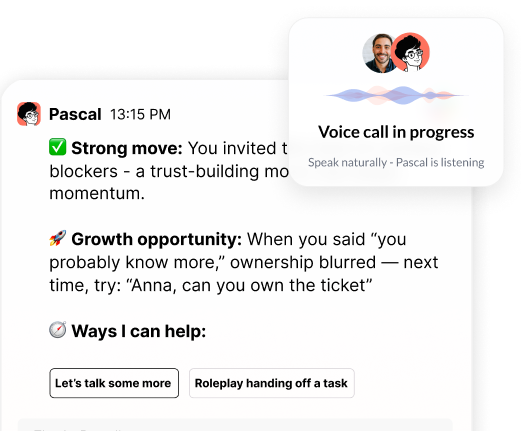
Ready to see how AI coaching works when it's built for manager development? See how Pascal works inside Slack and delivers coaching in the flow of work.
Header photo by Vitaly Gariev on Unsplash

.png)
.webp)
“Thank you for setting the great foundation for my promotion; now I have a plan!"

Curious to see how AI Coaching can 10X the impact and scale of your development initiatives. Book a demo today for: