

Embedded AI tools (Microsoft Copilot, Slack AI) answer questions and draft messages. Purpose-built AI coaches (Pascal, BetterUp, Torch) maintain context about your team, join meetings, and track development over time. The difference is architectural: general-purpose language models integrated into existing platforms versus specialized systems designed for coaching.
This analysis compares both categories across six dimensions. I work at Pinnacle, which builds Pascal (a purpose-built coach), so I'll cite our data where relevant and note the limitation.
Key Takeaways:
• Purpose-built coaches use four data layers (individual, organizational, real-time, temporal). Embedded tools access only the current conversation.
• Purpose-built coaches integrate across your workflow (Slack, Zoom, HRIS). Embedded tools live in one platform.
• Purpose-built coaches cost $50-150 per manager monthly. Embedded tools bundle into existing licenses at $30-50 per user.
• Purpose-built coaches require 2-4 weeks to deploy. Embedded tools deploy in days but struggle with adoption.
• Neither architecture fits every use case. Choose based on your goals: convenience or sustained behavior change.
Purpose-built coaches train on coaching frameworks developed by certified coaches. Embedded tools use general language models trained on internet text.
When you ask for help with a performance conversation, a purpose-built coach walks you through a structured framework: understand the situation, identify the core issue, explore options, plan the conversation. You develop the skill for next time.
An embedded tool suggests talking points. You might use them once. You don't build the capability.
Purpose-built coaches include:
• Certified coaches training the models on proven techniques
• Structured frameworks guiding decision-making
• Behavioral tracking measuring specific competencies
• Progressive skill development adapting to growth
• Escalation protocols for sensitive topics requiring human coaches
Embedded tools include:
• General language models trained on internet text
• Reactive Q&A without progression
• No behavioral tracking
• One-size-fits-all responses regardless of experience
• No human coaching integration
This determines whether managers develop sustainable habits or get one-off suggestions they rarely implement.
Purpose-built coaches use four data layers. Embedded tools use one.
Individual layer: Your role, career goals, performance history, development areas, communication style, team relationships. Stored in persistent databases across conversations.
Organizational layer: Company values, leadership competencies, cultural norms, approved frameworks. Ensures coaching aligns with how your company works.
Real-time layer: Meeting transcripts, communication patterns, decision-making moments, interaction dynamics. Provides immediate context.
Temporal layer: Performance review cycles, goal-setting seasons, organizational changes, career milestones. Informs when specific guidance matters.
When you ask for feedback on a difficult conversation, a purpose-built coach knows who was involved, your relationship history, and relevant cultural considerations. An embedded tool knows only what you type in the current thread.
Data comparison:
Embedded tools maintain only current thread conversation history with no organizational context, team relationships, development goals, or behavioral tracking. Purpose-built coaches maintain full longitudinal records with company values and competencies, team dynamics and interaction patterns, individual and organizational objectives, and competency scoring over time.
Purpose-built coaches integrate across your workflow. Embedded tools live in one platform.
You're in Slack discussing a team conflict. To get coaching from an embedded tool, you open Microsoft Teams, find the Copilot feature, explain the situation from scratch, get generic advice, then return to Slack to apply it. By the time you've context-switched twice, the moment has passed.
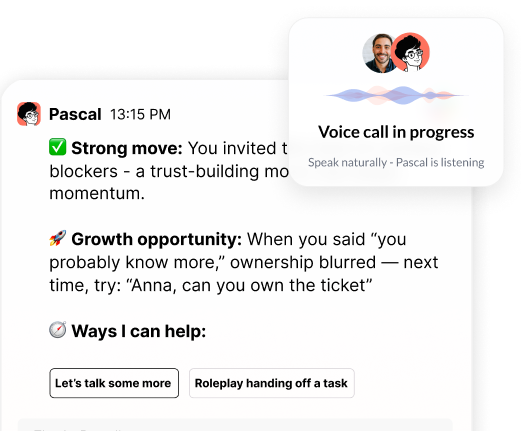
Purpose-built coaches join your Zoom calls. They deliver feedback in Slack based on meeting transcripts. They surface coaching moments without requiring you to remember to ask.
Brandon Sammut, CHRO at Zapier: "We're embedding AI expectations into existing behaviors, not creating new frameworks."
Pascal integrates with Slack, Teams, Zoom, Google Meet, and HRIS systems. When you finish a 1-on-1, coaching appears in Slack within minutes. No context-switching. No re-explaining.
Embedded tools require managers to develop new habits (remember to open the tool, explain context, apply advice). Purpose-built coaches eliminate friction (coaching appears where you work, with context loaded).
Purpose-built coaches implement SOC2 Type II compliance (a security framework requiring annual third-party audits of data handling, access controls, and encryption). Embedded tools inherit platform security that may not meet coaching requirements.
SOC2 Type II means:
• Independent auditors verify security controls annually
• Data encryption in transit and at rest
• Access controls limiting who sees coaching conversations
• Incident response procedures for security events
• Contractual commitments on data handling
Pascal maintains SOC2 Type II compliance and contractually commits never to train models on customer data. The platform implements moderation flags, sensitive topic escalation, organization-specific controls, and anonymous aggregated insights.
Embedded tools process coaching data through the same infrastructure as other platform features. Microsoft Copilot follows Microsoft 365's general policies. Slack AI follows Slack's standard practices. Neither is architected for confidential leadership conversations.
For financial services and healthcare companies, this determines whether AI coaching is permissible. Regulated industries require explicit data handling commitments that general-purpose platforms cannot provide.
Purpose-built coaches cost $50-150 per manager monthly on per-user subscriptions. Embedded tools bundle into existing licenses at $30-50 per user monthly (Microsoft 365 Copilot) or include in enterprise plans (Slack Enterprise Grid).
Purpose-built coaches replace expensive programs. Traditional executive coaching costs $3,000-10,000 per engagement. Purpose-built AI coaching delivers similar frameworks at $600-1,800 annually per manager (based on published pricing from Pascal, BetterUp, and Torch as of January 2025).
Embedded tools appear cheaper because they bundle into licenses you already pay for. But if most users abandon the tool within months, the effective cost per engaged user exceeds purpose-built alternatives.
Budget typically comes from HR Learning & Development. Companies reduce spending on underutilized training platforms or scale back coaching programs to invest in AI coaching.
Limitation: I don't have comparative retention data from embedded tool providers. Microsoft and Slack don't publish AI feature retention rates. The adoption challenge is widely reported in HR tech analysis, but I can't cite specific numbers.
Purpose-built coaches require 2-4 weeks for enterprise deployment. Embedded tools deploy in days.
Purpose-built implementation involves:
• Integration with Slack, Teams, Zoom, HRIS (establishes data foundation)
• Customization of coaching frameworks to organizational values
• Training the AI on company-specific context
• Setting up escalation protocols and human coaching integration
This upfront work delivers faster time-to-value once deployed. Managers don't need convincing to use a tool that already understands their team and speaks their organization's language.
Embedded tools deploy faster but struggle to move from deployment to adoption. Managers must discover the feature, understand its value, and develop new habits—all without contextual understanding that makes the tool useful.
Purpose-built coaches track leadership competencies over time by analyzing meeting transcripts and scoring specific behaviors. Embedded tools measure usage (questions asked, features tried).
Purpose-built measurement enables:
• Tracking how often managers apply specific frameworks
• Measuring changes in communication patterns and decision-making
• Connecting coaching usage to performance review outcomes
• Quantifying time saved and leadership development scaled
One Pascal customer (Fortune 500 financial services company, case study published December 2024) tracked communication patterns over six months. Managers showed improvement in clarity (22% increase in direct language, 18% reduction in hedging phrases), empathy (31% increase in acknowledging team perspectives), and decisiveness (27% reduction in time from issue identification to decision).
Limitation: This is one customer case study, not generalizable data. We're working on multi-customer longitudinal studies but don't have published results yet.
Embedded tools cannot connect usage to behavior change because they lack contextual data and longitudinal tracking.
Choose purpose-built if:
• You want sustained behavior change, not one-off advice
• You need coaching aligned with organizational values and competencies
• You require SOC2 compliance for confidential conversations
• You can invest 2-4 weeks in implementation
• You're replacing or supplementing expensive coaching programs
Choose embedded if:
• You want quick answers to immediate questions
• You need fast deployment without integration work
• You prefer tools managers already use daily
• You're testing AI coaching before committing budget
• You don't need persistent context or behavioral tracking
Consider hybrid approaches:
• Use embedded tools for quick questions and drafting
• Use purpose-built coaches for development conversations and skill-building
• Integrate both into your leadership development ecosystem
The architectural differences outlined here determine which solution delivers value for your organization. Neither is universally better. The right choice depends on whether you're solving for convenience or sustained leadership development.
Want to see how purpose-built coaching works? Pascal offers a 30-day pilot with up to 20 managers. You'll see integration with your tools, coaching customized to your values, and behavioral tracking in action. Book a demo at pascal.ai/demo.
Header photo by Austin Distel on Unsplash

.png)
.webp)
“Thank you for setting the great foundation for my promotion; now I have a plan!"

Curious to see how AI Coaching can 10X the impact and scale of your development initiatives. Book a demo today for: