

Purpose-built AI coaching platforms achieve higher manager adoption than bundled HR system features, but the choice depends on your organization's coaching maturity, technical infrastructure, and willingness to manage multiple vendors.
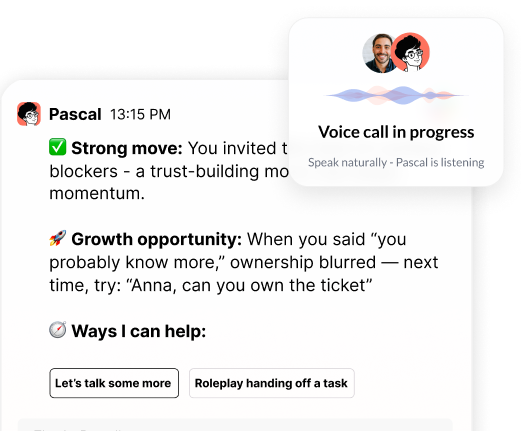
Proactive engagement versus reactive tools explains most adoption gaps. Purpose-built platforms join meetings, send timely nudges, and provide feedback based on actual work. Bundled features wait inside HR systems that managers visit quarterly for performance reviews.
Context awareness separates useful coaching from generic advice. Specialized platforms remember previous conversations, track communication patterns, and reference your company's leadership principles. Bundled tools treat each interaction as isolated, forcing managers to re-explain context.
Integration depth determines daily usage. Purpose-built solutions embed in Slack, Teams, Zoom, and email (where managers already work). Bundled features live inside HR platforms, requiring managers to leave their workflow and remember to use another tool.
Coaching model sophistication shows up in guidance quality. Specialized platforms train on ICF-certified coaching frameworks (the International Coaching Federation's professional standards). Bundled features use general AI models with basic HR prompts.
Data Breakdown:
• Dimension: Engagement Model | Purpose-Built AI Coaching: Proactive (joins meetings, sends nudges) | Bundled HR System Features: Reactive (manager initiates)
• Dimension: Context Awareness | Purpose-Built AI Coaching: Deep (relationships, patterns, culture) | Bundled HR System Features: Shallow (HRIS data only)
• Dimension: Coaching Expertise | Purpose-Built AI Coaching: ICF-certified frameworks | Bundled HR System Features: Generic AI prompts
• Dimension: Integration Points | Purpose-Built AI Coaching: Slack, Teams, Zoom, email | Bundled HR System Features: HR platform only
• Dimension: Data Sources | Purpose-Built AI Coaching: Meetings, messages, performance data | Bundled HR System Features: HRIS records, review text
Direct costs appear deceptive. Bundled features seem "free" but increase platform licensing by 15-30%. Purpose-built solutions cost approximately 1% of traditional coaching.
Adoption determines actual value. Calculate cost per active user, not cost per license. A tool with 15% monthly engagement delivers 15% of the value you're paying for.
Change management creates hidden costs. Bundled tools require training campaigns to drive adoption because they add another destination. Purpose-built coaches meet managers where they already work.
Opportunity cost impacts business results. Delayed manager effectiveness affects team performance immediately. Six months waiting for bundled feature adoption often costs more than the purpose-built solution.
Integration and maintenance require IT resources. Bundled features need configuration, testing, and updates as your HRIS platform changes. Purpose-built platforms handle integration as part of their service.
Test architectural depth and coaching sophistication with specific scenarios:
Contextual memory: "I had a difficult conversation with Sarah last week about her performance. How should I follow up?" Does the platform remember Sarah, the conversation, and your relationship dynamics? Or does it ask you to explain everything again?
Cultural alignment: "How should I handle conflict on my team?" Does it reference your company's values and leadership principles, or give generic advice? Purpose-built coaches train on your specific culture.
Proactive guidance: "When does your tool reach out to managers without being prompted?" Purpose-built coaches provide post-meeting feedback automatically. Bundled tools wait for questions.
Real-time support: "Can I get coaching help during a live meeting?" Some platforms integrate with Zoom and Teams for in-meeting support. Bundled tools require leaving the meeting to access another platform.
Behavioral insights: "Show me how the platform tracks my communication patterns over time." Purpose-built platforms build knowledge graphs that reveal patterns. Bundled tools show basic usage statistics.
Escalation protocols: "What happens if I ask about a sensitive HR issue?" Look for moderation flags, escalation to HR, and organization-specific controls.
Integration depth: "How does this pull data from my performance management system?" Purpose-built platforms integrate multiple data sources. Bundled tools access only their own database.
Coaching methodology: "What coaching frameworks does your AI use?" Specialized platforms train on ICF-certified frameworks with input from professional coaches. Bundled tools use generic prompts.
Privacy and compliance: "How do you handle data privacy and SOC2 compliance?" This reveals whether the vendor treats coaching data with appropriate security. (Pascal is SOC2 compliant and never trains on customer data.)
Measurable outcomes: "What metrics prove manager behavior change?" Look for direct report improvement rates, retention data, and time saved (not just usage statistics).
Purpose-built platforms typically go live in 2-4 weeks. Integration with Slack, Teams, and Zoom happens in days. Managers can start immediately without extensive training because the coach meets them in their existing workflow.
Bundled features require 3-6 months. You're coordinating with your HRIS vendor's release schedule, configuring the feature within your existing platform, and training managers to use another module in a system they already find complex.
The speed difference compounds. Every month of delayed implementation is a month of missed coaching opportunities and unresolved management challenges.
Bundled features make sense when vendor consolidation outweighs adoption concerns. If your organization prioritizes single-vendor relationships, values data living in one system, or has limited appetite for managing multiple tools, bundled features reduce complexity.
Early-stage coaching programs benefit from bundled features. If you're testing whether managers want AI coaching at all, starting with a bundled feature reduces risk. You can always switch to a purpose-built platform once you've proven demand.
Budget constraints sometimes force the decision. If your HRIS platform includes AI coaching in your existing contract, the incremental cost might be lower than adding a new vendor (despite lower adoption rates).
Technical infrastructure matters. Organizations with strict data residency requirements or limited API access might find bundled features easier to implement within existing security frameworks.
• Purpose-built platforms achieve higher retention because they integrate into daily workflow (Slack, Teams, Zoom) rather than requiring managers to visit another platform
• Calculate cost per active user, not cost per license (low adoption means you're paying for unused features)
• Test vendor claims with specific scenarios covering contextual memory, cultural alignment, proactive guidance, and measurable outcomes
• Implementation speed matters: purpose-built solutions go live in 2-4 weeks while bundled features require 3-6 months
• Bundled features make sense when vendor consolidation, early-stage testing, or technical constraints outweigh adoption concerns
The choice between purpose-built AI coaching and bundled HR features depends on whether you're optimizing for manager adoption or vendor simplicity.
Pascal works inside Slack, Teams, and Zoom to deliver coaching in the flow of work. See how the platform integrates with your existing tools at heypinnacle.com.
Header photo by Vitaly Gariev on Unsplash

.png)
.webp)
“Thank you for setting the great foundation for my promotion; now I have a plan!"

Curious to see how AI Coaching can 10X the impact and scale of your development initiatives. Book a demo today for: