

A good AI coach must demonstrate three core capabilities: coaching expertise grounded in proven frameworks, deep awareness of your organization and people, and integration into daily workflows where managers work. Generic chatbots fail because they lack coaching training, organizational context, and proactive engagement.
Most CHROs evaluate AI coaching vendors like any software: feature lists, pricing tiers, integrations. This approach misses what determines coaching effectiveness.
Traditional criteria don't predict whether managers will trust and apply the guidance. User interface polish, reporting dashboards, and API availability tell you nothing about coaching quality. Feature parity across vendors masks fundamental differences in how systems help managers navigate difficult conversations, develop teams, and change behavior.
Most demos showcase best-case scenarios rather than revealing how the system handles ambiguous, sensitive, or complex workplace situations. Procurement processes prioritize vendor stability and compliance over coaching effectiveness and behavior change.
An AI coach built for coaching is trained by ICF-certified professional coaches (International Coaching Federation, the industry's leading credential) on established frameworks like GROW, situational leadership, and feedback models. Pascal by Pinnacle, for example, uses coaching models trained by certified coaches, ensuring responses align with proven methodologies rather than generic advice.
Framework grounding prevents making up plausible-sounding but incorrect advice. Systems reference specific coaching models (GROW, SBI feedback, delegation frameworks) rather than generating ungrounded guidance.
The coaching versus consulting distinction is fundamental. Good AI coaches ask questions that drive self-discovery rather than providing answers. Test this during demos: Ask the AI coach to help you prepare for a difficult feedback conversation. Generic chatbots provide templates. Coaches ask about context, relationship history, and desired outcomes before offering guidance.
Test scenario comparison:
Data Breakdown:
• Prompt: "My team member missed a deadline again" | Generic AI Response: "Here's a feedback template: State the issue, explain the impact, set expectations..." | Coach Response: "Tell me about your previous conversations with this person. What patterns have you noticed? What outcome would success look like for you both?"
• Prompt: "How do I delegate better?" | Generic AI Response: "Five steps to effective delegation: 1. Choose the right person, 2. Define the task..." | Coach Response: "What's preventing you from delegating right now? Walk me through a recent situation where you held onto work you could have delegated."
Pascal is one example of this approach. Other vendors may use different methods to achieve coaching-specific training. Evaluate based on demonstrated coaching behavior, not marketing claims.
Context-aware AI coaching means the system knows your company's values, competencies, culture, and each manager's specific goals and challenges. Pascal integrates with existing systems, joins meetings, and tracks interaction patterns, enabling coaching that reflects actual behavior rather than self-reported situations.
Three levels of context determine coaching quality. Individual context includes performance data, goals, and development areas. Relational context covers team dynamics, peer feedback, and 1-on-1 history. Organizational context encompasses values, competencies, and strategic priorities.
AI coaches that join meetings and observe interactions can identify blind spots managers don't see in themselves. According to Melinda Wolfe, former CHRO at Bloomberg, Pearson, and GLG: "If we can finally democratize coaching—make it specific, timely, and integrated into real workflows—we solve one of the most chronic issues in the modern workplace."
Customization goes beyond branding. True organizational context means the AI coach reinforces your specific leadership frameworks, respects your legal guardrails, and aligns guidance with your culture. The best systems provide HR leaders with anonymized, aggregated data showing common challenges and skill gaps across the organization, replacing quarterly engagement surveys with continuous behavioral insights.
Limitation to consider: AI coaching works best for skill development and behavioral coaching. Complex situations involving organizational politics, major career transitions, or executive-level strategy often require human coaches. Evaluate whether your population needs AI coaching, human coaching, or both.
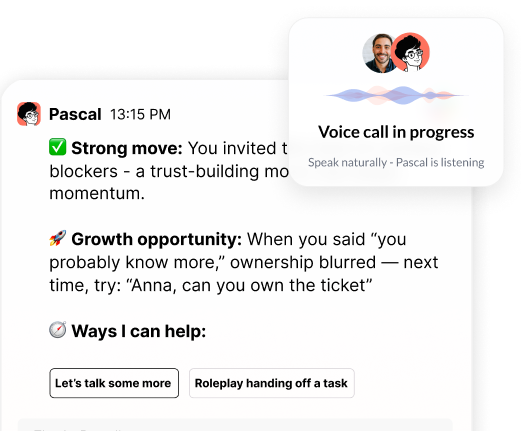
The best AI coach lives where managers work (Slack, Teams, email, calendar) rather than requiring them to open another portal. Pascal accompanies managers to meetings, provides feedback in communication channels, and proactively engages based on calendar events and interaction patterns.
Proactive versus reactive engagement makes the difference. Systems that wait for managers to ask questions see 5-15% monthly active usage. Systems that proactively offer guidance after meetings or before difficult conversations see 60-80% engagement. (These ranges come from Pinnacle's internal data across customers. Ask vendors for their adoption metrics and methodology.)
Meeting integration creates accountability. AI coaches that join video calls (as a bot participant that transcribes and analyzes the conversation) and observe interactions can provide specific, behavior-based feedback ("You interrupted Sarah three times in that discussion") rather than generic advice. Notification strategy matters—the best systems learn when and how each manager prefers to receive coaching.
Mobile accessibility is non-negotiable. Managers need coaching access during commutes, between meetings, and outside traditional work hours.
Test during evaluation: Ask vendors how their system would coach a manager who just received difficult feedback from their team in a 360 review. Generic systems require the manager to initiate the conversation and explain the situation. Integrated systems already know about the feedback and proactively offer guidance.
For insights on rapid adoption strategies, see The pilot trap: Why your AI strategy needs speed over perfection.
Effective AI coaching requires safety mechanisms that flag sensitive topics (harassment, discrimination, mental health crises) and escalate to human experts when appropriate. The best systems recognize when a situation exceeds AI capabilities and route to HR, legal, or external resources.
Look for four layers of protection. Content moderation flags inappropriate requests or responses. Sensitive topic detection identifies conversations requiring human intervention. Organization-specific controls let you define boundaries around what the AI can and cannot discuss. Privacy protection ensures individual coaching conversations remain confidential while providing aggregated insights to leadership.
Test the escalation process during demos. Ask the AI coach to handle scenarios involving potential harassment, mental health concerns, or legal issues. Strong systems acknowledge limitations and provide appropriate resources. Weak systems attempt to coach through situations requiring human expertise.
SOC2 compliance and data protection matter in coaching. Managers share sensitive information about team members, performance issues, and personal challenges. Verify your vendor never uses customer data to train models. Pascal is SOC2 compliant and guarantees customer data never trains AI models. Ask other vendors for the same commitment in writing.
Adoption rates tell you if people use the system. Effectiveness metrics tell you if it works. Track three categories: leading indicators (coaching conversation frequency, manager confidence scores), behavioral outcomes (feedback quality improvements, delegation increases), and business impact (team engagement, performance review consistency, manager ramp time).
Leading indicators appear within 30 days. Monitor how often managers engage with coaching, what topics they seek guidance on, and whether they report increased confidence handling difficult situations.
Behavioral outcomes emerge at 60-90 days. Measure changes in how managers conduct 1-on-1s, deliver feedback, delegate work, and handle conflict. Use direct report surveys, peer feedback, and observation data to track improvement.
Business impact becomes clear at 6-12 months. Track manager retention, team engagement scores, performance review quality, and time-to-productivity for new managers.
Avoid vanity metrics. Total coaching sessions, average session length, and user satisfaction scores don't predict business outcomes. Focus on behavior change and team impact.
Set realistic expectations: AI coaching won't fix broken organizational culture, compensate for poor hiring decisions, or replace necessary human interventions. It accelerates skill development for managers who want to improve. Measure accordingly.
Ask vendors to demonstrate how their system handles real scenarios, not scripted examples. Request live coaching on a situation from your organization. Watch how the AI responds to ambiguous information, sensitive topics, and follow-up questions.
Five critical demo questions:
• "Show me how your AI coach would help a manager prepare for a difficult performance conversation with a long-tenured employee who's underperforming."
• "What happens if a manager asks for coaching on a situation involving potential harassment?"
• "How does your system learn about our company's values, competencies, and culture?"
• "Walk me through what a manager experiences in their first week using your platform."
• "Show me the organizational insights HR leaders receive. What can I learn about my managers' challenges?"
Request references from customers with similar organizational size, industry, and maturity. Ask those customers about adoption rates, behavior change, and unexpected challenges. The best vendors connect you with customers who've been live for 6+ months and can speak to sustained impact.
Red flags to watch for: Vendors who can't demonstrate their system live, who refuse to share adoption metrics, who can't explain their escalation process for sensitive topics, or who can't provide customer references in your industry.
• Coaching expertise matters more than AI model sophistication. Systems trained by ICF-certified coaches on proven frameworks outperform generic chatbots.
• Deep organizational context separates effective coaching from generic advice. The best AI coaches know your culture, observe real behavior, and provide guidance grounded in your specific environment.
• Workflow integration drives higher adoption than standalone portals. Proactive coaching in Slack, Teams, and meetings reaches managers in their moment of need.
• Robust guardrails and escalation processes protect your organization. Require content moderation, sensitive topic detection, and clear escalation paths to human experts.
• Measure behavior change and business impact, not just engagement. Track manager effectiveness improvements, team engagement, and performance review quality.
• AI coaching has limits. It works best for skill development and behavioral coaching, not complex organizational politics or executive-level strategy. Know when you need human coaches.
Ready to see how AI coaching works in practice? Discover how Pascal delivers coaching in the flow of work inside Slack, Teams, and meetings—with the organizational context and guardrails that drive real behavior change.
Header photo by Christina @ wocintechchat.com M on Unsplash

.png)
.webp)
“Thank you for setting the great foundation for my promotion; now I have a plan!"

Curious to see how AI Coaching can 10X the impact and scale of your development initiatives. Book a demo today for: