

Before scheduling demos, interview managers across functions to identify specific pain points. Document patterns with measurable outcomes (e.g., "reduce time to first difficult conversation from 6 months to 6 weeks"). Then assess vendors on five dimensions: coaching expertise, contextual awareness, proactive engagement, workflow integration, and guardrails for sensitive topics.
Key Takeaways:
• Interview 15-20 managers to document specific coaching needs before evaluating vendors
• Test vendors with identical scenarios to compare coaching quality against generic AI
• Verify vendors can ingest your competency models, values, and policies
• Prioritize platforms that integrate with Slack, Teams, email, and calendar
• Confirm vendors escalate sensitive topics (harassment, legal issues, mental health) to HR
Interview managers across functions and experience levels. Ask: When do you wish you had coaching support but didn't? What management situations keep you up at night? What training have you received that you actually use?
Patterns emerge across 15-20 interviews. New managers struggle with delegation and accountability. Mid-level managers get stuck between executive pressure and team capacity. Senior managers struggle to develop other leaders. Technical experts promoted to management lack fundamental people skills.
Document these patterns with specificity. Instead of "managers need better communication skills," write "engineering managers avoid giving critical feedback to senior developers, causing performance issues that escalate to HR." Instead of "improve manager effectiveness," write "reduce the time it takes new managers to conduct their first difficult performance conversation from 6 months to 6 weeks."
This diagnostic creates internal alignment. When you present vendor recommendations to your executive team, you're solving documented business problems with measurable impact.
Set success metrics before talking to vendors: behavior changes, adoption rates, business outcomes. Identify integration requirements based on where managers work: Slack, Teams, email, calendar.
Purpose-built AI coaching platforms incorporate established coaching methodologies like GROW (Goal, Reality, Options, Will), cognitive behavioral coaching, and adult learning principles. Generic AI tools train on internet content optimized for information retrieval, not behavior change.
Test this yourself. Present the same scenario to ChatGPT and the vendor's tool: "I have a high-performing team member who delivers excellent work but undermines team morale with cynical comments in meetings. Other team members are starting to disengage. I've hinted at the problem but haven't addressed it directly. I'm worried that if I'm too direct, they'll leave, and I can't afford to lose their technical expertise."
ChatGPT provides generic advice about "having an honest conversation" and "setting clear expectations." A purpose-built coaching platform recognizes this as a common avoidance pattern, explores why you're prioritizing technical skills over team health, helps you calculate the actual cost of inaction (team disengagement, potential departures of other team members), guides you through preparing for the conversation, and provides specific language for addressing both the behavior and your previous avoidance.
The difference shows in how platforms handle emotional complexity. When a manager expresses fear about a difficult conversation, generic AI acknowledges the emotion and moves to tactics. Purpose-built coaching platforms explore the fear itself: What specifically worries you? What's the worst that could happen? What evidence do you have that this outcome is likely? This process (called cognitive reframing) helps managers recognize when their fears are disproportionate to reality, building confidence before the conversation happens.
Strong platforms also recognize patterns across conversations. If a manager asks about delegation three times but never follows through, the platform identifies this avoidance pattern and addresses it directly: "You've asked about delegation three times this month but haven't delegated any of the tasks we discussed. What's getting in the way?" This awareness of the coaching process itself accelerates behavior change.
Ask vendors: What coaching methodologies inform your responses? Who trained your models (engineers or certified coaches)? Show me how your platform handles a first-time manager preparing for a difficult performance conversation. What's the difference between your platform and asking ChatGPT? What coaching certifications do your content developers hold?
Red flags: Vague answers about "proprietary methods," inability to name specific coaching frameworks, or responses that sound like generic internet advice.
Without understanding your competencies, values, and policies, AI coaching becomes generic advice managers ignore. Strong platforms ingest organizational context (competency models, leadership frameworks, company policies, cultural values) and combine it with individual-level data (performance reviews, 360 feedback, personality assessments, career goals).
Context operates at three levels:
Organizational context includes your leadership competency model, company values, management philosophy, policies, and cultural norms. A company with a "radical candor" culture coaches managers differently than one with a "servant leadership" philosophy. A technology startup with a "move fast and break things" culture provides different guidance than a healthcare organization where safety and compliance are paramount.
If your leadership competency model includes "develops others" with specific behavioral indicators like "provides feedback within 48 hours of observed behavior," the platform should reinforce this standard. When a manager asks about feedback timing, the response should reference your 48-hour expectation, not generic best practices about "timely feedback."
Team context includes function, industry, team size, team maturity, and current challenges. A manager leading a 3-person startup team needs different coaching than one leading a 50-person enterprise team. An engineering manager faces different challenges than a sales manager.
Advanced platforms capture this context through integrations with your HRIS, organizational charts, and team data. They understand reporting relationships, team composition, tenure, and performance distributions. When a new manager asks about delegation, the platform considers their team's experience level and current workload, not just delegation theory.
Individual context includes the manager's experience level, development goals, personality, strengths, and growth areas. A first-time manager needs foundational skills. A senior leader needs help with strategic thinking and executive presence.
Platforms that integrate with performance management systems, 360 feedback tools, and assessment platforms know each manager's development priorities from their performance review. They understand working style from personality assessments. They track progress over time and adjust coaching accordingly.
If a manager's 360 feedback indicates they need to improve at "delegating effectively" and "developing team members," the platform proactively surfaces coaching on these topics. When the manager asks about workload management, the platform connects it to their delegation development goal. When they prepare for 1-on-1s, the platform suggests development conversations aligned with their growth area.
Ask vendors: How does your platform learn our culture? What organizational context can you ingest (competency models, values, policies)? What individual-level data does it use? Walk me through how it would coach two managers differently based on their development needs. Show me a specific example of how your platform referenced a customer's competency model in a coaching response.
Request a demonstration using your actual competency framework. Provide a sample manager profile with specific development needs. Ask the vendor to show how their platform would coach this person differently than a manager with different needs.
Red flags: "We can customize that for you" without showing how, claims about "learning your culture" without explaining the technical process, or inability to demonstrate personalization with real examples.
Reactive systems wait for managers to remember to ask for help. This results in low adoption and crisis-only usage. Proactive systems observe work patterns and surface guidance before problems escalate.
The adoption challenge with reactive systems is fundamental: managers seek help only when they're already in crisis, which is too late for coaching to be most effective. By the time a manager asks "how do I handle this performance issue," they've avoided the conversation for months, the problem has escalated, and the team member may already be disengaged.
Proactive systems flip this model. They observe work patterns through calendar integrations, email analysis, and collaboration tool monitoring. They identify coaching moments before managers recognize they need help.
A proactive system notices a manager has a 1-on-1 scheduled with a team member who received critical feedback in their last performance review. Thirty minutes before the meeting, it surfaces coaching: "You're meeting with Sarah, who's working on improving her project management skills. Here are three development-focused questions to ask and two ways to reinforce the feedback from her review."
Or it notices a manager has back-to-back meetings all week with no focus time blocked. It suggests: "Your calendar is 100% meetings this week. Managers typically need 40% focus time for strategic work. Would you like help identifying meetings to decline or delegate?"
The technical implementation varies by platform. Some use calendar APIs to identify coaching moments. Others integrate with email to detect communication patterns that indicate stress or conflict. Advanced platforms combine multiple signals: calendar density, email sentiment, Slack response times, meeting patterns, and team engagement data.
Coaching happens at the moment of need, not when managers remember to seek it. Managers don't need to remember to log into a platform or ask for help. Coaching comes to them, in their workflow, when they need it.
Proactive engagement also enables preventive coaching. Instead of helping managers recover from mistakes, it helps them avoid mistakes. A manager preparing to send a terse email gets a gentle nudge: "This message might come across as more critical than you intend. Would you like suggestions for softening the tone while maintaining clarity?"
The platform notices a manager hasn't had 1-on-1s with their team in three weeks and prompts: "You haven't met individually with your team recently. Consistent 1-on-1s correlate with higher engagement. Would you like to schedule them now?"
Ask vendors: How does your platform identify coaching moments proactively? What signals does it monitor? Show me examples of proactive coaching triggers. How do you balance helpfulness with intrusiveness? What controls do managers have over proactive notifications? What percentage of coaching interactions are proactive versus reactive among your current customers?
Red flags: Purely reactive systems that require managers to initiate all interactions, vague promises about "future proactive features," or notification strategies that would create alert fatigue.
AI coaching delivers maximum value when it integrates into managers' existing workflows (Slack, Teams, email, and calendar) rather than requiring them to log into a separate platform. Managers should receive coaching in the tools they already use daily, minimizing context switching and friction.
The best coaching platform is invisible. Managers don't log into a separate system, remember to check a dashboard, or carve out dedicated time for development. Coaching happens inside the tools they already use, at moments when they need it.
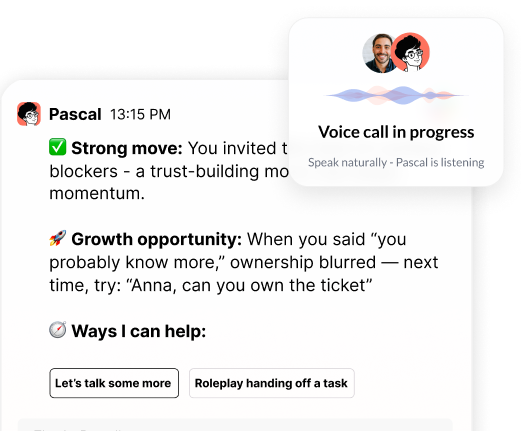
Slack and Teams integration means managers can ask coaching questions directly in their communication tools. They type a question in a direct message with the coaching bot and receive guidance without leaving their conversation flow. The platform maintains conversation history and context across interactions.
Advanced integrations also enable team-level coaching. A manager can add the coaching bot to a channel and ask questions in context: "We're discussing our Q3 roadmap. What questions should I ask to ensure we're considering risks?" The platform provides guidance visible to the whole team, modeling good leadership practices.
Email integration enables coaching on communication before it's sent. A manager drafts a difficult message, and the platform analyzes tone, clarity, and potential misinterpretations. It suggests revisions before the manager hits send, preventing communication problems rather than fixing them afterward.
Calendar integration surfaces coaching based on upcoming meetings. Before a performance review, the platform provides preparation guidance. Before a 1-on-1, it suggests discussion topics based on the team member's recent work and development goals. Before a difficult conversation, it helps the manager prepare mentally and strategically.
Calendar integration also enables time management coaching. The platform analyzes meeting patterns and suggests improvements: "You have 8 hours of meetings scheduled tomorrow with no breaks. Cognitive performance declines after 4 hours of continuous meetings. Would you like help restructuring your day?"
Mobile accessibility ensures coaching is available when managers need it, not just when they're at their desk. Many coaching moments happen between meetings, during commutes, or outside traditional work hours. Mobile apps should offer full functionality, not just read-only access.
Ask vendors: Where does coaching happen (in our existing tools or a separate platform)? What integrations do you offer with Slack, Teams, email, and calendar? Show me the mobile experience. How many clicks does it take for a manager to get coaching on a real-time situation? What percentage of your users access coaching through integrations versus logging into your platform?
Request a live demonstration in your actual tools. Have the vendor show Slack integration in your Slack workspace, Teams integration in your Teams environment. Test the mobile app yourself during the evaluation process.
Red flags: Standalone platforms that require separate logins, "integrations" that are just notification links back to the main platform, mobile apps that are just responsive web views with limited functionality, or vendors who can't demonstrate integrations in your specific tools.
AI coaching excels at skill development, behavior change, and everyday management challenges. It should not handle sensitive HR issues, legal matters, mental health crises, or situations requiring human judgment and organizational authority.
Strong platforms build guardrails at multiple levels:
Topic detection identifies when conversations enter sensitive territory. If a manager describes potential harassment, discrimination, retaliation, safety concerns, or mental health crises, the platform recognizes these triggers and shifts its response.
Instead of providing coaching advice, it says: "This situation involves [harassment/legal concerns/mental health], which requires support from HR. I'm going to connect you with [specific person/team] who can help. In the meantime, here are the immediate steps to take: [document the situation, ensure safety, etc.]."
The technical implementation requires sophisticated natural language understanding. The platform must distinguish between "my team member seems disengaged" (coaching opportunity) and "my team member said they're having suicidal thoughts" (immediate escalation). It must recognize both explicit statements and implicit signals.
Escalation protocols define exactly what happens when sensitive topics arise. Who gets notified? How quickly? What information is shared? What follow-up occurs?
The best platforms offer configurable escalation workflows. You define which topics trigger escalation, who receives notifications, and what information is shared. Some situations require immediate notification to HR leadership. Others might route to employee assistance programs, legal counsel, or specific HR business partners.
Escalation should be automatic and immediate, not dependent on the manager taking action. If a manager describes a situation involving potential harassment, the platform should notify your designated HR contact within minutes, not wait for the manager to remember to follow up.
Privacy and confidentiality matter for adoption. Managers won't use coaching if they fear everything they say goes to HR. Strong platforms maintain confidentiality for routine coaching conversations while escalating only genuine HR issues.
The platform should clearly communicate its privacy policy to managers: "Your coaching conversations are confidential. I only notify HR if you describe situations involving harassment, discrimination, safety concerns, legal issues, or mental health crises. In those cases, I'll tell you I'm escalating and explain why."
This transparency builds trust. Managers understand the boundaries and feel safe using the platform for everyday coaching needs.
Ask vendors: How does your platform identify sensitive topics that require HR intervention? What triggers escalation? Who gets notified and how quickly? Can we configure escalation workflows for our organization? What's your privacy policy for routine coaching conversations versus sensitive topics? Show me examples of how your platform has handled escalation with existing customers.
Red flags: Platforms that claim to handle all topics without human oversight, unclear privacy policies, no escalation process, or inability to demonstrate how topic detection works in practice.
Data Breakdown:
• Dimension: Coaching Expertise | Key Criteria: Incorporates established coaching methodologies (GROW, cognitive behavioral coaching); trained by certified coaches; handles emotional complexity; recognizes avoidance patterns | Red Flags: Vague "proprietary methods"; can't name specific frameworks; responses sound like generic internet advice
• Dimension: Contextual Awareness | Key Criteria: Ingests competency models, values, policies; integrates with HRIS and performance systems; personalizes by org, team, and individual level | Red Flags: "We can customize that" without demonstration; can't show existing personalization examples; no technical explanation of context integration
• Dimension: Proactive Engagement | Key Criteria: Surfaces coaching before problems escalate; integrates with calendar/email/collaboration tools; provides moment-of-need guidance | Red Flags: Purely reactive system; requires managers to remember to log in; no workflow integration
• Dimension: Workflow Integration | Key Criteria: Works inside existing tools (Slack, Teams, email); minimal context switching; mobile-accessible; fits into daily routines | Red Flags: Requires separate login; standalone platform only; disrupts manager workflow
• Dimension: Guardrails for Sensitive Topics | Key Criteria: Recognizes legal/HR escalation triggers; routes sensitive issues appropriately; maintains confidentiality; clear escalation protocols | Red Flags: Handles all topics without human oversight; unclear privacy policies; no escalation process
Schedule demos with 3-4 vendors that meet your baseline criteria. Prepare the same test scenario for each demo (use a real situation from your manager interviews). Bring your competency framework and ask vendors to demonstrate how they would ingest it. Test integrations in your actual Slack or Teams environment, not a demo environment.
Involve 2-3 managers in the evaluation process. They'll use the platform daily and can assess usability better than HR can. Run a 30-day pilot with 10-15 managers before committing to an enterprise contract.
At Pinnacle, we help CHROs evaluate and implement AI coaching platforms that integrate with your existing leadership development programs. Pascal and our team have guided dozens of organizations through vendor selection, pilot design, and scaled rollout.
Header photo by Vitaly Gariev on Unsplash

.png)
.webp)
“Thank you for setting the great foundation for my promotion; now I have a plan!"

Curious to see how AI Coaching can 10X the impact and scale of your development initiatives. Book a demo today for: