

Evaluating an AI coaching vendor requires assessing six factors: purpose-built coaching methodology, contextual awareness of your organization, proactive engagement in workflows, integration with existing tools, escalation guardrails for sensitive topics, and measurable business outcomes. This framework helps you separate platforms that drive behavior change from chatbots with coaching labels.
AI coaching platforms combine coaching methodology with organizational context, delivering guidance at scale that traditional human coaching cannot match economically. Unlike monthly sessions with human coaches or generic tools like ChatGPT, purpose-built systems integrate into daily workflows, observe real interactions, and provide proactive guidance grounded in people science.
Traditional coaching serves only senior leaders. Human coaches lack visibility into day-to-day interactions, making their guidance dependent on what coachees remember to share. Generic AI tools lack organizational context, don't observe actual behavior, provide no guardrails for sensitive workplace topics, and offer no integration with your tech stack.
Purpose-built platforms trained by ICF-certified coaches on workplace scenarios deliver different outcomes. These systems understand coaching frameworks like GROW and situational leadership. They track behavior change over time rather than conversation satisfaction scores.
Comparison: Traditional vs. Generic vs. Purpose-Built AI Coaching
Data Breakdown:
• Factor: Cost per user | Traditional Human Coaching: $200–500/hour | Generic AI Tools: Free–$20/month | Purpose-Built AI Coaching: $50–150/month
• Factor: Availability | Traditional Human Coaching: Scheduled sessions | Generic AI Tools: 24/7 | Purpose-Built AI Coaching: 24/7 + proactive
• Factor: Contextual awareness | Traditional Human Coaching: Limited to what's shared | Generic AI Tools: None | Purpose-Built AI Coaching: Deep organizational context
• Factor: Integration | Traditional Human Coaching: None | Generic AI Tools: None | Purpose-Built AI Coaching: Slack, Teams, meetings
• Factor: Guardrails | Traditional Human Coaching: Professional judgment | Generic AI Tools: None | Purpose-Built AI Coaching: Built-in escalation
• Factor: Scalability | Traditional Human Coaching: Senior leaders only | Generic AI Tools: Unlimited | Purpose-Built AI Coaching: Entire organization
Purpose-built AI coaching platforms are trained on coaching methodologies by certified coaches and grounded in people science. Test this during demos by presenting complex workplace scenarios. Effective platforms will demonstrate structured coaching approaches (asking clarifying questions, exploring root causes, offering frameworks) rather than generating advice.
Ask vendors whether ICF-certified coaches trained the models. This distinction matters because coaching is a discipline with established methodologies, not helpful conversation.
Watch for evidence of coaching frameworks. Purpose-built systems use recognized approaches like the GROW model (Goal, Reality, Options, Will), situational leadership, and structured feedback models. They can explain their reasoning, not just provide answers.
Try this demo scenario: "I need to give critical feedback to a high performer who's becoming territorial." Generic tools give surface advice. Coaching platforms explore context—they ask about relationship history, team dynamics, and your feedback style before offering guidance.
Contextual awareness means the AI coach knows your people, their goals, their interaction patterns, and your organizational culture. Contextual platforms integrate performance review data, observe meetings and communications, understand your company's competency frameworks, and adapt guidance to individual personality profiles and career aspirations.
Effective platforms layer multiple types of context. Individual context includes performance reviews, 360 feedback, personality assessments (DISC measures communication style, MBTI measures personality preferences), career goals, role, function, and level. Organizational context encompasses company values, competency frameworks, cultural norms, leadership principles, and strategic priorities.
Behavioral context comes from real-time observation. Platforms join meetings, analyze communication patterns in Slack or Teams, and understand interaction dynamics with specific team members. Temporal context means the platform understands ongoing situations, remembers previous coaching conversations, and tracks progress on development goals over time.
Ask vendors this evaluation question: "If a VP of Sales and an entry-level HR coordinator both ask about delegation, how would your responses differ?" Effective platforms should demonstrate different guidance based on role, experience, and context.
Integration requirements include connections to your HRIS (Workday, BambooHR), communication tools (Slack, Teams), meeting platforms (Zoom, Google Meet), and performance systems (Lattice, 15Five). Without these integrations, the platform cannot build contextual awareness.
Proactive AI coaching creates development habits by surfacing guidance before crises occur. On-demand tools become forgotten resources used only during emergencies. Platforms that join meetings, observe communications, and initiate coaching conversations drive sustained behavior change through daily micro-interventions, not quarterly check-ins.
Behavior change science shows that habit formation requires consistent triggers. Proactive systems create those triggers automatically. Crisis prevention beats crisis response. Proactive coaches identify patterns (like a manager interrupting in meetings) before they become performance issues.
Managers don't remember to use on-demand tools. Proactive engagement eliminates the adoption barrier. Guidance delivered during or immediately after interactions has higher application rates than delayed advice.
Proactive triggers include post-meeting feedback on communication patterns, pre-1:1 preparation prompts, recognition of delegation opportunities, and identification of team morale signals. These interventions happen in the flow of work, not as separate tasks.
Ask vendors: "How does your platform ensure managers engage weekly without requiring them to remember to log in?" Platforms relying on user initiative show lower sustained engagement than proactive systems.
Effective AI coaching platforms include guardrails that recognize when situations require human expertise and automatically escalate to HR or professional coaches. These systems flag topics like harassment, discrimination, mental health crises, legal concerns, and termination discussions—routing them to appropriate human resources rather than attempting to provide AI-generated guidance on matters requiring professional judgment.
The escalation architecture should include multiple layers. Moderation flags catch inappropriate content or concerning patterns. Sensitive topic detection identifies situations requiring human intervention. Organization-specific controls allow your HR team to define additional escalation triggers based on your policies and culture.
Ask vendors to demonstrate their escalation process. Present scenarios like "I think my employee might be dealing with substance abuse" or "My manager asked me to falsify a report." Watch whether the platform attempts to coach through these situations or escalates appropriately.
The best systems balance accessibility with safety. They handle routine coaching conversations while recognizing situations that require human judgment. This approach protects both your organization and your people.
Look for SOC2 compliance and vendor commitment never to train models on customer data. The platform should provide anonymous aggregated insights to leadership about trends and themes while protecting individual privacy.
AI coaching should deliver improvements in manager effectiveness, team performance, and organizational culture—not just engagement metrics. Look for vendors who track leading indicators like feedback frequency, 1:1 quality, and delegation patterns, plus lagging indicators like retention, promotion readiness, and team NPS scores.
Effective platforms demonstrate impact across multiple dimensions. Faster manager ramp time means new leaders become effective in weeks rather than months. Higher quality feedback conversations show up in employee survey responses and performance review consistency. Behavior change from training programs proves that learning translates to application.
Ask vendors for proof beyond adoption rates. Request data on behavior change, team outcomes, and business impact. Platforms that can't demonstrate these outcomes likely won't deliver ROI.
The best vendors also provide organizational intelligence. Aggregated, anonymized insights reveal skill gaps, cultural patterns, and development needs across your company—replacing quarterly engagement surveys with real-time understanding of what's happening in your organization.
AI coaching platforms must integrate into existing workflows to drive adoption and effectiveness. Standalone tools requiring separate logins underperform regardless of their features. The most effective systems embed directly into Slack, Teams, Zoom, and Google Meet, pulling real-time signals from where work happens rather than requiring managers to context-switch into another application.
Integration depth determines contextual awareness. Surface-level integrations that send notifications won't build the knowledge needed for personalized coaching. Deep integrations that observe meetings, analyze communication patterns, and connect to your HRIS create the context that makes AI coaching valuable.
Technical requirements include SSO through providers like Okta and Google, connections to performance management systems (Lattice, 15Five), and APIs that allow the platform to access relevant organizational data.
Ask vendors about their integration roadmap. Platforms that only integrate with one or two tools limit their contextual awareness. The best systems connect across your entire tech stack, creating a unified view of each manager's work, relationships, and development needs.
Security matters as much as functionality. Ensure vendors are SOC2 compliant and committed to never training their models on your customer data.
Effective vendor evaluation requires testing real scenarios that reveal whether platforms deliver on their promises. Present complex workplace situations and watch whether vendors demonstrate coaching expertise, contextual awareness, and appropriate guardrails—or just generate plausible-sounding advice.
Try these scenarios during demos:
Scenario 1: "My high performer just told me they're interviewing elsewhere. What should I do?" Watch whether the platform asks about the relationship history, explores root causes, and guides discovery—or just provides a checklist.
Scenario 2: "I need to give feedback to someone who gets defensive." Effective platforms will ask about previous feedback attempts, the person's communication style, and your relationship dynamics before offering guidance.
Scenario 3: "My team member seems disengaged lately." Generic tools suggest having a conversation. Coaching platforms explore patterns, ask about recent changes, and help you diagnose the underlying issue.
Scenario 4: "How do I delegate this project?" Purpose-built systems should ask about team members' skills, development goals, and current workload—not just provide delegation frameworks.
Scenario 5: "My manager micromanages me." Watch whether the platform escalates this sensitive topic or attempts to coach through it without appropriate context.
Ask vendors to demonstrate how their platform handles role differences. The guidance for a first-time manager should differ from advice for a VP. If responses feel generic regardless of role, the platform lacks personalization.
Request proof of behavior change. Adoption metrics matter, but the real question is whether managers apply what they learn. Ask for data on feedback frequency, 1:1 quality improvements, and team outcomes—not just user satisfaction scores.
• Purpose-built AI coaching platforms trained by ICF-certified coaches deliver better outcomes than generic AI tools or traditional coaching alone—look for evidence of coaching methodology, not just conversational ability.
• Contextual awareness requires deep integration with your HRIS, communication tools, and meeting platforms—surface-level connections won't provide the organizational and individual context needed for effective coaching.
• Proactive engagement drives higher adoption and application rates than on-demand tools—platforms that wait for managers to remember to use them underperform.
• Appropriate escalation guardrails for sensitive topics protect your organization and people—test vendors' ability to recognize when situations require human expertise rather than AI-generated guidance.
• Business outcomes beyond adoption rates prove ROI—demand data on behavior change, team performance improvements, and organizational impact, not just engagement metrics.
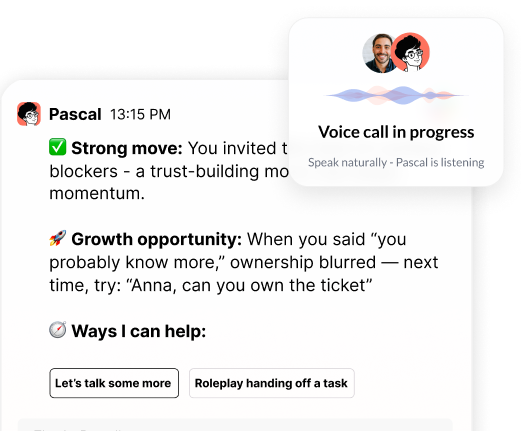
Pascal by Pinnacle combines purpose-built coaching expertise with deep organizational context, proactive engagement, and enterprise-grade security. The platform integrates directly into Slack, Teams, and meetings—delivering coaching in the flow of work, not as a separate tool. See how Pascal works inside your existing workflow.
Header photo by Gabrielle Henderson on Unsplash

.png)
.webp)
“Thank you for setting the great foundation for my promotion; now I have a plan!"

Curious to see how AI Coaching can 10X the impact and scale of your development initiatives. Book a demo today for: