

To evaluate AI leadership development software for competency mapping, check whether your competency model can go in as written, including different expectations by level or department. Then check whether the tool coaches against those competencies in real work. For measurable outcomes, ask how the provider scores behavior and what evidence supports each score.
A competency model usually sets expectations that differ by level or department, so a senior director and a first-line supervisor are held to different standards for the same competency. When you evaluate software, ask to load your own model and look at how each level and department shows up in the coaching.
The next check is whether the tool coaches against those competencies in real work. Coaching that happens inside actual meetings and conversations gives each competency a moment to show up in, and that moment is where behavior change happens. Ask each provider to show where in a manager's week the coaching meets the work, using one of your own competencies as the example.
Four questions about scoring show how measurable the outcomes will be. Each one can be asked in a first demo, and a clear answer to all four is a good sign that the results will stand up in a budget review.
Strong tools score actual behavior in real interactions and let you compare a group at two points in time. That comparison gives HR and L&D leaders a before and after view for a cohort, which is the basis for any claim about measurable outcomes.
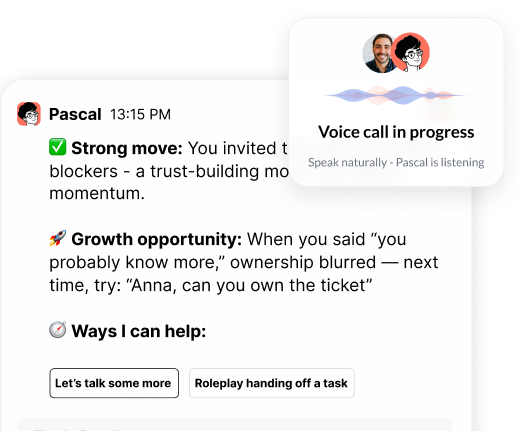
Pascal is an AI coach for every manager: a leadership companion who accompanies them in their meetings and work, and coaches from what actually happened. Pascal maps to your competency framework directly, so the behaviors you define become the behaviors he coaches. Pinnacle's team builds the rubric on those behaviors with you.
You can change skills and the rubric at any time, with new scoring applying from that point forward. Pascal scores interactions in meetings against that rubric, so the scores reflect conversations that really took place.
Each person's coaching conversations with Pascal stay private. HR and executives see aggregated, anonymized insights, and only for groups large enough to protect anonymity.
Scores become useful to leaders when they can be viewed at the level where decisions get made. Results roll up by cohort, group, function or level, with comparisons between an earlier and a later point. A head of L&D can look at one function across two quarters and see whether the behaviors in the rubric are shifting.
Each person also sees evidence of their own progress. That view lets each manager track their own behavior change against the competencies that matter in their role.
A good evaluation draws on your own material, so bring your competency model and a pair of groups with different levels or functions, and ask to see how the same competency is coached at each level. Then ask to see how results for each group compare across two points in time.
That exercise shows whether the scoring can support the conversations you will have with HR and executives about progress. It also shows how much of the rubric your team controls, which matters when priorities change and the model has to change with them.



“Thank you for setting the great foundation for my promotion; now I have a plan!"

Curious to see how AI Coaching can 10X the impact and scale of your development initiatives. Book a demo today for: