

Your VP of Engineering just lost two senior managers in one quarter. Exit interviews mention "lack of support" and "unclear expectations." Your L&D budget is frozen. You're evaluating AI tools that promise to develop managers at scale, but the market is confusing: some vendors sell chatbots, others sell "AI coaching platforms," and the distinctions aren't clear.
This guide maps the landscape and shows you what to evaluate.
Key Takeaways:
• Chatbots retrieve information. AI coaching platforms change behavior.
• AI coaching costs $50–$150 per manager annually vs. $5,000–$15,000 for human coaching
• Evaluate vendors on coaching methodology, contextual awareness, proactive engagement, workflow integration, and privacy guardrails
• Expect 30–40% sustained usage if the system integrates into workflow, 10–20% for standalone portals
• The hybrid model works: AI coaching for daily guidance, human coaching for complex situations
Before comparing tools, ask whether your organization has the problems AI coaching solves.
You benefit from AI coaching if managers need guidance on specific situations (underperforming team members, difficult conversations, performance reviews) but can't access it when decisions happen. Your HR team is stretched thin and can't provide real-time support to 50+ managers. Training doesn't stick because managers forget classroom lessons when pressure hits. Executive coaching works for senior leaders but doesn't scale to frontline and mid-level managers.
You don't need AI coaching if managers mainly need policy information ("What's our parental leave policy?") or simple task completion ("How do I submit a performance review?"). A knowledge base or basic chatbot handles these needs at lower cost.
The distinction matters because the tools are built differently.
Chatbots retrieve information. AI coaching platforms change behavior.
A chatbot answers questions when managers ask. It pulls from a knowledge base, provides policies, and completes simple tasks. The interaction ends when the manager stops asking questions.
An AI coaching platform observes how managers work, surfaces insights they didn't know to ask for, and guides them through development over time. It remembers past conversations, tracks growth patterns, and adapts recommendations based on individual needs.
Here's what that looks like in practice:
Chatbot interaction: Manager asks, "How should I give feedback to an underperformer?" System provides a framework for difficult conversations. Manager reads it, closes the window, and may or may not apply the advice.
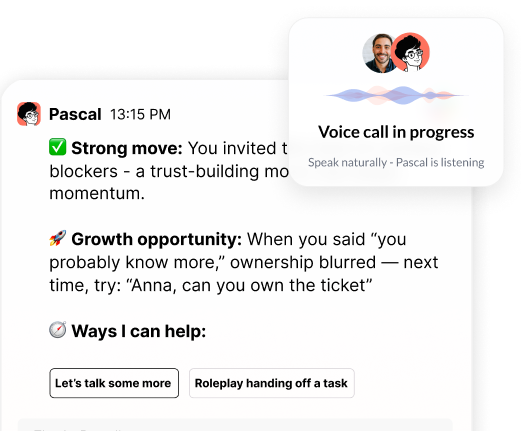
AI coaching interaction: System joins the manager's one-on-one meeting (with consent), observes the conversation, and provides specific feedback afterward: "You asked three questions but didn't leave space for answers. Try pausing five seconds after asking. You used 'but' four times, which undercut your positive feedback. Replace 'but' with 'and.'" The system tracks whether the manager improves in the next meeting.
Data Breakdown:
• Dimension: Primary Function | Chatbots: Information retrieval | AI Coaching Platforms: Behavior change | Human Coaching: Complex development & strategic guidance
• Dimension: Interaction Model | Chatbots: Reactive (user initiates) | AI Coaching Platforms: Proactive (system surfaces insights) | Human Coaching: Scheduled sessions
• Dimension: Memory & Context | Chatbots: Session-based (no memory between conversations) | AI Coaching Platforms: Longitudinal (tracks progress over weeks/months) | Human Coaching: Deep relationship over time
• Dimension: Personalization | Chatbots: General-purpose (same responses for all) | AI Coaching Platforms: Context-aware (understands culture, team dynamics) | Human Coaching: Fully customized to individual
• Dimension: Cost per User Annually | Chatbots: $10–$50 | AI Coaching Platforms: $50–$150 | Human Coaching: $5,000–$15,000
• Dimension: Best For | Chatbots: Policy questions, task completion | AI Coaching Platforms: Just-in-time guidance on common challenges | Human Coaching: Organizational politics, career transitions, personal crises
• Dimension: Scalability | Chatbots: Unlimited | AI Coaching Platforms: Scales to all managers | Human Coaching: Limited to senior leaders
• Dimension: Integration | Chatbots: Standalone or embedded | AI Coaching Platforms: Workflow-integrated (Slack, Teams, meetings) | Human Coaching: Separate scheduled meetings
The architectural differences:
Chatbots are reactive (user initiates every interaction), session-based (no memory between conversations), and general-purpose (same responses for every organization). They excel at information retrieval.
AI coaching platforms are proactive (system surfaces insights automatically), longitudinal (builds knowledge over time by remembering past conversations and tracking progress across weeks and months), and context-aware (understands your culture, competencies, and team dynamics). They excel at behavior change.
Both have uses. The question is which problem you're solving.
If you've decided AI coaching fits your needs, assess vendors on five dimensions.
Data Breakdown:
• Criterion: Coaching Methodology | What to Look For: System trained by certified coaches (ICF or equivalent); incorporates structured frameworks (GROW model, situational leadership); guides multi-step development processes | Questions to Ask: "Who designed your coaching methodology? What frameworks does the system use? Show me a sample coaching conversation on delegation or conflict resolution." | Red Flags: Can't name coaching frameworks or explain how certified coaches contributed to design
• Criterion: Contextual Awareness | What to Look For: Understands your competencies, values, leadership principles; tracks individual development over time; knows team dynamics | Questions to Ask: "How does the system learn our culture? What data does it use to personalize coaching? Can it remember context from previous conversations?" | Red Flags: Claims "personalization" but only uses manager's name
• Criterion: Proactive Engagement | What to Look For: Surfaces insights automatically; observes real interactions (meetings, communications); initiates coaching conversations based on triggers | Questions to Ask: "Show me how the system initiates a coaching conversation. What triggers proactive outreach? Can it observe my managers' work?" | Red Flags: Requires managers to self-diagnose needs and seek help
• Criterion: Workflow Integration | What to Look For: Embeds in daily tools (Slack, Teams, email); joins meetings to observe interactions; no context-switching required | Questions to Ask: "Where does coaching happen? Do managers need to open a separate app? Can it integrate with our existing tools?" | Red Flags: Requires standalone portal that managers must remember to visit
• Criterion: Privacy & Guardrails | What to Look For: SOC2 compliant; escalates sensitive topics (mental health, harassment, legal issues) to HR; provides aggregated insights without exposing individual conversations | Questions to Ask: "What happens if a manager discusses a sensitive topic? How do you handle data security? Can HR see individual conversations?" | Red Flags: Can't clearly explain data handling policies or escalation process
Coaching methodology: Is the system trained by certified coaches (credentialed by the International Coaching Federation or equivalent professional body), or is it a language model with coaching prompts? Does it incorporate structured frameworks (GROW model, situational leadership, feedback models), or does it improvise responses? Can it guide managers through multi-step development processes?
Ask vendors: "Who designed your coaching methodology? What frameworks does the system use? Show me a sample coaching conversation on delegation or conflict resolution."
Red flag: Vendors who can't name their coaching frameworks or explain how certified coaches contributed to the system design.
Contextual awareness: Does the system understand your organization's competencies, values, and leadership principles? Can it track individual manager development over time? Does it know team dynamics and relationships?
The mechanism matters. Does HR manually configure cultural context? Does the system learn from observing communications? Is it trained on company documents? Ask vendors to explain the technical implementation, not just claim the capability exists.
Ask vendors: "How does the system learn our culture? What data does it use to personalize coaching? Can it remember context from previous conversations?"
Red flag: Vendors who claim "personalization" but only mean the system uses the manager's name.
Proactive engagement: Does the coach surface insights automatically, or only when managers remember to ask? Can it observe real interactions (meetings, communications) to provide feedback on behavior?
The observation capability is the differentiator. Ask which vendors offer this today, how they implement it technically, and whether you can see a live demo. If vendors describe this as a future capability, treat it as vaporware.
Ask vendors: "Show me how the system initiates a coaching conversation. What triggers proactive outreach (calendar events, communication patterns, manager self-reporting)? Can it observe my managers' work?"
Red flag: Systems that require managers to self-diagnose needs and seek help. That's a chatbot with extra steps.
Workflow integration: Does it embed in daily tools (Slack, Teams, email), or is it a standalone portal managers must remember to visit? Can it join meetings to observe real interactions?
Ask vendors: "Where does coaching happen? Do managers need to open a separate app, or does it come to them? Can it integrate with our existing tools?"
Red flag: Platforms that require context-switching. Managers won't use them consistently.
Privacy and guardrails: Is it SOC2 compliant? Does it escalate sensitive topics (mental health, harassment, legal issues) to human HR professionals? Does it provide aggregated insights to HR without exposing individual conversations?
The escalation mechanism matters. Does the system detect keywords and flag conversations? Does it ask the manager "should I loop in HR?" Does it automatically create a ticket? Ask vendors to show you the process, not just describe it.
Ask vendors: "What happens if a manager discusses a sensitive topic? How do you handle data security? Can HR see individual conversations, or only aggregated trends?"
Red flag: Vendors who can't clearly explain their data handling policies or sensitive topic escalation process.
Here's the calculus a CHRO needs:
Data Breakdown:
• Your Situation: Managers need policy information and task completion | Recommended Solution: Chatbot | Annual Cost per User: $10–$50 | Expected Outcome: Fast answers, no behavior change
• Your Situation: Managers need just-in-time guidance on common challenges (delegation, feedback, conflict); HR can't scale to 50+ managers | Recommended Solution: AI Coaching Platform | Annual Cost per User: $50–$150 | Expected Outcome: 10–20% improvement in manager confidence, engagement, retention over 12 months
• Your Situation: Managers face complex situations (organizational politics, career transitions, personal crises) | Recommended Solution: Human Coaching | Annual Cost per User: $5,000–$15,000 | Expected Outcome: Deep development for senior leaders
• Your Situation: Need to scale development to all managers while reserving human coaching for strategic situations | Recommended Solution: Hybrid Model (AI + Human) | Annual Cost per User: $50–$150 (AI) + selective human coaching | Expected Outcome: Broad access to guidance + deep support where needed
If managers need policy information and task completion: Deploy a chatbot. Cost: $10–$50 per user annually. No behavior change expected.
If managers need just-in-time guidance on common challenges (delegation, feedback, conflict) and your HR team can't scale to support 50+ managers: Deploy AI coaching. Cost: $50–$150 per user annually. Expect 10–20% improvement in manager confidence scores, direct report engagement, and retention of high performers over 12 months (based on early deployments at mid-market technology companies with 200–500 employees, though the market is too new for peer-reviewed research).
If managers face complex situations (organizational politics, career transitions, personal crises): Deploy human coaching. Cost: $5,000–$15,000 per person annually. Reserve for senior leaders and strategic development.
If you're solving the VP of Engineering's problem (managers leaving due to lack of support): AI coaching addresses this if the root cause is managers needing guidance on common situations they can't access when decisions happen. It doesn't address this if the root cause is compensation, career progression, or organizational dysfunction. Diagnose the actual problem before buying tools.
The hybrid model: AI coaching for daily guidance and skill-building, human coaching for complex situations and strategic development. This scales development to all managers while reserving expensive human coaching for senior leaders.
Organizations implementing AI coaching see returns across three dimensions, but the timeline matters.
Months 1–3 (adoption): Managers explore the system, test it on low-stakes questions, and decide whether to trust it. In early deployments at technology companies (sample size: 8 organizations, 400–1,200 employees each, data from vendor case studies), 40–60% of managers tried the system at least once. The ones who engaged early were the strongest performers (already seeking development) and the most overwhelmed (desperate for support).
Months 3–6 (habit formation): Managers who found value start using the system regularly. Workflow-integrated systems see 30–40% monthly active usage. Standalone portals see 10–20% usage (data from the same vendor case studies).
Months 6–12 (sustained impact): You'll see measurable behavior change. Direct reports notice improvements in their managers' effectiveness. HR teams report fewer escalations on routine issues. Manager confidence increases on difficult conversations.
The three ROI dimensions:
Financial: AI coaching costs $50–$150 per manager annually (vendor pricing as of 2024 for contracts covering 50–200 managers), compared to $5,000–$15,000 for executive coaching. You won't replace all human coaching, but you can reserve it for senior leaders and complex situations while providing AI support to everyone else.
Operational: Small HR teams scale their impact without proportional headcount increases. The AI handles routine guidance (how to give feedback, how to run one-on-ones, how to address underperformance), allowing HR to focus on complex employee relations, strategic initiatives, and culture work.
Strategic: Track leading indicators for manager effectiveness. These include manager confidence scores (measured through quarterly surveys asking managers to rate confidence on specific skills like delegation and feedback), direct report engagement (measured through pulse surveys or annual engagement surveys with questions about manager effectiveness), retention of high performers (measured by comparing voluntary turnover rates for top-rated employees before and after implementation), and time-to-productivity for new managers (measured by tracking how long it takes new managers to achieve performance milestones). Early deployments show 10–20% improvements in these metrics over 12 months if the system achieves sustained adoption, though sample sizes are small and the market is too new for definitive conclusions.
The key differentiator in ROI: contextual awareness. Systems that understand your culture, track individual development, and integrate into workflow achieve higher engagement than generic chatbots. Without that context, usage drops to single digits within six months.
AI coaching platforms handle sensitive workplace conversations (performance issues, team conflicts, career concerns) that generic chatbots don't encounter. The security requirements are higher.
SOC2 compliance is table stakes. The platform must encrypt data at rest and in transit, maintain clear data handling policies, and never train AI models on customer data. If a vendor can't show you their SOC2 report, walk away.
Sensitive topic escalation separates AI coaching platforms from chatbots. The system must recognize when conversations involve mental health, harassment, legal issues, or other topics requiring human intervention. It should flag these conversations for HR review and provide appropriate resources (EAP, legal counsel, HR business partner contact).
Ask vendors: "What happens if a manager discusses suicidal thoughts, sexual harassment, or potential legal violations? Show me your escalation process."
Organization-specific controls let you set guardrails aligned with company policies. What topics are off-limits? What guidance contradicts your culture? The platform should respect these boundaries.
Example: If your organization prohibits ranking employees, the system shouldn't suggest "stack ranking" as a performance management approach.
Aggregated insights give HR visibility into trends (common skill gaps, frequent challenges, culture indicators) without exposing individual conversations. This balance protects employee privacy while enables strategic workforce planning.
You should be able to see: "30% of managers are asking about delegation" (useful for planning training) without seeing: "Sarah asked about delegation on Tuesday" (invasion of privacy).
Generic chatbots offer basic content filtering but lack specialized guardrails for workplace coaching. This creates risk: employees may receive inappropriate guidance, sensitive topics may go unescalated, and organizations lose the strategic insights that justify the investment.
Chatbots and AI coaching platforms serve different purposes. Chatbots excel at information retrieval—answering policy questions, completing simple tasks, and providing quick reference materials. AI coaching platforms drive behavior change through proactive guidance, contextual awareness, and development tracking over time.
Most organizations need both: chatbots for routine questions and AI coaching for manager development. The key is matching the tool to the problem.
When evaluating AI coaching vendors, prioritize coaching methodology, contextual awareness, proactive engagement, workflow integration, and privacy guardrails. Systems that excel in these areas achieve higher adoption and deliver measurable ROI within 12 months.
Start by identifying your specific management challenges. If managers need just-in-time guidance on common situations, AI coaching delivers value. If they mainly need policy information, a chatbot suffices. If they face complex situations requiring nuance and relationship depth, human coaching remains superior.
Ready to evaluate AI coaching for your organization? Pinnacle helps CHROs build scalable manager development programs that combine AI coaching, human coaching, and structured learning. We'll assess your specific needs and recommend the right mix of tools and approaches. Contact us to start the conversation.
Header photo by Lyubomyr Reverchuk on Unsplash

.png)
.webp)
“Thank you for setting the great foundation for my promotion; now I have a plan!"

Curious to see how AI Coaching can 10X the impact and scale of your development initiatives. Book a demo today for: