

AI coaching uses structured frameworks, organizational context, and adaptive questioning to guide managers through real leadership challenges in the flow of work. Chatbots provide generic, reactive responses disconnected from your people and culture. The distinction determines whether your investment drives measurable behavior change or becomes another abandoned HR tool.
AI coaching applies evidence-based coaching methodologies through adaptive conversations, contextual memory, and proactive guidance embedded in daily workflows. Chatbots respond to prompts with generic advice. AI coaching platforms guide managers to their own conclusions through structured questioning, scenario-based learning, and continuous feedback loops tied to real work situations.
The International Coaching Federation distinguishes coaching from advice-giving. AI coaching uses Socratic questioning rather than prescriptive answers, builds persistent memory of your goals and team dynamics, and provides proactive feedback based on observed patterns after meetings.
Melinda Wolfe, former CHRO at Bloomberg, Pearson, and GLG: "Managers rarely need help in a workshop—they need it when preparing for a tough 1:1 or in the middle of a team conflict." AI coaching meets that need by operating where work happens (Slack, Teams, Zoom) rather than requiring separate logins.
Key differences:
Data Breakdown:
• Dimension: Interaction Model | AI Coaching: Socratic questioning, guides to conclusions | Chatbots: Reactive responses, provides answers
• Dimension: Memory/Context | AI Coaching: Persistent memory across conversations | Chatbots: Each interaction starts fresh
• Dimension: Proactivity | AI Coaching: Joins meetings, initiates feedback | Chatbots: Only responds when prompted
• Dimension: Customization | AI Coaching: Adapts to company values, competencies, culture | Chatbots: Generic responses for all users
• Dimension: Integration | AI Coaching: Embedded in Slack, Teams, Zoom | Chatbots: Separate portal or basic chat interface
• Dimension: Methodology | AI Coaching: Coaching frameworks | Chatbots: General LLM responses
• Dimension: Use Cases | AI Coaching: Behavior change, leadership development | Chatbots: Information retrieval, task automation
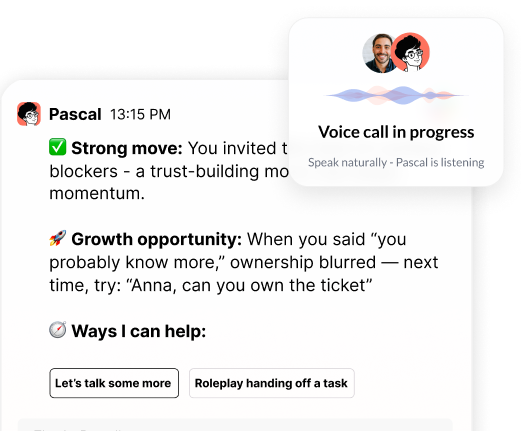
Pascal by Pinnacle exemplifies purpose-built AI coaching. Trained by certified coaches, it embeds coaching in workflow tools. It joins meetings, provides real-time feedback, and builds a persistent understanding of each manager's communication patterns and development areas.
Ask vendors these qualifying questions during evaluation:
Memory architecture: Does it remember context across conversations, or does each interaction start fresh? AI coaching maintains a persistent understanding of your team dynamics, past challenges, and development goals. Chatbots treat every conversation as new.
Proactive engagement: Does it join meetings and provide unsolicited feedback, or only respond when asked? AI coaching observes your work and offers insights based on what it sees. Chatbots wait for you to come to them.
Coaching methodology: Is it trained by certified coaches, or does it use generic LLM responses? A ChatGPT prompt asking for leadership advice is not coaching—it's advice retrieval.
Organizational customization: Can it learn your company's values, competencies, and culture, or does everyone get the same experience? AI coaching adapts to your leadership framework. Chatbots deliver one-size-fits-all responses.
Integration depth: Does it live in Slack, Teams, and Zoom, or require managers to visit a separate portal? Integration determines adoption. Tools that require context-switching see utilization rates below 20%.
Generic chatbots like ChatGPT or Microsoft Copilot lack the coaching infrastructure, organizational context, and proactive capabilities that drive behavior change. They're useful for information retrieval but ineffective for developing leadership habits.
AI coaching solves the "last mile" problem of leadership development: translating knowledge into behavior change in real work situations. Chatbots provide information. AI coaching builds habits through repetition, accountability, and contextual reinforcement over time.
New manager transitions: According to a March 2025 Fortune analysis, 60% of new managers feel unprepared. AI coaching provides continuous support during the first 90 days, not just a one-time workshop. It helps managers practice difficult conversations, receive feedback on delegation approaches, and build confidence through real scenarios.
Scaling coaching economics: Traditional executive coaching costs $15,000+ per person annually, making it accessible only to senior leaders. AI coaching costs $150–300 per person yearly, making it feasible for every manager in your organization.
Low L&D utilization: LinkedIn Learning and similar platforms see engagement rates below 20% because they require managers to remember to use them. AI coaching embedded in Slack and Teams achieves higher adoption because it meets managers where work happens.
HRBP capacity constraints: AI coaching handles routine guidance (preparing for difficult conversations, delegation strategies, recognition approaches), freeing HR business partners to focus on complex organizational issues.
Jeff Diana, former CHRO at Calendly, Atlassian, and SuccessFactors: "So much of the real learning and value comes from in-context coaching in the moment to drive performance and to solve problems in the moment." Chatbots can't deliver this because they lack contextual awareness and proactive engagement.
AI coaching delivers measurable ROI through three channels: replacement of expensive coaching programs, increased HR team leverage, and higher utilization versus low-engagement learning platforms. Chatbots may reduce support tickets but don't drive the behavior change that impacts business metrics.
Direct cost replacement: Executive coaching runs $15,000 per person annually. AI coaching costs $150–300 per person yearly. For a 500-manager organization, that's $7.5M versus $150K—a 98% cost reduction while expanding access from 20 executives to all 500 managers.
HR capacity multiplication: AI coaching saves HR teams time by handling routine manager queries, allowing HRBPs to increase span of control from 1:100 to 1:150+ employees.
Learning platform displacement: Companies spend $200–500 per employee annually on LMS platforms with under 20% utilization. AI coaching achieves higher active usage because it's embedded in workflow, not siloed in a separate system.
ROI comparison:
Data Breakdown:
• Solution Type: Traditional Coaching | Cost per User/Year: $15,000 | Typical Utilization: 100% (limited access) | Behavior Change: High | HR Time Savings: None
• Solution Type: LMS Platforms | Cost per User/Year: $200–500 | Typical Utilization: 15–20% | Behavior Change: Low | HR Time Savings: None
• Solution Type: Generic Chatbots | Cost per User/Year: $50–100 | Typical Utilization: 10–15% | Behavior Change: Minimal | HR Time Savings: Low
• Solution Type: Purpose-Built AI Coaching | Cost per User/Year: $150–300 | Typical Utilization: Higher | Behavior Change: Higher | HR Time Savings: Moderate to High
Chatbots reduce support volume but don't create the behavior change that shows up in engagement surveys, retention rates, and team performance metrics. Gail Fierstein, former CHRO at CaaStle and Goldman Sachs: "We need to define what performance and potential mean in the context of human-AI collaboration, not just traditional frameworks."
Selecting a chatbot disguised as AI coaching creates three risks: wasted budget on tools managers abandon, missed opportunity cost during the narrow adoption window, and organizational skepticism that poisons future AI initiatives.
Adoption failure: Tools that require managers to leave their workflow see 80% drop-off within 60 days. You've spent budget, created change fatigue, and have nothing to show for it. Recovery from a failed rollout takes 12–18 months.
Opportunity cost: The window for AI adoption is narrow. Early adopters who moved fast found value and built momentum. Organizations still debating strategy are losing ground daily. Choosing the wrong tool means losing another 6–12 months to procurement, implementation, and eventual replacement.
AI initiative poisoning: When your first AI coaching tool fails, managers conclude "AI coaching doesn't work" rather than "we chose the wrong tool." This skepticism spreads to other AI initiatives, making future adoption harder.
The distinction between AI coaching and chatbots isn't academic—it's the difference between transforming manager effectiveness and adding another unused license to your tech stack.
• AI coaching uses structured frameworks and organizational context to guide managers through real leadership challenges. Chatbots provide generic, reactive responses disconnected from your culture.
• AI coaching is proactive, maintains memory, and embeds in workflow—capabilities that distinguish purpose-built platforms from chatbots.
• AI coaching solves the "last mile" problem of translating knowledge into behavior change through continuous, contextual support in the flow of work.
• ROI comes from three sources: replacing expensive coaching programs (98% cost reduction), multiplying HR team capacity, and achieving higher utilization versus traditional learning platforms.
• The wrong choice creates lasting damage: wasted budget, missed opportunity during the narrow adoption window, and organizational skepticism that poisons future AI initiatives.
The difference between success and failure comes down to understanding what you're buying.
See how Pascal delivers AI coaching that managers use. Explore Pascal's approach to embedded, contextual coaching or read how leading organizations are building AI-first HR strategies.

.png)
.webp)
“Thank you for setting the great foundation for my promotion; now I have a plan!"

Curious to see how AI Coaching can 10X the impact and scale of your development initiatives. Book a demo today for: