

Disclosure: I work at Pinnacle, which builds Pascal. This guide reflects what we learned evaluating our own category, including our design decisions and their trade-offs.
AI coaching platforms succeed or fail based on three factors: whether they deliver coaching in real work moments, whether managers trust and use them, and whether they integrate with existing systems. Platforms that meet these criteria show measurable improvements within 90 days. Those that don't become shelfware.
Effective platforms deliver contextual guidance embedded in work moments, not generic advice in a separate app. The platform must understand your organization's leadership frameworks, values, and performance expectations.
The difference comes down to three architectural capabilities:
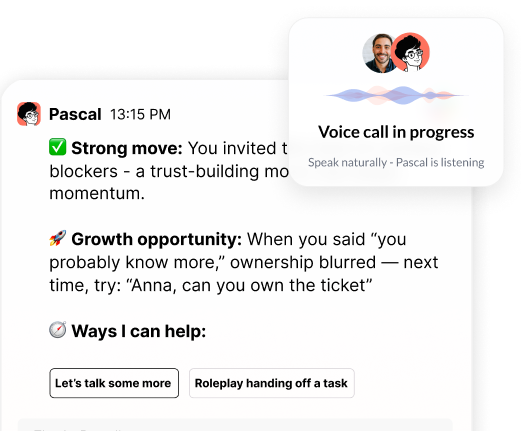
Proactive presence in workflow means the AI surfaces coaching moments in real-time through tools managers already use. When a manager struggles with delegation during a team meeting, the AI provides guidance immediately—not three days later when they log into a separate portal. At Pascal, we integrate into Slack, Teams, and Zoom rather than requiring another app.
Organizational context awareness ensures the system knows your company's competency models, values, and feedback frameworks. Generic chatbots offer universal advice that may contradict your culture. Purpose-built platforms reinforce behaviors that matter to your organization, whether that's your feedback model or your approach to performance conversations.
Relationship intelligence builds understanding of working relationships, communication patterns, and team dynamics over time. Generic chatbots lack memory of previous interactions. They can't tell you that Sarah's communication style clashes with Marcus's, or that this is the third time this quarter you've avoided a difficult conversation with your underperformer.
Data Breakdown:
• Capability: Organizational context | Generic Chatbot: Universal advice only | Purpose-Built Platform: Trained on company values, competencies, policies
• Capability: Proactive coaching | Generic Chatbot: Reactive—user must initiate | Purpose-Built Platform: Surfaces moments in real-time
• Capability: Integration depth | Generic Chatbot: Separate application | Purpose-Built Platform: Embedded in Slack, Teams, Zoom, HRIS
• Capability: Relationship awareness | Generic Chatbot: No memory of team dynamics | Purpose-Built Platform: Builds understanding of interactions over time
• Capability: Privacy & compliance | Generic Chatbot: Consumer-grade, may train on inputs | Purpose-Built Platform: SOC2 compliant, contractual guarantees
• Capability: Coaching methodology | Generic Chatbot: General AI responses | Purpose-Built Platform: Trained by certified coaches
Test platforms with real workplace scenarios that expose whether the AI delivers specific guidance or generic platitudes. Bring three scenarios to every demo: a difficult performance conversation with a struggling team member, a delegation challenge where you're unsure who to assign a critical project to, and a conflict between two high performers.
Performance conversation scenario: "I need to tell my top performer they're not ready for promotion. How do I deliver this feedback?" Watch whether the AI asks about your company's promotion criteria, performance review process, and feedback models, or just offers generic advice that ignores your organizational context.
Delegation dilemma: "I have a high-stakes project. Should I assign it to Sarah (experienced but overloaded) or Marcus (less experienced but available)?" Quality platforms ask follow-up questions about team dynamics, development goals, and project requirements. They consider both the immediate business need and long-term development opportunities.
Sensitive escalation: "My team member disclosed a mental health crisis during our 1:1." The platform should immediately recognize this requires HR involvement and provide escalation pathways—not attempt to coach through it. This reveals whether the vendor has built proper guardrails.
Culture-specific scenario: Reference a specific value or competency from your leadership framework and ask how to demonstrate it in a real situation. The platform should either know your framework or acknowledge it doesn't have that context yet. At Pascal, we train on each customer's specific values, competency models, and escalation policies during onboarding.
Request to see the platform handle ambiguous situations where the right answer depends on organizational context. Generic platforms default to universal advice. Sophisticated ones ask clarifying questions about your culture and policies before offering guidance.
Enterprise-grade AI coaching requires SOC2 Type II compliance, guaranteed data residency controls, and explicit commitments that customer data never trains the underlying AI models. These technical safeguards are table stakes for healthcare, financial services, and life sciences companies.
SOC2 Type II certification validates that the vendor has implemented and maintained security controls over time, not just at a point in time. Ask vendors for their SOC2 report and verify the certification is current. (Pascal maintains SOC2 compliance because enterprise customers in regulated industries require it.)
Data isolation guarantees ensure your organization's conversations, meeting transcripts, and coaching interactions are separated from other customers' data. Request the vendor's data architecture diagram. Consumer AI tools like ChatGPT train on user inputs unless explicitly disabled, which creates unacceptable risk for enterprise deployments. Demand contractual guarantees that your data won't train the vendor's models.
Native integrations determine adoption rates. Platforms that integrate with Slack, Teams, Zoom, and major HRIS systems deliver higher adoption than those requiring custom API work. Ask which integrations are native (built into the product) versus API-based (requiring configuration). Native integrations mean managers access coaching where work happens rather than adopting another tool.
Audit logs and admin controls give HR leaders visibility into platform usage, the ability to set organizational guardrails, and audit trails for compliance purposes. For companies in heavily regulated industries, ask vendors directly: "Will you sign a BAA (Business Associate Agreement) for HIPAA compliance?" or "Can you support data residency requirements for GDPR?"
Refusal to contractually guarantee they won't train on your data should eliminate a vendor immediately. If a vendor hedges on this question or offers vague assurances without contractual backing, walk away.
Vague ROI claims without evidence signal the vendor hasn't validated their approach. Demand specific studies showing the platform drives measurable improvements. Ask for customer references who can speak to outcomes, not just implementation experiences.
No escalation protocols for sensitive topics reveal the vendor hasn't thought through risk management. The platform must recognize when a conversation requires HR intervention—mental health disclosures, harassment allegations, discrimination concerns—and provide clear escalation pathways rather than attempting to coach through serious issues.
Resistance to customization means the platform will deliver generic advice that may contradict your culture. Effective platforms should train on your specific leadership frameworks, values, and competency models. If a vendor says "our AI already knows best practices," that's a red flag.
No certified coaching methodology suggests the vendor built a chatbot, not a coaching platform. Ask who designed their coaching models and what credentials they hold. At Pascal, our coaching models are trained by ICF-certified coaches who understand the difference between advice-giving and developmental coaching. (Trade-off: this customization extends our onboarding timeline to two weeks versus competitors' same-day deployment.)
Measurable improvements in manager effectiveness should appear within 90 days if the platform is working. Effective AI coaching platforms close the gap between deployment and behavior change through continuous, contextual guidance.
Week 1-2: Onboarding and customization. The vendor should train the AI on your leadership frameworks, values, and escalation policies. Managers complete initial setup and connect their communication tools.
Week 3-8: Active coaching and relationship building. Managers use the platform for real scenarios. The AI builds understanding of team dynamics and communication patterns. Usage metrics should show consistent engagement—at least 3-4 interactions per manager per week.
Week 9-12: Measurable outcomes. You should see improvements in specific manager behaviors: more frequent feedback conversations, better delegation practices, improved conflict resolution. (At Pascal, we track whether direct reports notice positive changes in their manager's effectiveness within this timeframe, though we acknowledge this is self-reported data from customer surveys, not controlled studies.)
Request specific metrics the vendor will track during the pilot. Vague promises of "improved engagement" aren't sufficient. Look for concrete behavioral changes: frequency of 1:1s, quality of feedback (measured through direct report surveys), delegation patterns, and conflict resolution speed.
• Test with real scenarios: Bring difficult performance conversations, delegation dilemmas, and sensitive escalation situations to vendor demos to reveal whether platforms deliver specific guidance or generic platitudes
• Demand enterprise-grade security: SOC2 Type II compliance, contractual guarantees against training on your data, and native integrations with your existing tech stack are table stakes for regulated industries
• Verify coaching methodology: Platforms trained by certified coaches deliver developmental guidance rather than advice-giving. Ask vendors about their coaching model design and credentials
• Expect 90-day results: Measurable improvements in manager effectiveness—more frequent feedback, better delegation, improved conflict resolution—should appear within three months if the platform is working
• Integration determines adoption: Platforms embedded in Slack, Teams, and Zoom achieve higher usage than standalone applications requiring separate logins
The AI coaching market is moving fast, but the fundamentals remain constant: platforms that deliver contextual guidance embedded in managers' daily workflows drive measurable outcomes. Those that require managers to remember to use them become shelfware.
See how Pascal works inside Slack, Teams, and your existing workflow at heypinnacle.com.
Header photo by Vitaly Gariev on Unsplash

.png)
.webp)
“Thank you for setting the great foundation for my promotion; now I have a plan!"

Curious to see how AI Coaching can 10X the impact and scale of your development initiatives. Book a demo today for: