

Test platforms with real workplace scenarios: difficult performance conversations, delegation challenges, conflict resolution, and sensitive topics requiring HR escalation. Effective platforms deliver specific, culture-aligned guidance. Generic tools offer surface-level advice that could apply to any company.
Critical test scenarios:
• Performance conversation prep: "I need to address consistent missed deadlines with a senior team member who's been here longer than me."
• Delegation challenge: "My team is overwhelmed, but I'm not sure which tasks I can delegate without losing quality."
• Conflict resolution: "Two of my direct reports aren't collaborating and it's impacting project delivery."
• Sensitive topic: "I'm considering terminating an employee for performance issues. What should I do?"
The last scenario reveals whether the platform has proper guardrails. Generic tools will attempt to answer. Purpose-built platforms like Pascal escalate to HR, recognizing that termination decisions require human judgment and legal review.
Ask vendors to demonstrate how their platform personalizes to your organization's leadership competencies. Request examples of how it integrates with your existing tools. Demand anonymized customer data showing measurable improvements in manager effectiveness.
Ask five critical questions: Where is customer data stored and for how long? Does the vendor train AI models on our proprietary data? What SOC2 or equivalent certifications exist? How does the platform handle sensitive topics requiring HR escalation? Can we audit data usage and access logs?
Essential data governance questions:
• Data storage and retention: "Where is our data stored, and what is your data retention policy? Can we configure zero-day retention?"
• Model training: "Do you train your AI models on our company's proprietary data? If so, how do we opt out?"
• Compliance certifications: "What security certifications do you maintain? SOC2 Type II? ISO 27001? GDPR compliance?"
• Sensitive topic handling: "How does your platform identify and escalate sensitive HR topics like harassment, discrimination, or legal issues?"
• Audit capabilities: "Can we audit data access logs? What visibility do we have into how our data is used?"
Large enterprises in financial services, healthcare, and pharmaceuticals are cautious about AI tools that record meeting information. The key is offering alternatives like integrations with existing note-taking tools that companies already approve (Zoom Companion, Microsoft Teams recording).
Pascal addresses these concerns through SOC2 compliance, zero training on customer data, configurable data retention policies, and sensitive topic escalation protocols that route complex HR issues to human judgment.
Three red flags disqualify vendors: no workflow integration requiring managers to visit separate platforms, generic responses that ignore company culture, and vague data practices without SOC2 compliance or clear retention policies.
Immediate disqualifiers:
• No workflow integration: Requires managers to leave Slack, Teams, or email to access coaching. If it's not embedded where work happens, adoption will fail within weeks.
• Generic, context-free responses: Provides the same advice to every manager regardless of company culture, team dynamics, or individual leadership style.
• Unclear data practices: Cannot articulate data retention policies, lacks SOC2 certification, or trains AI models on customer data without explicit consent.
Secondary warning signs:
• No measurable outcomes: Cannot provide customer proof points showing manager effectiveness improvements, time savings, or engagement increases
• Missing guardrails: No moderation for inappropriate content, no escalation protocols for sensitive HR topics like terminations, harassment, or legal issues
• One-size-fits-all deployment: Doesn't customize to your leadership competencies, values, or organizational structure
• Vendor lock-in without integration flexibility: Proprietary systems that don't connect to existing HR tech stack (HRIS, performance management, learning platforms)
• Unrealistic promises: Claims to "replace human coaches entirely" or "solve all leadership challenges." Effective AI coaching augments human judgment, never replaces it.
Five capabilities separate effective platforms from generic tools:
Proactive delivery: The platform surfaces guidance at decision moments, not just when managers remember to ask. This means joining meetings, providing real-time feedback, and delivering coaching in the flow of work. Managers shouldn't need to open a separate app or remember to check for advice.
Context-building over time: The platform constructs a knowledge graph (a structured record of team interactions, relationships, and communication patterns) rather than treating each conversation as isolated. This allows it to understand team dynamics, track progress on development goals, and recognize patterns in management challenges.
Personalized guidance: The platform adapts recommendations to your organization's values, leadership competencies, and culture. It doesn't deliver generic best practices from the internet. Ask vendors: "How do you customize to our specific leadership framework? Can you show examples of culture-aligned guidance?"
Workflow integration: The platform works inside Slack, Teams, Zoom, and other daily tools without requiring separate logins or platform visits. Managers receive coaching where they already work. If it requires leaving workflow, adoption will fail.
Data protection: SOC2 compliance, zero training on customer data, clear data retention policies, and sensitive topic escalation protocols. This is non-negotiable for enterprises, especially in regulated industries.
Data Breakdown:
• Capability: Delivery model | Generic Tool: Pull (manager initiates) | Purpose-Built Platform: Push + Pull (proactive + on-demand)
• Capability: Context awareness | Generic Tool: Single conversation | Purpose-Built Platform: Longitudinal knowledge graph
• Capability: Personalization | Generic Tool: Generic best practices | Purpose-Built Platform: Culture + competency-aligned
• Capability: Integration | Generic Tool: Separate platform | Purpose-Built Platform: Embedded in workflow tools
• Capability: Data governance | Generic Tool: Unclear/trains on data | Purpose-Built Platform: SOC2, zero training on customer data
As Melinda Wolfe, former CHRO at Bloomberg, Pearson, and GLG, notes: "It makes it easier not to make mistakes. It gives you frameworks to think through problems before you act."
Pascal demonstrates these capabilities through its architecture: ICF-certified coaches train the coaching models, the platform observes team interactions to build context, and it delivers guidance at a fraction of traditional coaching costs while maintaining enterprise-grade security.
Measure ROI through three categories: efficiency gains (time saved on coaching and HR queries), effectiveness improvements (manager performance and direct report satisfaction), and engagement metrics (platform adoption and sustained usage).
ROI measurement framework:
Efficiency gains:
• Hours saved per manager on coaching-related tasks
• Reduction in HR team time spent on basic manager queries
• Decreased need for external coaching spend
Effectiveness improvements:
• Manager performance ratings before and after implementation
• Direct report satisfaction and engagement scores
• Quality of performance conversations and feedback
Engagement metrics:
• Platform adoption rate across manager population
• Sustained usage over 3, 6, and 12 months
• Frequency of proactive guidance acceptance
Avoid vendors that only report vanity metrics like logins or chat volume. Demand proof points showing measurable behavior change: hours saved, performance improvements, sustained adoption rates.
Enterprise-ready platforms integrate with communication tools (Slack, Teams, Zoom), authentication systems (SSO, SAML), calendar platforms (Outlook, Google Calendar), and HR systems (HRIS, performance management, learning platforms). Basic tools require separate logins, manual data entry, and exist outside daily workflow.
Critical integration requirements:
• Communication platforms: Native integrations with Slack, Microsoft Teams, Zoom, and Google Meet that don't require managers to leave their workflow
• Authentication systems: Single sign-on (SSO) support with SAML, OAuth, and enterprise identity providers
• Calendar systems: Automatic meeting detection and scheduling integration with Outlook and Google Calendar
• HR technology stack: Connections to HRIS for organizational data, performance management systems for goals and feedback, and learning platforms for development plans
The architecture should be API-driven and modular. This means easier integration and more flexibility. However, some platforms like Zoom and Slack only allow registration of one app, so white-label implementations require creating branded versions of these integrations.
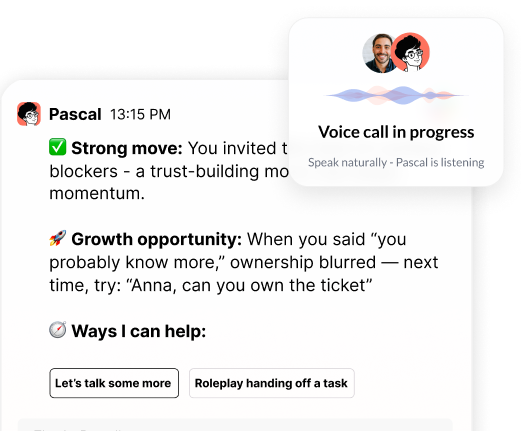
Pascal works inside the tools managers use every day (Slack, Teams, Zoom, meetings) without requiring separate platform visits or manual data entry.
• Test with real scenarios during demos: Run vendors through difficult performance conversations, delegation challenges, and sensitive topics to reveal whether they deliver specific guidance or surface-level advice
• Five capabilities define effective platforms: Proactive delivery, context-building over time, personalized guidance, workflow integration, and data protection separate transformative platforms from generic tools
• Three red flags disqualify vendors: No workflow integration, generic responses ignoring company culture, and unclear data practices without SOC2 compliance
• Data governance is non-negotiable: Demand clear answers on data storage, retention policies, model training practices, compliance certifications, and sensitive topic escalation protocols
• Measure ROI through three categories: Efficiency gains (time saved), effectiveness improvements (manager performance), and engagement metrics (sustained adoption rates)
Pascal by Pinnacle embeds AI coaching directly into Slack, Teams, and meetings, delivering real-time guidance at the moments that matter. ICF-certified coaches train our models, we never train on your data, and we maintain SOC2 compliance. See how Pascal works inside your workflow.
Header photo by Md Ishak Rahman on Unsplash

.png)
.webp)
“Thank you for setting the great foundation for my promotion; now I have a plan!"

Curious to see how AI Coaching can 10X the impact and scale of your development initiatives. Book a demo today for: