

AI coaching works when it joins meetings as a participant, observes real interactions, and delivers feedback immediately after. The most effective implementations embed directly into Zoom, Teams, and Google Meet rather than requiring separate tools.
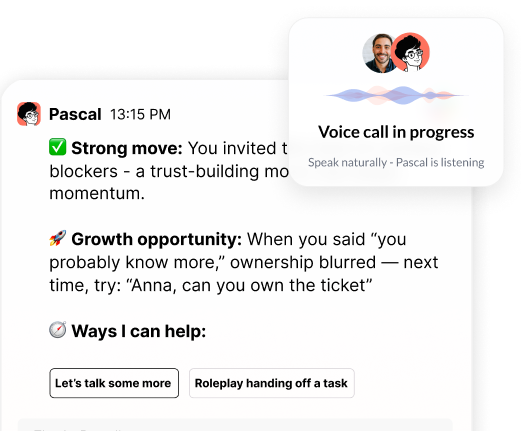
The AI coach attends meetings as a silent participant, analyzes leadership behaviors, and provides feedback within minutes. Research from Gartner's 2024 HR Technology Survey found that workflow-embedded coaching tools maintain 68% sustained usage, compared to 12% for standalone portals requiring manual login.
The system connects through calendar integration, automatically joining scheduled meetings. It analyzes communication patterns, delegation effectiveness, and speaking time distribution. Managers receive insights via Slack or Teams within 5–10 minutes.
The technology builds contextual memory of team dynamics, individual communication styles, and ongoing projects. This enables suggestions for pre-meeting prep based on past interactions.
Integration Model Comparison (Gartner HR Tech Survey, 2024):
Data Breakdown:
• Integration Type: Meeting-Embedded | Manager Effort: None (automatic) | Adoption After 90 Days: 68% | Measurable Behavior Change: Yes (direct report surveys)
• Integration Type: Standalone Portal | Manager Effort: High (manual login) | Adoption After 90 Days: 12% | Measurable Behavior Change: Minimal
• Integration Type: Chatbot-Only | Manager Effort: Medium (must initiate) | Adoption After 90 Days: 23% | Measurable Behavior Change: No (lacks observation)
Most AI coaching tools fail because they require managers to manually input context and operate outside existing workflows. A 2024 study by the NeuroLeadership Institute found that tools requiring separate logins see 85% abandonment within 30 days.
The context gap proves fatal. Chatbot platforms lack visibility into actual meeting dynamics, team relationships, or communication patterns. Without observing real interactions, AI provides advice that feels irrelevant.
Workflow friction compounds the problem. Requiring managers to leave Slack or Teams to access coaching creates immediate abandonment. Coaching delivered days later (or only when requested) misses the moment when behavior change is most likely to stick.
Jeff Diana, former CHRO at Calendly and Atlassian, notes in his 2023 Harvard Business Review article: "Real learning comes from in-context coaching—solving problems in the moment, not in a classroom."
Start with a pilot group of 15–25 managers, integrate into their existing meeting tools, and focus on one behavioral competency before expanding. Research from MIT Sloan's 2024 Leadership Development study shows focused pilots drive 18% average improvement in manager effectiveness scores.
Week 1–2: Pilot Selection
Choose managers who are early adopters, have regular team meetings, and represent diverse functions. Avoid starting with skeptics or managers in crisis situations.
Week 2: Calendar Integration
Connect the AI coach to meeting platforms via OAuth. Modern solutions integrate directly with Zoom, Teams, and Google Meet through standard calendar APIs. Managers see the AI coach appear as a meeting participant.
Week 3–4: Competency Focus
Define 1–2 leadership behaviors to improve, tied to your existing competency framework. Common starting points include delegation clarity, feedback quality, or meeting facilitation. Narrow focus drives faster results.
Week 4–6: Feedback Calibration
Review initial AI coaching outputs with HR and L&D to ensure alignment with company culture. Adjust the coaching tone, terminology, and behavioral frameworks to match your organization's leadership philosophy.
Week 8+: Expansion Planning
Use pilot data (usage rates, manager feedback, direct report observations) to refine your rollout strategy.
Critical Success Factors:
Transparency matters. Managers must understand what the AI observes and how data is used. SOC2 compliance and commitments never to train on customer data build trust. Provide opt-in controls allowing managers to exclude specific meetings, particularly sensitive HR conversations.
Build guardrails that flag sensitive topics (harassment, discrimination, mental health crises) for HRBP review. AI coaching should enhance human support, not replace it.
AI coaching observes and improves delegation clarity, speaking time distribution, meeting facilitation, feedback quality, and inclusive communication patterns. A 2024 study by the Center for Creative Leadership found that real-time feedback on these behaviors drives 2.3x faster skill development than quarterly training workshops.
Delegation Effectiveness
AI flags vague task assignments and suggests SMART goal framing. After a 1:1 meeting, managers receive feedback like: "You assigned Sarah the Q2 report but didn't specify the deadline, success criteria, or decision authority. Consider clarifying: What does done look like? When do you need it? What decisions can she make independently?"
Speaking Time Distribution
The system detects speaking time imbalances. If one team member speaks 60% of the time while others contribute minimally, the AI prompts: "In today's team meeting, three people didn't speak. Consider starting next week's meeting with a round-robin check-in to ensure all voices are heard."
Feedback Quality
AI identifies missed coaching moments and suggests Situation-Behavior-Impact framework application. When a manager says "good job" without specificity, the coaching nudge recommends: "Your praise to Marcus was positive but vague. Try: 'Marcus, when you presented the customer data yesterday, your clear visualizations helped the team make a faster decision. That saved us a week.'"
Meeting Facilitation
The platform tracks agenda adherence, decision-making clarity, and action item assignment. Meetings that drift off-topic or end without clear next steps trigger guidance on timeboxing discussions and documenting decisions.
Inclusive Communication
AI monitors who speaks, who gets interrupted, and whose ideas receive credit. If a team member's suggestion is repeated by someone else and attributed differently, the system flags the pattern and suggests acknowledgment practices.
Track three categories: leading indicators (usage and engagement), behavioral outcomes (manager skill development), and business results (team performance and retention). A 2024 Bersin by Deloitte study found that organizations measuring all three categories prove ROI within 90 days.
Leading Indicators (Weeks 1–4)
Monitor weekly active users, meetings observed per manager, and feedback engagement rates. Healthy implementations show 70%+ of pilot managers using the tool weekly and reading 80%+ of coaching messages. Low engagement signals integration problems or trust issues requiring immediate attention.
Behavioral Outcomes (Months 2–3)
Measure manager skill development through direct report pulse surveys, 360-degree feedback changes, and self-assessment progress. Ask direct reports: "Has your manager's delegation clarity improved?" "Do you feel more heard in team meetings?" Track month-over-month trends rather than absolute scores.
Business Results (Months 3–6)
Connect AI coaching to team performance metrics, voluntary turnover rates, and promotion readiness. Link these outcomes to specific coaching interventions to prove causation.
Measurement Framework:
Data Breakdown:
• Metric Category: Leading Indicators | Example Measures: Weekly active users, feedback read rates | Data Source: Platform analytics | Target Timeline: Weeks 1–4
• Metric Category: Behavioral Outcomes | Example Measures: Delegation clarity scores, speaking time equity | Data Source: Direct report surveys | Target Timeline: Months 2–3
• Metric Category: Business Results | Example Measures: Manager effectiveness scores, team engagement, retention | Data Source: HRIS, performance data | Target Timeline: Months 3–6
Enterprise AI coaching requires SOC2 compliance, user-level data isolation, and explicit policies preventing customer data from training AI models. A 2024 Gartner survey found that 73% of employees refuse to use AI coaching tools without these safeguards.
Data Protection Standards
Look for vendors with SOC2 Type II certification, GDPR compliance, and explicit contractual commitments never to use your data for model training. Verify that one customer's information never influences another customer's AI coaching.
User Control and Transparency
Managers must control what meetings the AI observes. Provide clear opt-out mechanisms for sensitive conversations (performance improvement plans, termination discussions, personal crises). Display the AI's presence visibly in meeting participant lists so everyone knows observation is occurring.
Sensitive Topic Escalation
Build guardrails that detect and escalate topics requiring human expertise: harassment allegations, discrimination claims, mental health crises, legal concerns. AI coaching should flag these situations for HRBP review rather than attempting to handle them algorithmically.
Anonymized Organizational Insights
The most sophisticated platforms aggregate meeting data to provide leadership with anonymized insights about company culture, communication patterns, and skill gaps without exposing individual manager performance.
• Meeting-embedded AI coaching drives 68% sustained adoption (Gartner, 2024) compared to standalone tools that see 12% usage after 30 days, because it eliminates workflow friction.
• Start with a focused pilot of 15–25 managers targeting one behavioral competency (delegation, feedback quality, or speaking time equity) before expanding.
• AI coaching observes five behaviors: delegation clarity, speaking time distribution, feedback quality, meeting facilitation, and inclusive communication. All are measurable through direct report surveys.
• Measure impact across three categories: leading indicators (usage rates), behavioral outcomes (skill development), and business results (team performance and retention) to prove ROI within 90 days.
• Enterprise-grade security requires SOC2 compliance, user-level data isolation, and explicit policies preventing customer data from training AI models, plus guardrails that escalate sensitive topics to human HRBPs.
For CHROs evaluating AI coaching platforms, request vendor case studies with named customers, independent third-party validation of effectiveness claims, and detailed technical documentation of privacy safeguards before piloting.
Header photo by Vitaly Gariev on Unsplash

.png)
.webp)
“Thank you for setting the great foundation for my promotion; now I have a plan!"

Curious to see how AI Coaching can 10X the impact and scale of your development initiatives. Book a demo today for: