

Full disclosure: I work at Pinnacle, which builds Pascal, a purpose-built AI coaching platform. This piece draws on our research and customer data. I'll cite competing platforms where relevant and flag where I'm relying on our own findings.
Purpose-built AI coaching platforms maintain higher engagement (Pascal shows 94% monthly retention) through specialized coaching expertise and contextual awareness, while embedded tools achieve faster initial adoption but typically see engagement drop within months. The question isn't which is "better" — it's which fits your organization's needs, constraints, and manager population.
Purpose-built AI coaching platforms are designed as coaching systems grounded in behavioral science and leadership development frameworks. Embedded AI coaching refers to general-purpose AI capabilities added to existing HR platforms, LMS systems, or productivity tools.
Purpose-built solutions like Pascal integrate ICF-certified coaching methodologies (ICF is the International Coaching Federation, the main credentialing body for professional coaches) and maintain contextual awareness of your organization's competencies, culture, and individual development needs. Embedded tools offer conversational interfaces without the specialized coaching architecture required to drive sustained behavior change.
The architectural difference shows up in outcomes. According to Cloverleaf's 2024 analysis of AI coaching platforms (https://cloverleef.me/blog/best-ai-coaching-platforms-for-managers-and-teams), purpose-built platforms maintain engagement rates above 90% through behavioral science expertise, while embedded solutions see usage drop after initial curiosity fades.
Key architectural distinctions:
Data Breakdown:
• Element: Coaching expertise | Purpose-Built: ICF-certified frameworks | Embedded: General conversational AI
• Element: Contextual memory | Purpose-Built: Persistent knowledge graph | Embedded: Session-based or none
• Element: Engagement model | Purpose-Built: Proactive nudges | Embedded: Reactive responses
• Element: Integration depth | Purpose-Built: Native workflow embedding | Embedded: Feature within existing platform
• Element: Behavior change focus | Purpose-Built: Core design principle | Embedded: Secondary consideration
Purpose-built platforms train their models on coaching conversations and leadership development research. They understand the difference between coaching (asking questions to help someone reach their own conclusions), mentoring (sharing experience to guide decisions), and advising (providing direct recommendations). Embedded tools apply general AI capabilities to coaching use cases without this specialized training.
The contextual depth matters most. Purpose-built systems build knowledge graphs (structured databases of relationships between people, meetings, conversations, and development goals) of team dynamics, meeting patterns, and individual development trajectories. They remember what happened in your 1:1 yesterday and can reference specific conversations. Embedded tools lack this persistent memory, forcing managers to repeatedly explain context.
Purpose-built AI coaching platforms maintain higher session frequency because they meet managers in their existing workflow and provide contextually relevant guidance tied to actual work situations. Pascal shows 2.3 coaching sessions per week with 94% monthly retention (source: https://www.heypinnacle.com/blog/what-are-the-differences-in-engagement-and-outcomes-between-purpose-built-and-embedded-ai-coaching). Embedded AI coaching tools see initial adoption spikes during launch but engagement typically drops within three to six months as managers revert to familiar workflows.
The engagement gap stems from friction. Embedded tools require managers to remember to visit a separate portal, navigate to the AI feature, and explain their situation without context. Purpose-built platforms eliminate this friction by integrating into Slack, Teams, and Zoom — the tools managers already use daily.
Melinda Wolfe, former CHRO at Bloomberg and Pearson, notes that democratizing coaching requires making it "specific, timely, and integrated into real workflows" to solve chronic workplace issues. Purpose-built platforms deliver on this promise through zero-friction access.
Why embedded tools struggle with sustained engagement:
Managers must context-switch to a separate platform or feature. They receive generic advice without knowledge of team dynamics or organizational culture. No proactive engagement means coaching only happens when managers remember to ask. Competing priorities within the host platform (performance reviews, learning modules, policy questions) dilute focus on coaching.
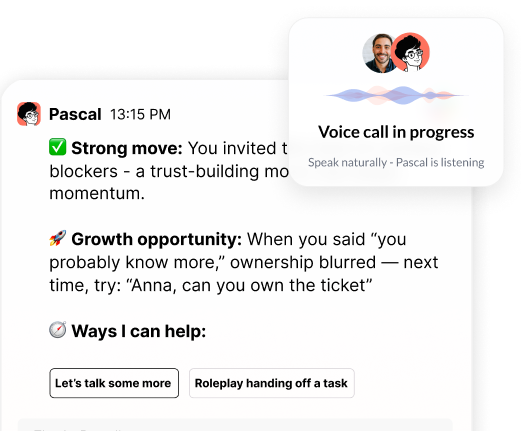
Pascal addresses this by embedding directly into communication platforms while maintaining purpose-built coaching intelligence. In Pinnacle's customer data, managers using Pascal report saving 2-3 hours per week on coaching-related tasks through proactive, contextually aware guidance that happens in the flow of work.
CHROs should evaluate five dimensions: coaching expertise depth, contextual awareness capabilities, integration into manager workflows, guardrails for sensitive topics, and measurable behavior change outcomes. The strongest indicator of effectiveness is whether the platform drives sustained behavior change (measured through direct report feedback, manager Net Promoter Score improvements, and performance review quality) rather than just engagement metrics or user satisfaction scores.
Does the platform incorporate ICF-certified coaching methodologies? Can it differentiate between coaching, mentoring, and advising situations? Does it adapt coaching style based on individual development needs?
Purpose-built platforms train on coaching frameworks and leadership development research. They understand when to ask questions versus when to provide direct guidance. Embedded tools apply general conversational AI without this specialized training.
Does the coach know your organizational competencies, values, and culture? Can it reference specific meetings, conversations, or team dynamics? Does it understand individual performance history and development goals?
The difference between "you should give more feedback" and "in yesterday's 1:1 with Sarah, you missed an opportunity to acknowledge her work on the Q4 presentation" is the difference between generic advice and actionable coaching.
Where does coaching happen — in a separate portal or embedded in daily tools? Does the coach proactively engage or wait to be asked? How many steps does a manager take to get coaching support?
Purpose-built platforms can A/B test nudges, experiment with habit formation techniques, and continuously optimize coaching effectiveness. They move faster than embedded solutions, which are bound by release cycles that lag behind the pace of behavioral learning (source: https://www.heypinnacle.com/feature-blog/the-ai-coaching-architecture-decision-embedded-vs-purpose-built-2026).
How does the platform handle sensitive topics like harassment, discrimination, or mental health? What escalation protocols exist for situations requiring human HR expertise? Is the system SOC2 compliant with appropriate data handling?
Purpose-built coaching platforms include moderation flags for sensitive topics and escalation protocols to HR when appropriate. When a manager discusses a potential harassment situation, the system flags it for HR review rather than providing coaching advice. Embedded tools lack these workplace-specific guardrails.
What leading indicators predict behavior change? What lagging indicators demonstrate impact? How does the platform measure coaching effectiveness beyond usage metrics?
Pascal demonstrates this effectiveness through an 83% improvement rate in direct report feedback scores (measuring whether direct reports report improved 1:1 quality, feedback frequency, and development conversations) and 20% increase in manager NPS (source: Pinnacle customer data, https://www.heypinnacle.com/blog/what-are-the-differences-in-engagement-and-outcomes-between-purpose-built-and-embedded-ai-coaching).
Embedded AI coaching features launch faster (within weeks) because they're added to platforms already deployed in your organization, while purpose-built solutions require 4-8 weeks for integration, customization, and change management. However, purpose-built platforms reach sustained adoption faster because they're designed for the coaching use case from the ground up, while embedded tools face ongoing adoption challenges that extend the time to value.
Embedded tools promise faster deployment because they're already part of your tech stack. You enable a feature, announce it to managers, and start tracking usage. Purpose-built platforms require integration with your HRIS, performance management systems, and communication tools. They need customization to your competencies, values, and culture.
But faster launch doesn't mean faster value. Embedded tools see initial curiosity-driven usage that drops within months. Purpose-built platforms invest upfront in integration and customization, then maintain sustained engagement that drives measurable behavior change.
Purpose-built platforms require deeper integration but deliver persistent value. They connect to your HRIS for performance data, your communication platforms for contextual awareness, and your organizational frameworks for relevant guidance. This integration work pays dividends through sustained engagement.
Embedded tools avoid integration complexity but sacrifice contextual awareness. They can't reference specific meetings, team dynamics, or organizational competencies. The reduced friction at launch becomes increased friction in daily use.
CHROs should track three categories of metrics: adoption and engagement (active users, session frequency, time to first value), leading indicators of behavior change (feedback quality scores, 1:1 consistency, development conversation frequency), and lagging outcome measures (direct report satisfaction, manager NPS, performance review quality, promotion readiness). Purpose-built platforms show stronger performance on leading indicators within 90 days and measurable outcome improvements within six months.
The ROI conversation starts with cost per user. Embedded tools appear cheaper because they're bundled with existing platforms. Purpose-built solutions charge separately. But cost per user ignores the real question: cost per behavior change.
Adoption and engagement metrics:
Track active users weekly, not just at launch. Monitor session frequency (how often do managers use the coaching?). Measure time to first value (how quickly do new users find the platform helpful enough to return?).
Pascal maintains 94% monthly retention. In Pinnacle's customer research, embedded tools see engagement drop to 10-20% within months. The cost per engaged user tells a different story than the cost per licensed user.
Leading indicators of behavior change:
Measure feedback quality through direct report surveys. Track 1:1 consistency (are managers holding regular conversations?). Monitor development conversation frequency (are managers discussing growth with their teams?).
These leading indicators predict downstream outcomes. They show whether coaching is changing behavior before that behavior change shows up in performance reviews or engagement scores.
Lagging outcome measures:
Track direct report satisfaction scores. Monitor manager NPS (would your managers recommend the coaching to peers?). Measure performance review quality through calibration consistency and development plan specificity. Assess promotion readiness through succession planning metrics.
CHROs should run parallel pilots with 20-30 managers in each cohort, measuring identical metrics across both solutions for 90 days. Select cohorts with similar experience levels, team sizes, and baseline performance to isolate the impact of the coaching approach. Track weekly engagement, monthly behavior change indicators, and direct report feedback to identify which solution drives sustained adoption and measurable outcomes.
The pilot structure determines what you learn. Sequential pilots (test one solution, evaluate it, then test another) introduce confounding variables. Market conditions change. Organizational priorities shift. Manager cohorts differ in ways that affect outcomes.
Parallel pilots control for these variables. You test both approaches simultaneously with comparable manager populations. You measure identical metrics. You learn which solution drives behavior change in your environment.
Pilot design considerations:
Select cohorts carefully. Match experience levels (don't compare new managers using one solution with senior leaders using another). Control for team size (managers with three direct reports face different challenges than those with fifteen). Consider baseline performance (mix high and low performers in each cohort).
Define success metrics upfront. What constitutes sustained engagement? What behavior changes matter most? How will you measure direct report impact? Agree on these metrics before launch to avoid post-hoc rationalization.
Track leading indicators weekly. Don't wait 90 days to discover one solution isn't working. Monitor active usage, session frequency, and user feedback continuously.
Collect qualitative feedback. Numbers tell part of the story. Manager interviews reveal why engagement patterns emerge. Direct report focus groups show whether coaching translates to better leadership.
The hidden costs include ongoing change management to drive adoption, lost productivity from managers seeking coaching elsewhere, opportunity cost of delayed behavior change, and potential need to implement a purpose-built solution anyway. Organizations that choose embedded solutions spend 12-18 months discovering engagement limitations before investing in purpose-built alternatives, paying twice for AI coaching while delaying the manager effectiveness gains they need.
The sticker price comparison favors embedded solutions. They're bundled with existing platforms. No separate procurement. No additional vendor relationship. The finance team sees lower incremental cost.
But the total cost of ownership tells a different story. Embedded tools require continuous promotion to maintain awareness. Managers forget the feature exists. HR teams run campaigns, create resources, and host training sessions to drive usage. This ongoing change management has a cost.
Productivity costs:
Managers still need coaching. When the embedded tool doesn't provide contextual guidance, they seek help elsewhere. They schedule meetings with HR business partners. They reach out to external coaches. They spend time explaining context that a purpose-built platform would already know.
These productivity costs don't appear in the AI coaching budget. They're distributed across HR operations, manager time, and delayed decision-making.
Opportunity costs:
Every month of low engagement is a month of missed behavior change. Managers continue giving vague feedback. 1:1s remain inconsistent. Development conversations don't happen. The opportunity cost of delayed improvement compounds over time.
Purpose-built platforms deliver measurable behavior change within 90 days. Embedded tools take 12-18 months to reach similar adoption (if they ever do). The opportunity cost of that delay exceeds the price difference between solutions.
The answer depends on your constraints and priorities. If you need a solution deployed in weeks, have limited budget, and want to test AI coaching with low commitment, embedded tools offer a reasonable starting point. If you need measurable behavior change, sustained engagement, and are willing to invest in integration and customization, purpose-built platforms deliver stronger outcomes.
The strongest implementations combine purpose-built coaching intelligence with embedded delivery into existing workflows like Slack, Teams, and Zoom. This approach delivers specialized coaching expertise without requiring managers to adopt new tools.
• Purpose-built AI coaching platforms maintain higher engagement through specialized coaching expertise and contextual awareness, while embedded tools see engagement drop within months
• The five critical evaluation dimensions are coaching expertise depth, contextual awareness capabilities, workflow integration, guardrails for sensitive topics, and measurable behavior change outcomes
• Parallel pilots with 20-30 managers per cohort, measuring identical metrics for 90 days, provide the clearest comparison between approaches
• Hidden costs of embedded solutions include ongoing change management, lost productivity from managers seeking coaching elsewhere, and opportunity costs of delayed behavior change
• The right choice depends on your constraints: embedded tools offer faster deployment and lower upfront cost; purpose-built platforms deliver stronger behavior change outcomes
Pascal delivers purpose-built coaching intelligence where your managers already work (in Slack, Teams, and meetings). The platform maintains 94% monthly retention through ICF-certified coaching expertise and contextual awareness of your people, culture, and organizational goals.
See how Pascal scales coaching across your organization
Header photo by Compagnons on Unsplash

.png)
.webp)
“Thank you for setting the great foundation for my promotion; now I have a plan!"

Curious to see how AI Coaching can 10X the impact and scale of your development initiatives. Book a demo today for: