

AI coaching comes in two forms: purpose-built platforms designed exclusively for manager development, and features added to existing HR tools. The difference matters because where coaching lives determines whether managers use it. This guide shows you how to evaluate both options for your organization.
Purpose-built platforms are standalone systems architected for manager development. They're trained on coaching methodologies, integrate across your tech stack, and live in the tools managers already use.
Embedded AI coaching consists of features added to existing HR platforms (performance management systems, learning management systems, HRIS tools). These provide AI-powered suggestions within those environments.
The architectural difference shapes what's possible. Purpose-built solutions can observe behavior across meetings, communications, and interactions. Embedded features typically access only data within their parent platform.
Key distinctions:
Data Breakdown:
• Dimension: Architecture | Purpose-Built: Standalone coaching system | Embedded: Feature in existing HR platform
• Dimension: Data Access | Purpose-Built: Cross-platform (meetings, messaging, calendar) | Embedded: Limited to parent system
• Dimension: User Experience | Purpose-Built: Lives in workflow (Slack, Teams, meetings) | Embedded: Requires platform login
• Dimension: Integration | Purpose-Built: Multiple systems | Embedded: Single platform ecosystem
• Dimension: Development Priority | Purpose-Built: Coaching effectiveness | Embedded: Competes with core platform features
Managers won't use tools that require extra steps. If coaching lives where work happens (Slack, Teams, meetings), it becomes a habit. If it requires logging into a separate platform, engagement drops.
Melinda Wolfe, former CHRO at Bloomberg, Pearson, and GLG: "If we can finally democratize coaching, make it specific, timely, and integrated into real workflows, we solve one of the most chronic issues in the modern workplace."
Adoption patterns vary by integration type:
• Workflow-embedded coaching (Slack, Teams, meeting companions) sees higher sustained adoption
• Platform-embedded features get fast initial adoption (managers already use the parent system) but steep drop-off when coaching requires context-switching
• Standalone portals see lowest sustained engagement unless mandated
Questions to ask:
Does the coach join your managers' meetings, or do they recreate scenarios in a separate environment? Can managers get coaching without leaving their current tool? Does the solution require manual context input, or does it observe real interactions?
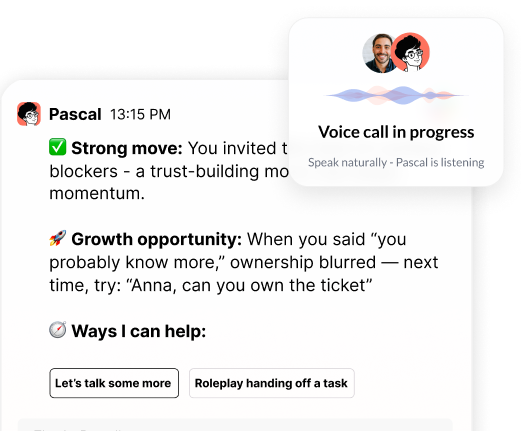
Pascal by Pinnacle lives in Slack and Teams, and joins Zoom and Google Meet calls to provide real-time feedback. This eliminates the friction that kills adoption. (Full disclosure: this guide is published by Pinnacle, Pascal's parent company.)
Context means the AI understands your people, their goals, their interactions, and your organizational culture. Without it, coaching feels generic.
Purpose-built platforms can build knowledge from meetings, communications, and performance data. Embedded features typically access only profile fields and form responses within their parent system.
Jeff Diana, former CHRO at Calendly, Atlassian, and SuccessFactors: "So much of the real learning and value comes from in-context coaching in the moment to drive performance and solve problems in the moment."
Four layers of context:
• Individual: Role, goals, performance history, communication patterns
• Organizational: Company values, competencies, cultural norms, leadership frameworks
• Real-time behavioral: Meeting dynamics, communication style, decision-making patterns
• Temporal: Performance review cycles, goal-setting seasons, organizational changes
Evaluation framework:
Can the platform observe behavior across multiple systems (calendar, email, meetings, messaging)? Or is it confined to data within a single platform? Managers trust coaching that references their actual challenges.
Pascal joins meetings, integrates with Slack and Teams, and builds a knowledge graph of interactions. This lets it provide feedback on real conversations rather than hypothetical scenarios.
The methodology determines whether the platform can handle complex situations or only surface-level questions. Purpose-built platforms trained by certified coaches on established frameworks provide structured guidance for difficult conversations, performance issues, and leadership development. Generic AI tools may provide plausible-sounding advice that lacks necessary nuance.
Methodology criteria:
• Training foundation: Was the AI trained by certified coaches on coaching frameworks, or does it apply general AI to HR topics?
• Sensitive topic handling: Does the platform have guardrails and escalation protocols for situations requiring human expertise?
• Framework integration: Can it apply specific coaching models (GROW, situational leadership, feedback frameworks) to real scenarios?
• Continuous learning: Does the vendor update coaching models based on new research and outcomes?
Pascal's coaching models are trained by ICF-certified coaches and include moderation flags, sensitive topic escalation, and organization-specific controls. This ensures appropriate human expertise gets involved when needed.
Proactive coaches join meetings, monitor interactions, and surface coaching moments. Reactive tools wait for managers to ask questions. The difference determines whether your investment builds consistent development habits or just provides crisis support.
Taylor Malmsheimer, COO of Section, identifies proactive engagement as critical for adoption. Managers don't know what they don't know. Waiting for them to recognize coaching moments means missing most development opportunities.
Proactive capabilities:
• Joining calls to provide feedback on real interactions
• Identifying recurring challenges across multiple interactions
• Surfacing relevant coaching before critical moments (performance reviews, difficult conversations)
• Following up on training with in-the-moment application support
Reactive limitations:
Managers must recognize they need help, context-switch to a coaching tool, explain the situation, and apply advice back to their workflow. This friction means coaching happens only during crises.
Pascal proactively joins meetings and provides real-time feedback, creating coaching moments that reactive tools miss.
Enterprise AI coaching requires integration with your existing systems: HRIS, performance management, learning platforms, calendar, email, and messaging tools. Purpose-built platforms offer API-driven architectures designed for multi-system integration. Embedded features are typically limited to their parent platform's ecosystem.
Integration determines whether your AI coach can access the context needed for personalized guidance. A coach that integrates only with your performance management system sees annual review data but misses daily interactions where managers need help.
Critical integration points:
• Calendar systems (meeting schedules, participants, context)
• Messaging platforms (Slack, Teams for in-workflow coaching)
• Video conferencing (Zoom, Google Meet, Teams for meeting observation)
• HRIS and performance systems (employee data, goals, competencies, review cycles)
• Learning platforms (training completion, development plans, skill assessments)
Questions to ask:
Does the vendor offer pre-built integrations with your core systems? Is the platform API-driven to support custom integrations? Can it operate across multiple systems simultaneously?
Pascal's API-driven architecture supports integration with Zoom, Slack, Microsoft Teams, calendar systems, and HRIS platforms. The modular design connects with your existing tech stack rather than requiring system replacement.
AI coaching tools without proper guardrails create risk when managers face situations requiring human expertise: harassment claims, mental health concerns, legal issues, or termination decisions. Purpose-built platforms include moderation systems, sensitive topic detection, and escalation protocols. Many embedded features lack these protections because they weren't designed specifically for workplace coaching.
Managers will ask AI coaches about every workplace situation they face. Without proper controls, generic AI tools may provide advice on topics where they shouldn't.
Essential guardrails:
• Sensitive topic detection (harassment, discrimination, mental health, legal matters)
• Escalation protocols (routing sensitive situations to appropriate human resources)
• Moderation systems (preventing inappropriate advice or responses)
• Organization-specific controls (defining boundaries for your context)
Risk assessment:
What happens when a manager asks about terminating an employee? How does the system handle questions about mental health or harassment? Can you customize boundaries based on your organization's policies?
Pascal includes moderation flags, sensitive topic escalation, and organization-specific controls. When situations require human expertise, Pascal routes them appropriately rather than attempting AI-generated advice on matters demanding professional HR judgment.
Vendor claims require scrutiny. Look for specific proof points: retention rates, behavior change metrics, time savings, and customer testimonials with measurable outcomes.
Critical proof points to request:
• Sustained engagement (monthly active usage rates beyond 90 days)
• Behavior change (measurable improvements in feedback quality, 1:1 effectiveness, or team engagement)
• Time efficiency (hours saved per manager through AI coaching vs. traditional methods)
• Business outcomes (impact on retention, promotion readiness, or team performance)
• Customer validation (testimonials with specific, quantifiable results)
Ask vendors for data on these metrics. Generic statements like "improves manager effectiveness" mean nothing without specific measurements.
• Purpose-built platforms are architected for coaching; embedded features add AI to existing tools. The difference shows up in adoption and impact.
• Workflow integration determines whether managers use coaching consistently. Tools that live in Slack, Teams, and meetings see higher sustained usage than standalone platforms.
• Context separates trusted guidance from generic advice. Purpose-built systems observe real behavior across meetings and communications; embedded features access only parent platform data.
• Proactive engagement drives behavior change. Coaches that join meetings and surface coaching moments create development opportunities that reactive tools miss.
• Guardrails and escalation protocols de-risk AI adoption. Purpose-built platforms include sensitive topic detection and human escalation; many embedded features lack these protections.
The choice between purpose-built and embedded AI coaching determines whether your investment scales manager effectiveness or becomes another underutilized tool. Evaluate both options against your organization's needs, existing tech stack, and risk tolerance.
See how Pascal works inside Slack, Teams, and meetings at heypinnacle.com.
Header photo by Jarred Manasse on Unsplash

.png)
.webp)
“Thank you for setting the great foundation for my promotion; now I have a plan!"

Curious to see how AI Coaching can 10X the impact and scale of your development initiatives. Book a demo today for: