

Purpose-built AI coaching platforms are designed exclusively for leadership development with coaching-specific models, organizational context, and workflow integration. Embedded solutions add general AI features to existing HR or productivity tools. Purpose-built systems deliver measurable behavior change because they understand your people, culture, and the moments when guidance matters most. Embedded solutions offer convenience but lack the contextual depth that drives manager effectiveness.
Purpose-built AI coaching platforms architect every component—data models, coaching frameworks, integration strategy, and user experience—specifically for leadership development. These systems use coaching-specific language models trained on management scenarios, integrate with HRIS and performance systems to understand organizational context, and embed into workflow tools where managers work.
Embedded solutions add general-purpose AI (ChatGPT, Microsoft Copilot) as a feature to existing tools—your LMS, HRIS, or productivity suite. These systems rely on the AI's general knowledge rather than coaching-specific training, access only the data within their host platform, and require managers to remember to use them.
The architectural choice determines whether your AI coach understands "How do I give feedback to Sarah about her presentation?" versus needing managers to explain who Sarah is, what presentation, what their relationship is, and what feedback principles your company values.
Architectural Comparison
Data Breakdown:
• Dimension: AI Model | Purpose-Built: Coaching-specific, trained by certified coaches | Embedded: General-purpose (ChatGPT, Copilot)
• Dimension: Organizational Context | Purpose-Built: Deep (HRIS, performance, 360s, competencies) | Embedded: Limited (host platform data only)
• Dimension: Engagement Model | Purpose-Built: Proactive (surfaces insights automatically) | Embedded: Reactive (wait for user to ask)
• Dimension: Workflow Integration | Purpose-Built: Multi-platform (Slack, Teams, Zoom, Meet) | Embedded: Single platform (host tool only)
• Dimension: Memory Architecture | Purpose-Built: Persistent knowledge graph of people and patterns | Embedded: Session-based or limited history
• Dimension: Guardrails | Purpose-Built: Workplace-specific escalation protocols | Embedded: Generic content moderation
Start by assessing three dimensions: your manager effectiveness gaps, your existing technology ecosystem, and your organizational readiness for AI adoption.
Manager effectiveness assessment: Identify specific behaviors that need to change. Are managers struggling with feedback quality, 1:1 effectiveness, delegation, or difficult conversations? How many managers need development—50 or 500? Do you need real-time guidance during meetings or post-hoc reflection after the fact?
Technology ecosystem evaluation: What's your primary communication platform—Slack, Teams, or email? Where do managers spend their time—meetings, messaging, or project management tools? What HR systems hold performance and development data (Workday, BambooHR, Lattice, Culture Amp)? How mature is your HR tech stack—integrated or fragmented? Do you have API access and integration capabilities?
Organizational readiness factors: Who champions new tools in your organization—HR, IT, or business leaders? What's your change management capacity? How do employees respond to new technology? What's your budget flexibility?
Choose purpose-built when you need measurable manager behavior change, have 200+ managers, can invest in integration, and want to lead AI adoption in your industry. Choose embedded when you're testing AI coaching viability, have fewer than 100 managers, need quick proof-of-concept, or must work within existing tool budgets. Consider hybrid when you want to pilot with embedded, then scale with purpose-built once you've proven value.
Contextual awareness means your AI coach knows who your people are, what they're working on, how they interact, and what your organization values—then applies that knowledge to deliver guidance that feels personally relevant rather than generic.
Four layers of coaching context determine effectiveness:
Individual context includes role, tenure, development goals, performance history, personality assessments, 360 feedback, and career aspirations.
Relational context covers team structure, reporting relationships, collaboration patterns, communication styles, and past interactions.
Organizational context encompasses company values, leadership competencies, cultural norms, policies, training content, and shared language.
Situational context tracks current projects, recent meetings, upcoming deadlines, performance review cycles, and goal-setting seasons.
Purpose-built platforms build this context through deep integrations. They connect to your HRIS to understand organizational structure, pull performance review data to know development priorities, and integrate with Slack or Teams to track communication patterns. This creates a persistent knowledge graph (a data structure that maps relationships between people, teams, projects, and interactions) that grows more valuable over time.
Embedded solutions lack this depth. A chatbot in your LMS knows only what's in the LMS. A Copilot feature in Microsoft Teams sees only Teams data. Without cross-platform integration, the AI can't connect the dots between a manager's 360 feedback, their recent difficult conversation, and their upcoming performance review season.
Here's what this looks like in practice: A manager named David has a 1:1 scheduled with Sarah, who reports to him. A purpose-built system knows Sarah joined the team three months ago, her onboarding feedback indicated she needs more clarity on priorities, and David's 360 review flagged him for giving vague direction. When David opens Slack before the meeting, the AI surfaces: "Sarah's onboarding feedback mentioned unclear priorities. Today's 1:1 is a good time to clarify her Q2 goals and check understanding." An embedded solution would require David to open a separate app, explain who Sarah is, describe the context, and ask for advice—adding friction that kills adoption.
An AI coach living in a separate portal that managers need to remember to visit will be abandoned within weeks. An AI coach embedded in Slack, Teams, and Zoom—where managers already work—becomes a daily habit.
Purpose-built platforms integrate across your workflow. They deliver feedback through Slack or Teams where managers already communicate and connect to your HRIS to understand organizational context. This multi-platform presence means coaching happens in the flow of work, not as an additional task managers must remember.
Embedded solutions integrate within their host platform only. A coaching feature in your LMS requires managers to log into the LMS. A chatbot in Teams stays in Teams. This single-platform limitation creates friction—managers must context-switch and remember to use the tool.
Tools that require behavior change (remembering to visit a portal) see 10-20% adoption. Tools that embed into existing behavior (Slack, meetings) see 60-80% adoption.
Proactive versus reactive engagement matters equally. Purpose-built coaches surface insights automatically—joining your 1:1, observing the conversation, and delivering feedback afterward. Embedded solutions wait for managers to ask questions. The proactive model builds habits; the reactive model depends on manager discipline.
Workplace coaching surfaces sensitive topics that require human expertise—performance issues, interpersonal conflicts, potential harassment, mental health concerns. Purpose-built platforms include workplace-specific guardrails that recognize sensitive topics and escalate to HR appropriately. Embedded solutions apply generic content moderation designed for consumer AI, not workplace dynamics.
Purpose-built guardrail architecture includes moderation flags for inappropriate content, sensitive topic detection that recognizes when conversations require human expertise, organization-specific controls that align with your policies, and anonymous aggregated insights that protect individual privacy. When a manager discusses a potential performance issue that might involve legal considerations, the system recognizes the context and suggests involving HR—the AI stops providing coaching advice and displays a message like "This situation may require HR support. I've flagged this conversation for your People team to follow up within 24 hours."
Generic AI tools lack this sophistication. ChatGPT's content moderation prevents harmful content but doesn't understand workplace escalation protocols. Microsoft Copilot applies enterprise security but doesn't recognize when a coaching conversation has crossed into territory requiring HR involvement.
An AI coach that provides guidance on a potential harassment situation without escalating to HR creates liability. A coach that recognizes the situation and routes it appropriately protects both the organization and the employee.
Enterprise-grade AI coaching requires SOC2 compliance, data residency controls, and guarantees that customer data never trains the underlying models. Purpose-built platforms build these protections into their architecture. Embedded solutions inherit the security model of their host platform, which may not meet enterprise coaching requirements.
Purpose-built platforms cost more upfront but deliver higher ROI through adoption and behavior change. Embedded solutions appear cheaper because they're bundled with existing tools, but low adoption means you pay for unused features.
Per-user pricing for purpose-built AI coaching ranges from $15-50 per user per month depending on features and scale. Embedded solutions often bundle AI features into existing platform costs, appearing as $5-15 incremental per user. But this comparison misses the larger picture.
Implementation costs differ. Purpose-built platforms require integration with HRIS, performance management, and communication tools—40-80 hours of IT time over 4-8 weeks. Embedded solutions require minimal setup since they live within existing platforms—10-20 hours over 1-2 weeks. However, purpose-built platforms deliver value immediately after integration, while embedded solutions require ongoing change management to drive adoption.
Adoption rates determine actual cost per active user. If you pay $20 per user for a purpose-built platform with 70% adoption, your cost per active user is $28.50. If you pay $10 per user for an embedded solution with 15% adoption, your cost per active user is $66.70. The cheaper option costs more than twice as much per person who uses it.
Calculate total cost over 12-24 months including platform fees, implementation, integration, change management, and the value of behavior change outcomes.
• Purpose-built AI coaching platforms use coaching-specific models, deep organizational context, and multi-platform integration to deliver personalized guidance in the flow of work—embedded solutions add general AI to existing tools with limited context and single-platform constraints
• Evaluate your organization's needs across three dimensions: manager effectiveness gaps (specific behaviors, scale, urgency), technology ecosystem (communication platforms, HR systems, integration maturity), and organizational readiness (AI adoption DNA, change capacity, budget flexibility)
• Contextual awareness—knowing your people, culture, team dynamics, and organizational priorities—determines whether managers trust and apply AI coaching guidance or abandon it as generic advice
• Integration strategy drives adoption: AI coaches embedded in Slack, Teams, and meetings where managers work see 60-80% adoption versus 10-20% for standalone portals requiring behavior change
• Enterprise-grade guardrails that recognize sensitive workplace topics and escalate to HR appropriately protect your organization and employees—generic content moderation designed for consumer AI creates liability risk
• Total cost calculation must include implementation, integration, change management, and opportunity cost of failed adoption—purpose-built platforms cost more upfront but deliver higher ROI through measurable behavior change
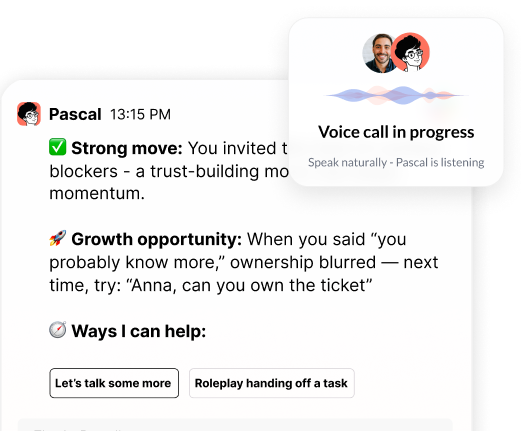
See how Pascal works inside Slack, Teams, and your meetings to deliver AI coaching that managers use. Learn more about Pascal's approach to contextual AI coaching.
Header photo by Arlington Research on Unsplash

.png)
.webp)
“Thank you for setting the great foundation for my promotion; now I have a plan!"

Curious to see how AI Coaching can 10X the impact and scale of your development initiatives. Book a demo today for: