

Coaching managers through layoffs, reorganizations, and burnout requires a different approach than traditional leadership development. You need to combine emotional support with tactical guidance, delivered when managers need it most.
Traditional manager training programs collapse during organizational crisis. Workshops scheduled months in advance can't address the urgent conversations managers face during layoffs or restructuring.
Crisis moments expose the gap between knowing leadership principles and executing them under pressure. The cost of getting these moments wrong compounds: broken trust, legal exposure, disengaged teams, and manager burnout.
Melinda Wolfe, former CHRO at Bloomberg, Pearson, and GLG, puts it this way: "Managers rarely need help in a workshop—they need it when preparing for a tough 1:1 or in the middle of a team conflict."
Layoffs demand tactical precision and legal compliance. Burnout requires sustained emotional intelligence and workload management. Both crises share a common need: managers must maintain psychological safety while delivering difficult messages.
The coaching approach must flex between directive guidance (for layoffs) and exploratory support (for burnout), often within the same week.
Key differences in coaching approach:
Data Breakdown:
• Crisis Type: Layoffs | Primary Manager Need: Script confidence, legal compliance | Coaching Focus: Tactical preparation, message delivery, immediate team stabilization | Timeline: Acute (days to weeks)
• Crisis Type: Reorganizations | Primary Manager Need: Change communication, role clarity | Coaching Focus: Stakeholder mapping, transition planning, managing ambiguity | Timeline: Medium-term (weeks to months)
• Crisis Type: Burnout | Primary Manager Need: Workload assessment, boundary-setting | Coaching Focus: Delegation, prioritization, sustainable performance | Timeline: Ongoing (months to quarters)
During layoffs, managers need help with conversation scripts, legal guardrails, and immediate next steps. Burnout coaching requires pattern recognition across multiple interactions to identify workload trends and energy drains. Reorganizations demand both: tactical communication planning and sustained support as new structures stabilize.
Scenario planning and emotional rehearsal before a crisis improve manager performance when high-stakes moments arrive. Preparation combines tactical skill-building with emotional processing, allowing managers to develop muscle memory for difficult conversations.
Start with specific scenarios. What will you say when an employee asks about job security? How will you respond to anger or tears during a termination conversation? Managers who practice these moments beforehand show better composure and clarity when the real conversation happens.
Map resources before the crisis. Managers need to know who they can escalate to, what support is available for affected employees, and what legal boundaries they must respect. This prevents paralysis in the moment.
Managers executing terminations need tactical support, not a training module. They need to know: What should I prioritize? What are the legal landmines? How do I handle specific reactions?
Provide conversation scripts that include:
• Opening statement (clear, direct, compassionate)
• Key information (severance, benefits, timeline)
• Anticipated questions and responses
• Legal boundaries (what not to say)
• Closing statement and next steps
After each conversation, managers need to reflect: Where could I have done better? What should I adjust for the next conversation? This rapid iteration prevents repeated mistakes across multiple team members.
Don't overlook emotional regulation support. Managers must manage their own stress while holding space for team reactions. Help managers process their own anxiety so it doesn't leak into team conversations.
Team rebuilding after layoffs requires managers to acknowledge what happened, create space for grief and uncertainty, and establish new psychological safety through consistent, transparent communication.
Start by naming the reality. Teams know when something difficult has occurred. Managers who try to move on too quickly without acknowledging the impact create resentment and distrust. The most effective managers say: "This was hard. I know you're processing a lot. Here's what I can tell you, and here's what I don't know yet."
Create structured space for team reactions. This doesn't mean endless processing, but it does mean giving people permission to voice concerns, ask questions, and express frustration. Managers who shut down these conversations drive concerns underground where they fester.
Establish new communication patterns. Remaining team members need to understand workload redistribution and priorities. Consistent, transparent communication rebuilds the foundation of trust.
Reorganizations create sustained ambiguity. Managers need different support than they do during layoffs.
Help managers map stakeholders and communication needs:
• Who needs to know what, and when?
• What can you share now versus later?
• How will you handle questions you can't answer?
• What channels will you use for different messages?
Provide message frameworks for common scenarios:
• Announcing the reorganization to your team
• Explaining role changes
• Addressing uncertainty about future changes
• Managing rumors and speculation
Reorganizations often unfold over weeks or months. Managers need coaching on how to lead through sustained uncertainty:
• Acknowledge what you don't know
• Share information as soon as you can
• Create stability through consistent routines
• Focus team energy on what they can control
As new structures take shape, managers need help establishing:
• New roles and decision rights
• Collaboration patterns with new peers
• Team rituals and communication norms
• Performance expectations in the new structure
Burnout requires different coaching than acute crises. You're looking for patterns over time and building sustainable practices.
Managers burning out show specific behavioral patterns:
• Declining meeting attendance
• Delayed responses to team questions
• Irritability in previously calm interactions
• Withdrawal from collaborative work
Watch for changes in communication patterns. A manager who previously responded within hours now takes days. A leader who used to engage in team discussions now stays silent.
Performance indicators matter too. Missed deadlines, quality drops in work output, and increased errors all point to overwhelm. So does over-delegation without follow-through (managers who assign work but don't provide support or check in).
Physical and emotional signals include increased sick days, visible exhaustion in video calls, and emotional volatility. Managers who were previously steady now snap at minor issues or seem defeated in routine conversations.
The most effective intervention combines workload assessment with boundary-setting coaching. Help managers identify what can be delegated, deprioritized, or eliminated.
Ask these questions:
• What tasks are you doing that someone else could do?
• What meetings could you skip or send a delegate to?
• What projects could be delayed without significant impact?
• What are you saying yes to that you should decline?
Support managers in having honest conversations with their own leaders about capacity constraints.
Burnout coaching is ongoing work. Help managers establish:
• Clear boundaries between work and personal time
• Regular check-ins with team members to spot early warning signs
• Delegation practices that build team capability
• Prioritization frameworks for saying no
Manager confidence, team engagement scores, and time-to-stability after crisis events provide the clearest indicators of coaching effectiveness. Track these metrics before, during, and after crisis periods to understand what's working.
Manager confidence can be measured through pulse surveys asking: "How prepared do you feel for difficult conversations?" and "How supported do you feel by organizational resources?" Scores should increase as coaching interventions take effect.
Team engagement metrics reveal downstream impact. Monitor eNPS, psychological safety scores, and voluntary turnover rates for teams whose managers received crisis coaching versus those who didn't.
Time-to-stability measures how quickly teams return to baseline performance after disruption. Track metrics like project completion rates, quality scores, and team collaboration patterns.
Behavioral indicators matter too: manager follow-through on action items and quality of difficult conversations as rated by HR observers. These process metrics predict outcome success.
• Traditional manager training fails during crisis because it can't deliver support when managers face urgent conversations
• Layoffs require tactical precision and legal compliance. Burnout demands sustained emotional intelligence. Both need managers to maintain psychological safety.
• Effective crisis coaching operates in three phases: preparation (scenario planning and emotional rehearsal), execution (real-time tactical support), and recovery (team rebuilding and manager self-care)
• Track manager confidence, team engagement scores, and time-to-stability to measure coaching effectiveness
• The most effective approach combines structured frameworks with flexibility to adapt to each crisis type
The next time your organization faces layoffs, reorganizations, or widespread burnout, your managers will need more than a workshop. They'll need coaching that meets them in the moment and adapts to the specific crisis they're navigating.
Header photo by Vitaly Gariev on Unsplash

.png)
.webp)
“Thank you for setting the great foundation for my promotion; now I have a plan!"

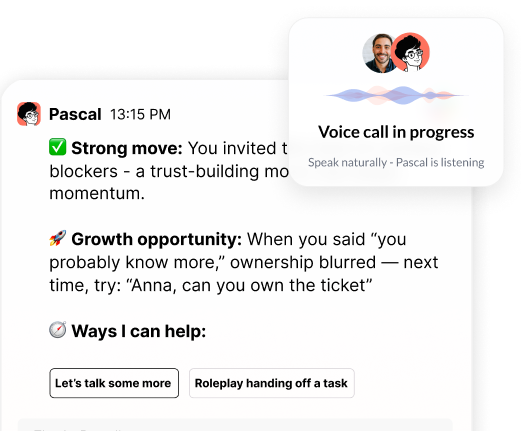
Curious to see how AI Coaching can 10X the impact and scale of your development initiatives. Book a demo today for: