

Seventy percent of managers say they weren't ready for their first leadership role. Most never get coaching because companies can't afford to scale it. Traditional executive coaching costs $10,000–$25,000 per person annually and reaches 5–10% of managers through quarterly sessions. First-time managers navigating performance issues get nothing.
AI leadership coaching costs $250 per person annually. Organizations can coach 200 managers for the cost of coaching five executives—and deliver help when managers need it, not three weeks later.
The constraint isn't whether coaching works. It's whether you can deliver it to everyone who needs it.
Melinda Wolfe, former CHRO at Bloomberg, Pearson, and GLG: "If we can democratize coaching, make it specific, timely, and integrated into real workflows, we solve one of the most chronic issues in the modern workplace."
A mid-sized company with 200 managers would spend $3–5 million annually to provide traditional coaching to everyone. Most companies allocate that budget to 20–30 senior leaders. The rest complete generic training courses.
Traditional coaching costs $10,000–$25,000 per person annually. Sessions happen every two weeks. A manager facing an underperformer conversation waits until the next scheduled session—often after the situation escalates.
Organizations spend $15,000–$30,000 per executive on coaching while frontline managers get nothing. The budget math forces a choice: depth for a few or breadth for most.
Cost comparison for 100 managers:
Data Breakdown:
• Cost Category: Per-person annual cost | Traditional Coaching: $15,000 | AI Coaching: $250
• Cost Category: Total direct cost | Traditional Coaching: $1,500,000 | AI Coaching: $25,000
• Cost Category: HR admin time (hours/year) | Traditional Coaching: 200+ hours | AI Coaching: 10 hours
• Cost Category: Integration/setup | Traditional Coaching: Minimal | AI Coaching: 20–40 hours (one-time)
• Cost Category: Scalability cost to 300 managers | Traditional Coaching: $4,500,000 | AI Coaching: $75,000
• Cost Category: Availability | Traditional Coaching: Scheduled sessions | AI Coaching: 24/7 access
Traditional coaching requires HR coordination: matching coaches to managers, scheduling sessions, tracking progress, managing invoices. AI coaching requires initial integration (connecting to Slack, Teams, calendar systems) but eliminates ongoing coordination.
Traditional coaching pulls managers away from their teams for 1–2 hours per session plus prep time. AI coaching works inside existing tools without dedicated time blocks.
Traditional coaching takes 4–8 weeks to match coaches and begin sessions. AI coaching starts day one.
Pascal costs $250 per license annually—$0.60 per day.
First-time managers face tactical challenges multiple times per week: giving feedback, running 1-on-1s, handling conflict. They can't wait two weeks for their next coaching session when a team member quits or a performance conversation derails.
New managers (0–2 years): A new manager preparing for a difficult conversation can get specific advice 30 minutes before the meeting, not three days after. They need help with execution, not strategy.
Mid-level managers (2–7 years): AI coaching handles day-to-day execution and skill reinforcement. Traditional coaching addresses career transitions or major leadership challenges. Most benefit from AI coaching for volume and human coaching for depth.
Senior leaders (VP+): Traditional coaching works better for strategic thinking, executive presence, and board-level challenges. These leaders need the relationship depth and confidential space that human coaches provide. AI coaching can supplement with communication and team dynamics support.
High-potential individual contributors: AI coaching provides development without the cost barrier of traditional coaching. Organizations can identify and develop future leaders earlier when coaching isn't limited by budget.
The pattern: tactical challenges benefit from immediate access. Strategic challenges benefit from relationship depth.
Use AI coaching for broad manager populations and everyday challenges. Reserve traditional coaching for senior leaders and complex transitions.
Deploy AI coaching for all managers (200+ people). Reserve traditional coaching budget for 15–20 senior leaders. Use AI coaching to identify managers who need human coaching escalation—when sensitive topics surface or complex situations require deeper exploration.
The economics: If you spend $500,000 on traditional coaching for 30 executives, maintain that investment for your top 20 leaders while adding AI coaching for 200 managers at $50,000 annually. You've increased coaching coverage 10x without increasing budget.
Track manager behavior change, direct report experience, and team performance. Traditional coaching relies on self-reported progress and quarterly check-ins. AI coaching provides continuous behavioral data through usage patterns and conversation topics.
Outcome measurement:
Data Breakdown:
• Outcome Type: Manager behavior change | Traditional Coaching: Coach assessments, self-reports | AI Coaching: Usage analytics, conversation patterns
• Outcome Type: Direct report experience | Traditional Coaching: Annual engagement surveys | AI Coaching: Continuous pulse surveys
• Outcome Type: Skill development speed | Traditional Coaching: 6–12 month engagement | AI Coaching: Real-time feedback, progress in weeks
• Outcome Type: Organizational reach | Traditional Coaching: 5–10% of managers | AI Coaching: 100% of managers
• Outcome Type: Time to impact | Traditional Coaching: 3–6 months | AI Coaching: Immediate
Manager effectiveness shows up in 360 feedback scores (anonymous peer and direct report assessments), direct report engagement, and team retention rates. Business impact appears in team performance metrics and promotion readiness.
Traditional coaching has high engagement because it's expensive and scheduled. AI coaching requires measuring active usage, session frequency, and feature adoption.
Track leading indicators (usage frequency, conversation topics, feature adoption) and lagging indicators (manager effectiveness scores, direct report engagement, team retention) to prove ROI within 90 days.
Integration complexity, change management, and ongoing administration determine whether your AI coaching investment delivers ROI or becomes another underutilized tool.
Integration requirements: AI coaching platforms connect to calendar systems, communication tools (Slack, Teams), and HRIS (Human Resources Information System) for organizational data. Budget 20–40 hours for initial setup. Pascal integrates with Slack, Teams, Zoom, and Google Meet without custom development.
Change management: The difference between 30% adoption and 80% adoption comes down to launch execution. Budget 10–15 hours of HR time for launch communications and initial training. Executive sponsorship and clear communication about data privacy drive adoption.
Ongoing administration: Traditional coaching requires continuous HR coordination—matching coaches, scheduling sessions, tracking progress, managing invoices. AI coaching eliminates most overhead but requires monitoring usage metrics and addressing adoption barriers. Budget 2–3 hours monthly for AI coaching administration versus 15–20 hours for traditional coaching programs.
Data privacy and compliance: Enterprise-grade AI coaching platforms are SOC2 compliant (a security certification for handling sensitive data) and don't use customer data to train models. Verify security certifications before deployment, especially in regulated industries.
• AI coaching costs $250 per person annually versus $10,000–$25,000 for traditional coaching, enabling organizations to coach 100% of managers instead of the top 5%
• Traditional coaching delivers depth for senior leaders; AI coaching delivers scale for everyday challenges—run both in parallel with clear segmentation by role level
• Track leading indicators (usage, engagement) and lagging indicators (manager effectiveness, direct report experience, team performance) to prove ROI within 90 days
• First-time and mid-level managers see higher ROI from AI coaching when they need help with execution, not strategy
• Budget for total cost of ownership: direct licensing costs, integration time (20–40 hours), change management, and ongoing administration (2–3 hours monthly)
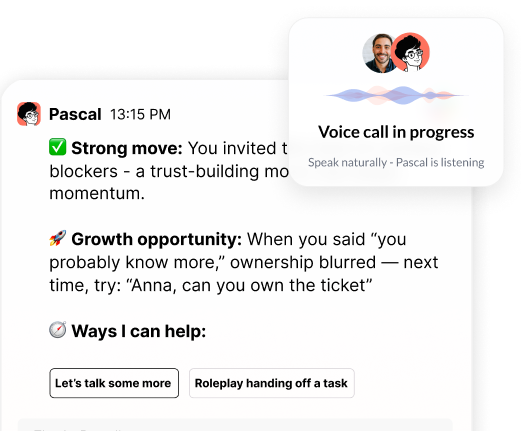
Pascal delivers coaching at a fraction of traditional costs. See how Pascal integrates into your team's workflow or explore how AI coaching strengthens your leadership pipeline.
Header photo by Jakub Żerdzicki on Unsplash

.png)
.webp)
“Thank you for setting the great foundation for my promotion; now I have a plan!"

Curious to see how AI Coaching can 10X the impact and scale of your development initiatives. Book a demo today for: