

Most organizations spend $3,000–$15,000 per person annually on executive coaching that reaches less than 5% of their workforce. AI-powered coaching platforms now deliver personalized guidance to every manager at $100–300 per person—a 10–50x cost reduction that makes universal access financially viable. Companies extending coaching beyond executives report measurable improvements in manager effectiveness, employee retention, and HR capacity.
Democratizing coaching means giving every manager and employee access to personalized developmental support through AI platforms that work inside existing tools. Instead of scheduled sessions with human coaches (available only to executives), managers get real-time guidance before difficult conversations, during performance reviews, and when navigating team conflicts.
The shift transforms coaching from an exclusive perk into an organizational capability. According to Tandem Coaching's analysis of executive coaching trends for 2026, democratized access beyond the C-suite is now one of eight defining trends reshaping the industry.
Three characteristics define democratized coaching:
Continuous support, not scheduled events: Coaching becomes available 24/7 in the moments that matter. AI platforms join meetings, provide feedback after conversations end, and surface development opportunities rather than waiting for employees to seek help.
Personalized guidance, not generic training: AI adapts to individual competencies, company culture, and specific role challenges. Two managers working on delegation skills receive completely different coaching based on their unique contexts.
Economically viable at scale: AI coaching costs $100–300 per employee annually versus $3,000–15,000 for traditional executive coaching. This cost reduction makes universal access financially feasible for the first time.
Data Breakdown:
• Dimension: Access | Traditional Executive Coaching: Top 3–5% of organization | Democratized AI Coaching: 100% of managers/employees
• Dimension: Cost per person | Traditional Executive Coaching: $3,000–$15,000 annually | Democratized AI Coaching: $100–$300 annually
• Dimension: Availability | Traditional Executive Coaching: Scheduled sessions (biweekly/monthly) | Democratized AI Coaching: 24/7 on-demand
• Dimension: Context awareness | Traditional Executive Coaching: Coach learns over time | Democratized AI Coaching: Integrates with meetings, Slack, performance data
• Dimension: Scalability | Traditional Executive Coaching: Limited by coach capacity | Democratized AI Coaching: Unlimited
• Dimension: Time to value | Traditional Executive Coaching: 3–6 months | Democratized AI Coaching: Immediate
• Dimension: Cultural consistency | Traditional Executive Coaching: Varies by coach | Democratized AI Coaching: Trained on company values/competencies
The gap between where coaching is needed and where it's available creates a performance tax across organizations. According to DDI's Global Leadership Forecast, only 25% of managers are rated highly effective at coaching and feedback. Yet traditional executive coaching reaches less than 5% of the workforce.
The manager effectiveness crisis is accelerating. 60% of new managers report feeling unprepared for their roles, yet receive minimal ongoing support beyond initial onboarding. They're thrust into people leadership with no practice, no feedback loop, and no safety net.
Economic pressure intensifies the problem. Organizations are asking more of managers with fewer resources. The player-coach model is unsustainable without scalable support systems. As Melinda Wolfe, former CHRO at Bloomberg, Pearson, and GLG, notes: "We're asking more of managers with fewer resources. That's not sustainable without better support."
Technology creates an inflection point. AI coaching platforms now deliver personalized, contextual guidance at a fraction of traditional coaching costs, making universal access economically viable.
The most common objections center on AI replacing human connection, data privacy concerns, and implementation complexity. Address each with specific evidence and clear boundaries about what AI coaching does and doesn't replace.
"AI can't replace human coaches": Correct—and that's not the goal. AI coaching extends access to the 95% of employees who never receive any coaching. Human coaches remain valuable for executives and complex situations. Enterprise AI coaching platforms include guardrails that escalate sensitive topics to human HR professionals.
"Our managers won't use another tool": Adoption rates exceed 70% when AI coaching integrates into existing workflows (Slack, Teams, Zoom). Managers receive feedback in the tools they already use daily. It's not another login to remember.
"What about data privacy and security": Enterprise AI coaching platforms are SOC2 compliant and never use customer data to train models. Individual coaching conversations remain private. Only anonymized, aggregated insights are shared with HR leadership.
"Implementation will disrupt operations": Modern AI coaching platforms deploy in weeks, not months. Managers complete a 15-minute onboarding, connect their calendar, and start receiving coaching. No lengthy training programs required.
Democratized coaching delivers just-in-time, contextual support embedded in daily work rather than scheduled training events removed from real challenges. The Conference Board's research on AI coaching shows that this approach is redefining leadership development by making personalized guidance available at the moment of need, not weeks later in a classroom.
Learning in context vs. learning in theory: Managers receive coaching while preparing for actual performance conversations, not in role-play scenarios months earlier. The knowing-doing gap collapses when feedback arrives seconds after a meeting ends.
Continuous reinforcement vs. one-time events: AI platforms provide ongoing feedback and accountability, not just a two-day workshop followed by no follow-up. Development becomes a daily practice, not an annual event.
Personalized pathways vs. one-size-fits-all: AI coaching adapts to individual strengths, weaknesses, and development goals rather than delivering identical content to everyone.
As Jeff Diana, former CHRO at Calendly, Atlassian, and SuccessFactors, explains: "So much of the real learning and value comes from in-context coaching in the moment to drive performance and to solve problems in the moment."
Organizations report improvements in manager effectiveness, time savings, and employee retention. These outcomes translate directly to bottom-line impact: reducing turnover by 5% in a 1,000-person organization saves $750,000–$1.5M annually in replacement costs.
Manager effectiveness improvements: Early adopters report measurable improvements in direct report satisfaction and manager performance within 90 days of implementation.
Time savings and productivity: Managers save time by accessing instant coaching rather than scheduling meetings with HR business partners or waiting for training sessions. HR teams report handling fewer routine manager development queries.
Retention and engagement: Companies extending coaching access see higher retention rates among managers and their direct reports. According to Gallup's research on millennials and job mobility, lack of development opportunities is a primary driver of turnover. High performers stay when they see investment in their development.
Cultural transformation velocity: Organizations using AI coaching to reinforce specific behaviors see faster adoption of new cultural competencies compared to training-only approaches. Every conversation becomes a teaching moment.
Holly Tyson, Chief People Officer at Cushman & Wakefield, explains how AI coaching can be "a massive unlock by democratizing great management and giving thousands of frontline leaders real-time guidance, institutional knowledge, and in-the-moment practice."
Calculate coaching democratization ROI by comparing current costs against projected savings and productivity gains from universal access. A mid-sized tech company with 500 employees typically sees 3–5x ROI within the first year by reducing turnover, scaling HR capacity, and improving manager effectiveness.
Current state costs to quantify:
• Executive coaching spend: (number of executives receiving coaching) × ($5,000–$15,000 per person)
• HR capacity costs: (number of HRBP hours spent on manager development) × (fully loaded hourly rate)
• Turnover costs: (number of regrettable departures) × (1.5–2x annual salary for replacement costs)
• Learning platform costs: Annual spend on platforms with low engagement rates
Projected savings and gains:
• AI coaching investment: (number of employees) × ($100–300 per person)
• Turnover reduction: 5–10% decrease in regrettable departures × (replacement cost savings)
• HR capacity expansion: Hours saved per HRBP annually × (fully loaded hourly rate)
• Manager productivity gains: (number of managers) × (hours saved) × (average hourly value)
Example calculation for a 500-person organization:
• Current executive coaching: 25 executives × $8,000 = $200,000
• Current preventable turnover: 5% of 50 departures × $100,000 replacement cost = $250,000
• AI coaching investment: 500 employees × $200 = $100,000
• Projected turnover reduction (5%): 2.5 fewer departures = $250,000 saved
• HR capacity expansion: 3 HRBPs × 150 hours × $75/hour = $33,750 saved
• First-year net benefit: $383,750 (3.8x ROI)
Note: This calculation assumes AI coaching prevents 5% of regrettable turnover. Actual results will vary based on your organization's current manager effectiveness and retention challenges.
Start with 50–100 managers in a single business unit or functional area where you can measure impact quickly and build momentum for broader rollout. Choose a population with clear performance metrics and supportive leadership.
Ideal pilot populations:
• New managers (first 12 months in role) who need intensive support
• Sales managers with clear performance metrics (team quota attainment, rep retention)
• High-potential mid-level managers preparing for senior roles
• Distributed teams where in-person coaching is impractical
Success metrics to track:
• Engagement: Weekly active usage rates, coaching sessions per manager
• Manager effectiveness: 360 feedback scores, direct report satisfaction surveys
• Business outcomes: Team performance metrics, retention rates, promotion readiness
• Efficiency: HR query volume, time to competency for new managers
Timeline for a 90-day pilot:
• Weeks 1–2: Onboarding, goal setting, initial coaching sessions
• Weeks 3–8: Active usage, weekly check-ins with pilot participants
• Weeks 9–12: Impact measurement, testimonial collection, business case refinement
Evaluate AI coaching vendors on five dimensions: foundational expertise (are coaches training the AI?), contextual awareness (does it integrate with your tools and culture?), personalization depth (does it adapt to individuals?), privacy architecture (how is data protected?), and escalation protocols (when does it involve humans?).
Critical questions to ask vendors:
• Who trains your coaching models? (Look for ICF-certified coaches, not just data scientists)
• How does your platform learn about our company culture and competencies?
• What data do you collect and how is it protected? (Demand SOC2 compliance minimum)
• How do you handle sensitive topics like mental health, harassment, or performance issues?
• What does the implementation timeline look like and what resources do we need?
Red flags to watch for:
• Generic chatbot experiences with no company customization
• Vague answers about data privacy and model training
• No clear escalation protocols for complex situations
• Implementation timelines exceeding 90 days
• Pricing models that penalize adoption (per-session fees vs. per-user licensing)
• AI coaching costs $100–300 per employee annually versus $3,000–15,000 for traditional executive coaching—making universal access economically viable
• Organizations typically see 3–5x ROI in year one by reducing turnover costs, scaling HR capacity, and improving manager effectiveness
• Start with a 90-day pilot focused on 50–100 managers in a single business unit with clear performance metrics and supportive leadership
• Address objections directly: AI coaching extends access to the 95% who never receive coaching; it doesn't replace human coaches for complex situations
• Evaluate vendors on coaching expertise, contextual awareness, personalization, privacy architecture, and escalation protocols—not just technology features
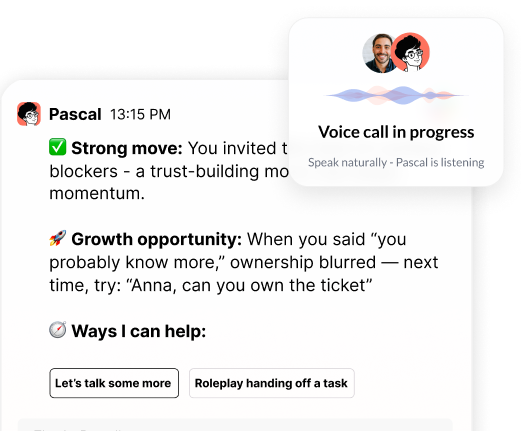
Ready to see how AI coaching works in practice? Explore how we deliver real-time coaching inside Slack, Teams, and meetings to help every manager become more effective.
Header photo by Christina @ wocintechchat.com M on Unsplash

.png)
.webp)
“Thank you for setting the great foundation for my promotion; now I have a plan!"

Curious to see how AI Coaching can 10X the impact and scale of your development initiatives. Book a demo today for: