
AI coaching builds AI fluency by embedding personalized, real-time guidance into daily workflows where managers actually use AI tools. Unlike traditional training that delivers knowledge in isolated sessions, AI coaching provides contextual support during real decisions, enabling managers to develop practical AI skills through consistent practice with immediate feedback.
AI fluency is the ability to recognize when AI adds value, use it effectively in real situations, and make sound decisions based on AI-generated insights. For managers, this means knowing which tasks to delegate to AI, how to interpret AI outputs critically, and how to lead teams through AI-driven change.
SHRM's 2026 research found that 36% of workers report managers reference AI capabilities when discussing productivity expectations (rising to 60% at director level). Yet most organizations struggle to move managers from awareness to application. AI fluency requires three components: recognition (when to use AI), execution (how to use it effectively), and judgment (evaluating AI outputs).
This capability develops through practice, not passive learning. BCG found 79% of employees receiving 5+ hours of AI training become regular users versus 67% with less exposure. The gap is most critical for mid-level managers who translate strategy into execution and model AI adoption for their teams.
Traditional training delivers information at the wrong time—in workshops disconnected from actual work contexts. Managers attend a session, learn concepts, then return to their desks where the learning doesn't transfer to real decisions.
Scheduled training creates a "knowing-doing gap"—managers understand concepts but can't apply them when they need to. Self-paced modules in learning management systems see low completion rates, and one-time workshops lack the repetition required for skill development—managers need 15-20 practice opportunities to internalize new behaviors.
Generic content doesn't account for company-specific AI tools, workflows, or cultural norms. There's no feedback loop to correct misapplication or reinforce effective use.
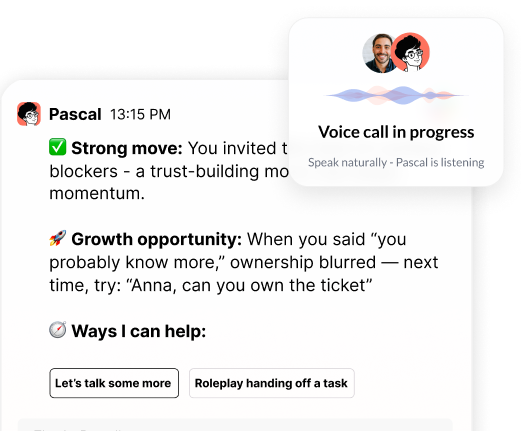
AI coaching transforms abstract AI concepts into applied skills by meeting managers where they work—in Slack conversations, Zoom meetings, and daily decision points. Pascal by Pinnacle, for example, integrates directly into Microsoft Teams, Slack, Zoom, and Google Meet, providing real-time guidance as managers navigate actual AI use cases.
This contextual approach enables the consistent practice required for fluency development. AI coaches observe actual work situations and provide guidance specific to the task at hand, delivering feedback within seconds of an AI interaction rather than days later in a review session. Managers can test AI approaches with coaching support before high-stakes applications, creating 15-20+ practice moments per week instead of occasional training sessions.
Platforms train on company values, leadership principles, and approved AI use cases, ensuring cultural alignment. Pascal's proactive approach joins meetings and provides feedback in real-time, achieving 83% observable improvement from direct reports.
Before implementing AI coaching, establish where managers and teams currently stand. This baseline enables you to measure progress and identify which populations need the most support.
Conduct a skills assessment across three dimensions: AI awareness (do they know what tools exist?), AI application (are they using tools?), and AI judgment (are they using them effectively?). Identify high-priority populations—first-time managers, mid-level managers, and distributed teams typically show fastest ROI. Map existing AI tools in your tech stack and measure adoption rates, then survey direct reports on whether their managers effectively use AI in team workflows.
Review support tickets and HR inquiries related to AI tool confusion or misuse. SHRM reports that 36% of employees feel adequately trained on AI today. This gap represents your opportunity to build competitive advantage through systematic fluency development.
Clear outcomes prevent AI coaching from becoming another underutilized learning tool. Define what "AI fluent" looks like for different roles in your organization, then establish metrics that track behavior change, not just engagement.
Set role-specific fluency standards—for example, managers should use AI for meeting prep 80% of the time, or use AI for performance review drafting. Establish leading indicators like frequency of AI tool usage, diversity of AI applications, and quality of AI-generated outputs. Define lagging indicators including manager effectiveness scores, team productivity metrics, and time saved on administrative tasks.
Pascal customers track 150+ hours saved per manager annually and 20% increases in manager NPS. Include qualitative measures like direct report feedback on manager's AI-enabled decision quality. Set adoption thresholds before scaling—as Marriott's Victor Arguelles notes in recent PeopleTech conversations, they "only scale after employee satisfaction reaches defined thresholds."
Link AI fluency to business outcomes: faster decision-making, improved team performance, and reduced manager burnout.
Not all AI coaching platforms build fluency equally. Generic chatbots provide answers but don't develop skills. Coaching systems that integrate into workflows, provide contextual guidance, and adapt to your organization's specific needs deliver better results.
Evaluate integration capabilities—platforms must work within existing tools (Slack, Teams, Zoom) where managers actually work. Assess personalization depth: does the platform adapt to individual manager styles, team dynamics, and company culture? Verify data privacy and security—SOC2 compliance is table stakes, and ensure the vendor never trains models on your data.
Check for proactive versus reactive coaching. Platforms that observe interactions and intervene (like Pascal) drive higher adoption than on-demand tools. Confirm coaching quality—are models trained by certified coaches? Pascal uses ICF-certified coaches to train its models, delivering coaching at 1% of traditional coaching costs while maintaining quality.
Request customer references from similar industries and company sizes. Look for proof points beyond engagement metrics—does the vendor track behavior change and business outcomes?
Start with a focused pilot that generates clear insights before full deployment. Select 50-100 managers from your high-priority population identified in Step 1, ensuring representation across departments, experience levels, and geographic locations.
Define a 90-day pilot timeline with clear milestones: weeks 1-2 for onboarding and setup, weeks 3-8 for active usage and data collection, weeks 9-12 for analysis and decision-making. Establish both quantitative metrics (usage frequency, time saved, decision quality scores) and qualitative feedback mechanisms (manager interviews, direct report surveys, HR partner observations).
Create a control group using similar managers not in the pilot to measure comparative effectiveness. Document baseline metrics for both groups before launch. Build feedback loops with weekly check-ins for the first month, then bi-weekly thereafter, adjusting based on what you learn.
AI coaching adoption depends on integration into tools managers already use daily. Configure your platform to connect with calendar systems, communication tools, and meeting platforms without requiring managers to learn new interfaces or change existing habits.
Set up proactive coaching triggers based on common scenarios: pre-meeting preparation reminders, post-meeting reflection prompts, performance review season support, and difficult conversation preparation. Enable managers to access on-demand coaching through familiar channels—a Slack message, a Teams chat, or a meeting assistant.
Train your AI coach on company-specific content: leadership competencies, values statements, approved AI use cases, and internal terminology. This customization ensures coaching feels relevant and aligned with organizational culture. Pascal learns from each interaction, building context about individual manager styles and team dynamics over time.
AI fluency development requires both leading and lagging indicators tracked consistently. Leading indicators show behavior change in real-time: frequency of AI tool usage, diversity of AI applications across different tasks, quality ratings of AI-generated outputs, and manager confidence scores in using AI for specific scenarios.
Lagging indicators demonstrate business impact: team productivity metrics, manager effectiveness scores from direct reports, time saved on administrative tasks, and decision quality outcomes. Track these monthly for pilot groups and quarterly for broader populations.
Use direct report feedback as a measure—are team members observing their managers using AI more effectively? Survey direct reports on specific behaviors: "My manager uses AI to prepare for our 1:1s," "My manager helps me understand how to use AI in my work," "My manager makes better decisions using AI insights."
Compare AI fluency scores against business outcomes like team engagement, performance ratings, and retention. Organizations using Pascal report 83% of direct reports observe improvement in their managers' effectiveness after 90 days of AI coaching.
Initial adoption resistance is common, especially from experienced managers who view AI coaching as questioning their expertise. Frame AI coaching as a performance enhancement tool, not a replacement for human judgment. Share early success stories from respected managers who embraced the technology.
Privacy concerns will surface—managers worry about surveillance or performance monitoring. Be transparent about what data is collected, how it's used, and who has access. Emphasize that AI coaching platforms like Pascal are SOC2 compliant and never train models on customer data. Make coaching interactions confidential between the manager and the system unless managers choose to share insights.
Technical integration challenges may arise with legacy systems or security protocols. Work closely with IT teams early in the process to address authentication, data flow, and compliance requirements. Budget extra time for enterprise security reviews.
Expect uneven adoption across different manager populations. Some will embrace AI coaching immediately while others need more time and support. Create manager champions who can share their experiences and help peers overcome hesitation.
Scale systematically based on pilot results and organizational readiness. Start by expanding to adjacent populations—if your pilot focused on first-time managers, expand to mid-level managers next. If you piloted in one department, expand to similar departments before moving to different functions.
Develop an internal communication strategy that shares success metrics, manager testimonials, and specific examples of how AI coaching improved outcomes. Create a library of use cases showing how different roles and departments apply AI coaching to their unique challenges.
Build a community of practice where managers share AI fluency tips, discuss challenges, and learn from each other's experiences. This peer learning accelerates adoption and creates internal advocates. HubSpot, Zapier, and Marriott have used this approach in their AI transformation efforts.
Integrate AI coaching into formal development programs. Make it part of new manager onboarding, leadership development curricula, and performance improvement plans. When AI coaching becomes an expected part of manager development rather than an optional tool, adoption increases.
• AI fluency develops through consistent practice with real-time feedback in actual work situations, not through traditional training workshops disconnected from daily workflows
• Implementation requires clear baseline assessment, role-specific outcomes, and metrics that track behavior change rather than just engagement
• AI coaching platforms that integrate into existing tools (Slack, Teams, Zoom) and provide proactive guidance drive higher adoption than reactive on-demand systems
• Pilot programs should run 90 days with 50-100 managers, establishing both quantitative metrics and qualitative feedback mechanisms before scaling
• Privacy, security, and cultural alignment are critical—choose platforms that are SOC2 compliant, never train on customer data, and can be customized to your organization's values and leadership principles
Pascal by Pinnacle delivers AI coaching directly in Slack, Teams, and Zoom—meeting managers where they work with real-time guidance that builds AI fluency through practice. See how Pascal works to transform your managers from AI-aware to AI-fluent.
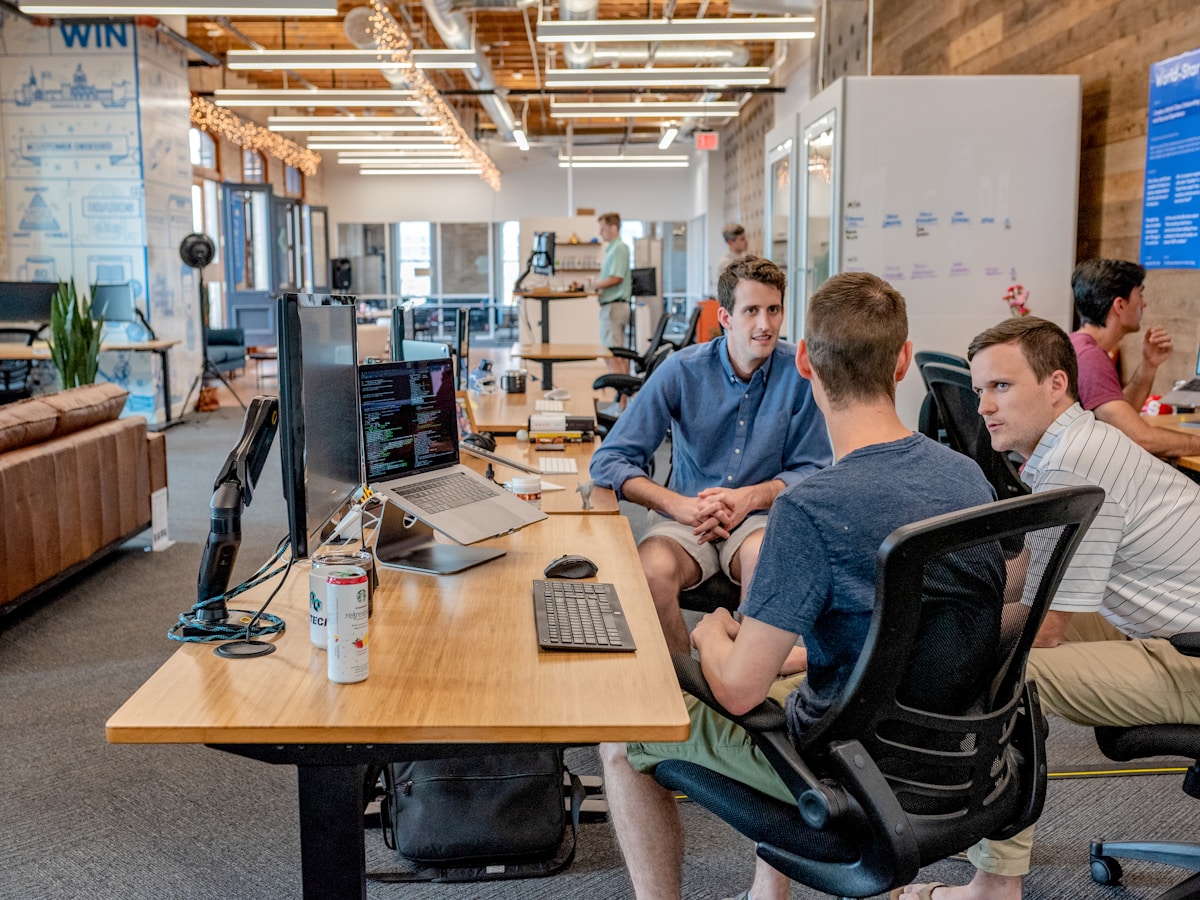
Header photo by Austin Distel on Unsplash

.png)
.webp)
“Thank you for setting the great foundation for my promotion; now I have a plan!"

Curious to see how AI Coaching can 10X the impact and scale of your development initiatives. Book a demo today for: