

AI coaching extends personalized development to your entire manager population while preserving human coaches for complex transitions and senior leadership. Organizations using this model report 20% increases in manager effectiveness while cutting per-manager costs by 60-70%.
AI coaching handles continuous, context-specific guidance for everyday management situations. Human coaches focus on complex emotional work, executive transitions, and accountability relationships that require human presence.
This creates a continuous development loop: human coaches deepen awareness and strategy in monthly sessions, while AI coaches support practice and day-to-day decision-making between those sessions. The integration point is where human coaches use AI-generated insights (meeting patterns, skill gaps, behavioral trends) to focus sessions on highest-value topics, while AI coaches reinforce frameworks introduced in human sessions.
AI coaching strengths: 24/7 availability, instant feedback on routine situations, scalable to entire workforce, consistent application of frameworks, real-time meeting support.
Human coaching strengths: Deep emotional processing, career transitions, executive presence development, accountability partnerships, complex interpersonal dynamics, strategic career planning.
The distinction matters because most organizations limit coaching to senior executives due to cost constraints. Traditional executive coaching costs $3,000-15,000 per person annually, making it impossible to scale beyond senior leadership. AI coaching operates at roughly $300-500 per person annually, enabling broader access while preserving human coaches for situations requiring human judgment.
According to Melinda Wolfe, former CHRO at Bloomberg, Pearson, and GLG, "We're asking more of managers with fewer resources." The hybrid model addresses this gap by matching coaching intensity to complexity, not seniority.
Map what you're spending, who's getting access, and what's being used. Most organizations invest heavily in programs with single-digit utilization rates while limiting high-impact coaching to senior executives.
Calculate your coaching coverage gap: Document how many managers have access to human coaching (typically 5-15% in most organizations) versus total manager population. This reveals where first-time managers, individual contributors, mid-level managers, and remote teams receive zero coaching support.
Measure L&D utilization: Pull actual usage data from your LMS, training platforms, and coaching marketplaces. Not enrollment numbers—actual usage. Most organizations find that expensive learning platforms see less than 10% active engagement.
Identify cost per coached employee: Include program fees, internal coordination time, and opportunity costs of scheduling. Factor in HR business partner time spent fielding routine management questions that could be handled by on-demand coaching.
Data Breakdown:
• Metric: Coaching Coverage | Current State (Traditional): 5-15% of managers | Hybrid Model Target: 100% of managers
• Metric: Cost per Manager | Current State (Traditional): $3,000-15,000 annually | Hybrid Model Target: $300-500 annually
• Metric: Response Time | Current State (Traditional): Days to weeks | Hybrid Model Target: Immediate
• Metric: Utilization Rate | Current State (Traditional): 10-20% | Hybrid Model Target: 70-85%
Use a decision matrix based on emotional complexity, strategic importance, and frequency. High-frequency, moderate-complexity situations (90% of manager challenges) are ideal for AI coaching. Low-frequency, high-stakes transitions require human expertise.
AI-appropriate scenarios: Preparing for 1-on-1s, practicing feedback delivery, navigating team conflicts, delegation decisions, time management, meeting facilitation, onboarding new team members, performance documentation. These situations occur daily, follow recognizable patterns, and benefit from immediate guidance.
Human-appropriate scenarios: Executive transitions, significant career pivots, deep-seated behavioral patterns, trauma-informed coaching, succession planning, board-level presence, merger integration leadership. These require emotional holding space and long-term accountability relationships.
Hybrid scenarios: Leadership development programs where AI provides daily reinforcement of frameworks introduced by human facilitators. Performance improvement plans where AI supports daily check-ins between monthly human coach sessions.
Jeff Diana, former CHRO at Calendly, Atlassian, and SuccessFactors, explains the principle: "Real learning and value come from in-context coaching—solving problems in the moment, not in a classroom."
Build a system where AI coaching serves as the foundation available to all, human group coaching develops mid-level leaders, and 1-on-1 human coaching supports senior leaders and critical transitions.
Tier 1 (Foundation): AI coaching platform accessible to 100% of managers and high-potential individual contributors. Embedded in daily tools like Slack, Teams, and Zoom. Provides proactive meeting support and on-demand guidance. This tier handles volume—thousands of coaching interactions weekly.
Tier 2 (Acceleration): Human-facilitated group coaching cohorts of 8-12 participants for mid-level managers. AI coaching provides between-session practice and reinforcement of concepts introduced in group sessions. This tier develops leadership depth.
Tier 3 (Strategic): 1-on-1 executive coaching for VP+ leaders, critical role transitions, and high-stakes situations. AI provides contextual data to human coaches (meeting patterns, communication trends, team feedback themes) enabling more focused, high-value sessions.
Integration layer: Your AI platform should surface anonymized, aggregated insights to L&D teams showing skill gaps, common challenges, and engagement patterns without compromising individual privacy. Look for SOC2 compliance and clear data usage policies.
This architecture reduces total coaching costs by 60-70% while increasing access by 20x. Organizations typically reallocate 40% of their traditional coaching budget to AI coaching, maintain 40% for senior executive coaching, and redirect 20% to other talent initiatives.
Start with 50-100 managers representing diverse roles, tenures, and challenges. Gather proof points over 90 days, then scale while optimizing your human coaching allocation based on AI-generated insights.
Phase 1 (Weeks 1-4): Select pilot group. Configure AI coach with company values, competency frameworks, and cultural norms. Train pilot participants on when to engage AI versus escalate to human support. Set clear success metrics: engagement frequency, manager confidence scores, direct report feedback.
Phase 2 (Weeks 5-12): Monitor engagement patterns. Collect qualitative feedback through brief surveys and focus groups. Identify which human coaching sessions could be replaced versus enhanced. Document time savings and skill improvements with specific examples.
Phase 3 (Weeks 13-16): Analyze aggregated data to identify organization-wide skill gaps. Redesign human coaching allocation based on actual need versus seniority. Prepare scaling communications emphasizing expanded access, not replacement. Address concerns from human coaches by positioning AI as capacity expansion.
Phase 4 (Weeks 17-24): Roll out to full manager population in waves. Reallocate human coaching budget to focus on Tier 3 strategic coaching and Tier 2 group programs. Establish feedback loops where AI insights inform human coaching focus areas, and human coaches provide frameworks that AI reinforces daily.
The critical success factor is starting with a pilot that generates undeniable proof points. When managers report measurable time savings and direct reports show improvement in engagement scores, resistance to scaling evaporates.
Track leading indicators like engagement frequency and manager confidence, then connect them to lagging indicators like retention, promotion readiness, and team performance scores.
Leading indicators (measure monthly):
• AI coaching engagement rate (target: 70%+ of managers using weekly)
• Average interactions per manager (target: 2-3 per week)
• Manager confidence scores on key competencies (pre/post comparison)
• Time saved on routine management tasks (survey-based)
Lagging indicators (measure quarterly):
• Direct report engagement scores (compare coached vs. uncoached managers)
• Manager retention rates (first-year manager retention is particularly telling)
• Promotion readiness assessments (are managers developing faster?)
• Team performance metrics (productivity, quality, delivery)
Cost metrics (measure annually):
• Cost per coached manager (should drop 60-70% in hybrid model)
• HR business partner capacity (can they cover broader scope?)
• Human coaching utilization rates (are high-value sessions fully booked?)
Organizations implementing hybrid models typically see 20% increases in manager NPS, 30% reductions in time-to-proficiency for new managers, and 15% improvements in direct report engagement scores within six months.
The financial case is straightforward: if you're spending $500,000 annually coaching 50 executives at $10,000 each, a hybrid model lets you coach 500 managers for the same budget—a 10x increase in reach with measurable improvements in manager effectiveness.
Pitfall 1: Positioning AI as a replacement for human coaches. This creates resistance from both coaches and managers. Position AI as capacity expansion that enables human coaches to focus on highest-value work. Involve human coaches in AI coach configuration and framework development.
Pitfall 2: Launching without clear use cases. Generic "coaching for everyone" messaging fails. Define specific scenarios where AI coaching adds immediate value: preparing for difficult conversations, practicing feedback delivery, navigating team conflicts.
Pitfall 3: Ignoring data privacy and security. Managers won't engage if they're concerned about surveillance. Choose platforms with SOC2 compliance, clear data usage policies, and organizational controls that prevent individual monitoring.
Pitfall 4: Treating implementation as a one-time launch. Hybrid coaching requires ongoing optimization. Review engagement patterns quarterly. Adjust AI coaching prompts based on common questions. Reallocate human coaching resources based on emerging needs.
Pitfall 5: Failing to integrate with existing L&D programs. AI coaching works best when reinforcing concepts from leadership development programs, not operating in isolation. Build explicit connections between training content and AI coaching scenarios.
Organizations that avoid these pitfalls see 70-85% sustained engagement rates. Those that don't typically see engagement drop to 20-30% within three months.
• Hybrid AI-human coaching extends development access from 5% to 100% of managers while reducing per-manager costs by 60-70%, creating both scale and impact
• AI coaching handles high-frequency, moderate-complexity situations like feedback delivery and team conflicts, while human coaches focus on executive transitions and deep behavioral change
• A three-tier architecture (AI foundation for all, group coaching for mid-level, 1-on-1 for executives) optimizes both cost and effectiveness
• Implementation success requires a 90-day pilot with 50-100 managers to generate proof points before scaling organization-wide
• Measure both leading indicators (engagement frequency, manager confidence) and lagging indicators (retention, promotion readiness, team performance) to prove ROI
The coaching gap in most organizations isn't a budget problem—it's an architecture problem. When you combine AI coaching for continuous, contextual guidance with human coaching for complex transitions, you create a system that scales expertise rather than rationing it.
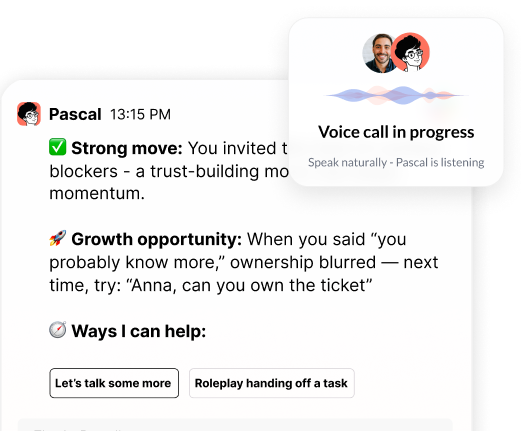
Pascal by Pinnacle demonstrates this approach by joining meetings to provide real-time guidance on everyday management situations. See how it works inside Slack, Teams, and your meetings at heypinnacle.com.
Header photo by Vitaly Gariev on Unsplash

.png)
.webp)
“Thank you for setting the great foundation for my promotion; now I have a plan!"

Curious to see how AI Coaching can 10X the impact and scale of your development initiatives. Book a demo today for: