

Organizations must establish psychological safety for AI experimentation, redefine manager roles, and embed continuous learning into daily workflows before deploying AI management tools. The sequence matters: culture-first preparation accelerates adoption and prevents the resistance that kills most AI initiatives.
Culture readiness means employees view AI as a trusted collaborator rather than a surveillance tool, managers understand their evolving role, and leadership has aligned on which decisions AI should inform versus which require human judgment.
Three conditions define readiness. First, psychological safety—employees feel comfortable experimenting with AI tools without fear of punishment for mistakes. Second, clear role definitions that specify how managers collaborate with AI rather than compete with it. Third, transparent governance frameworks that employees trust to protect privacy while enabling organizational learning.
HubSpot achieved 98% employee AI tool usage by establishing cultural norms around collective learning. Employees demo AI use cases in 60-second sessions, creating peer-driven adoption. This approach addresses cultural barriers before technology deployment.
Traditional vs. AI-Ready Management Cultures
Data Breakdown:
• Dimension: Manager role | Traditional Culture: Decision authority | AI-Ready Culture: Decision orchestrator
• Dimension: Learning model | Traditional Culture: Scheduled training events | AI-Ready Culture: Continuous, contextual coaching
• Dimension: Performance measurement | Traditional Culture: Annual reviews | AI-Ready Culture: Real-time behavioral insights
• Dimension: Information flow | Traditional Culture: Hierarchical reporting | AI-Ready Culture: AI-augmented transparency
• Dimension: Failure response | Traditional Culture: Risk avoidance | AI-Ready Culture: Experimentation mindset
• Dimension: Privacy stance | Traditional Culture: Data minimization | AI-Ready Culture: Privacy-first data utilization
The sequencing matters for three reasons. Trust precedes adoption: employees need psychological safety to experiment with AI coaching without fear that data will be weaponized in performance reviews. Role clarity prevents resistance: managers who understand AI as an enabler rather than a replacement become champions instead of blockers. Governance frameworks enable scale: clear policies on data usage, privacy, and AI decision boundaries allow rapid expansion after initial pilots.
Jeff Diana, former CHRO at Calendly and Atlassian, frames the urgency: "HR leaders face a choice: shape how AI transforms work or watch other functions make those decisions for you." Organizations that wait for other functions to define AI's role in management struggle with cultural resistance because the technology arrives without supporting behavioral norms.
Gail Fierstein, former CHRO at CaaStle, Goldman Sachs, and Pearson, emphasizes the performance redefinition required: "What companies and HR need to do is define what is performance and potential in the context of the human-AI collaborative. It's different." This isn't about adding AI to existing processes—it's about rethinking what management looks like.
Cultural preparation timeline:
Months 1–2: Leadership alignment on AI's role in management, manager role redefinition, privacy framework establishment. This phase focuses on executive clarity about what AI should and shouldn't do.
Months 3–4: Pilot with early adopters, collect feedback, refine governance based on real usage patterns. Early adopters become cultural champions who demonstrate value to peers.
Months 5–6: Scale to broader population with cultural champions embedded in each team. Continuous learning rituals like demo sessions and use case sharing accelerate adoption.
Ongoing: Behavioral competency tracking and iterative refinement based on what managers need in their daily work.
The three most common cultural challenges are privacy anxiety (employees fear AI surveillance), role ambiguity (managers don't know what they're responsible for versus AI), and trust deficits (skepticism that AI understands organizational context).
Privacy anxiety manifests as reluctance to use AI tools in sensitive conversations about performance issues, compensation discussions, or interpersonal conflicts. Employees worry that AI-generated insights will be used punitively in performance reviews or that individual data will be identifiable despite aggregation promises.
The solution requires clear data governance policies before deployment. Establish what data is collected, how it's used, and who can access it. Transparency about limitations builds trust faster than generic privacy assurances.
Role ambiguity creates paralysis when managers don't understand their new responsibilities. If AI handles performance documentation, meeting summaries, and feedback delivery, what's left for managers to do? This question triggers defensive resistance unless organizations clearly articulate the manager's evolved role.
Managers become orchestrators of human-AI collaboration. They set context, make judgment calls, build relationships, and handle situations requiring empathy and nuance. AI handles administrative coordination, pattern recognition, and real-time guidance delivery. Organizations that clearly communicate this division see managers embrace AI as a capability multiplier rather than a threat.
Trust deficits emerge when AI gives generic advice that doesn't reflect organizational reality. Employees dismiss the tool as "just another chatbot" if it doesn't understand company values, leadership frameworks, or cultural norms. Context matters more than sophistication—an AI coach trained on your competency models delivers more value than a general-purpose assistant with advanced capabilities.
Organizations build psychological safety by treating AI adoption as a learning journey rather than a performance test, celebrating productive failures, and ensuring early adopters face no negative consequences for honest feedback about what doesn't work. Leaders must model vulnerability by sharing their own AI learning experiences.
Start with explicit permission to experiment. Announce that the first six months are for exploration, not evaluation. Make it clear that trying AI tools and deciding they don't work for a specific use case is a success, not a failure. This framing shifts the cultural narrative from "you must adopt this" to "help us figure out where this adds value."
Create visible learning rituals. HubSpot's 60-second demo sessions work because they normalize the learning process and create peer-to-peer knowledge transfer. When employees see colleagues experimenting and sharing results, it signals that exploration is valued. These rituals also surface use cases that leadership might not anticipate.
Protect early adopters from negative consequences. If someone tries AI coaching and gives feedback that the tool missed important context, that feedback must be welcomed and acted upon. If employees perceive that honest criticism leads to being labeled "resistant to change," they'll stop providing the input needed to refine the system.
Leadership modeling accelerates cultural acceptance. When executives share their own AI learning experiences (including what didn't work), it signals that experimentation is safe at all levels. Khadija Ben Hammada, Chief People Officer at Merck Group, emphasizes that leaders cannot run organizations from an ivory tower. Being close to employees on the ground creates the trust and safety people need to speak up about what's working and what isn't.
AI-ready cultures require updated manager competencies that emphasize judgment, context-setting, and human-AI collaboration skills over traditional command-and-control capabilities. Organizations must redefine what "good management" looks like when AI handles administrative tasks.
The competency shift includes four new capabilities. AI orchestration: managers must know when to rely on AI recommendations versus when to override them based on context AI can't see. Continuous coaching: instead of annual performance conversations, managers provide real-time feedback enabled by AI-surfaced insights. Transparency navigation: managers balance data-driven decision-making with privacy protection and human dignity. Adaptive learning: managers model continuous skill development as AI capabilities evolve.
Organizations that update competency frameworks before deploying AI tools create clarity about expectations. Managers understand they're being evaluated on their ability to use AI effectively, not on whether they resist or embrace it blindly. This removes the ambiguity that fuels resistance.
Organizations should measure cultural readiness through three metrics: psychological safety scores, manager role clarity surveys, and governance framework completion with employee trust validation. These leading indicators predict adoption success better than technology readiness assessments.
Psychological safety measurement uses validated survey instruments that assess whether employees feel comfortable taking interpersonal risks, admitting mistakes, and challenging the status quo. Low scores indicate cultural barriers that will block AI adoption regardless of technical sophistication.
Role clarity surveys ask managers and their reports to define what managers should do versus what AI should handle. Low agreement rates signal that the organization hasn't clearly communicated the new management model. This misalignment creates confusion and resistance during deployment.
Governance framework validation goes beyond policy documentation to measure employee trust. Ask: "Do you trust that AI-generated insights will be used to support your development rather than punish you?" If most employees answer no, the governance framework needs refinement before deployment.
These metrics provide early warning signals that allow course correction before technology investment. Organizations that measure cultural readiness avoid the common trap of deploying sophisticated tools into cultures that aren't prepared to use them effectively.
• Culture-first sequencing accelerates adoption: Organizations that invest in cultural preparation before deploying AI management tools see better outcomes than those leading with technology.
• Psychological safety is the foundation: Employees must feel comfortable experimenting with AI tools without fear of punishment.
• Manager roles must be redefined: Shift from decision-makers to orchestrators of human-AI collaboration. Clear role definitions prevent resistance and confusion.
• Privacy governance builds trust: Transparent policies about data collection, usage, and access create the trust required for employees to engage authentically with AI coaching.
• Continuous learning replaces training events: AI-ready cultures embed coaching into daily workflows rather than relying on scheduled training sessions.
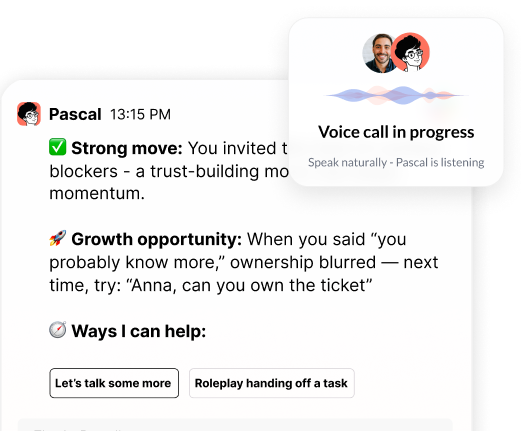
Ready to build an AI-ready culture that drives manager effectiveness? See how Pascal works inside Slack to deliver real-time coaching that scales across your organization while protecting privacy and aligning with your leadership frameworks.
Header photo by Marvin Meyer on Unsplash

.png)
.webp)
“Thank you for setting the great foundation for my promotion; now I have a plan!"

Curious to see how AI Coaching can 10X the impact and scale of your development initiatives. Book a demo today for: