

Organizations must establish psychological safety and redefine performance expectations before deploying AI management tools. Cultural readiness determines whether AI-enabled management drives measurable improvements or creates resistance.
Cultural readiness means your organization has established the trust and transparency necessary for managers and employees to view AI as a supportive tool rather than surveillance. HubSpot achieved 98% employee AI tool usage with 84% comfort levels by addressing culture before deploying technology.
Four elements define cultural readiness. First, employees understand how AI tools use their data, what decisions AI influences, and where humans retain final authority. Second, senior leaders demonstrate AI tool usage openly and share their learning experiences. Third, teams feel comfortable asking AI tools questions and discussing AI limitations without judgment.
Fourth, organizations define what performance means in human-AI collaborative contexts. Gail Fierstein, former CHRO at CaaStle, Goldman Sachs, and Pearson, explains: "What companies and HR need to do is define what is performance and potential in the context of the human-AI collaborative. It's different."
Organizations must shift from viewing management as purely human expertise to recognizing it as human-AI collaboration, from scheduled development to continuous learning, and from generic training to contextual coaching.
Data Breakdown:
• Traditional Management Culture: Coaching reserved for executives | AI-Enabled Management Culture: Coaching accessible to all managers
• Traditional Management Culture: Development happens in scheduled sessions | AI-Enabled Management Culture: Development happens in real-time
• Traditional Management Culture: Generic best practices applied universally | AI-Enabled Management Culture: Context-specific guidance aligned to company culture
• Traditional Management Culture: Managers rely solely on experience | AI-Enabled Management Culture: Managers augment judgment with AI insights
Establish privacy confidence first. Employees need clear data governance policies they can verify. Address how the system handles sensitive information and whether employee data trains AI models.
Align AI to your culture. Generic AI tools provide generic advice. Customize company values, culture frameworks, and competency models so coaching reflects how your organization actually works.
Redefine performance metrics. Success in AI-enabled management means effective human-AI collaboration, not just individual output.
Create experimentation spaces. Managers need safe environments to test AI tools, share failures, and learn collectively. This requires leadership modeling (executives using AI tools openly and discussing what works and what doesn't).
CHROs should evaluate cultural readiness across four dimensions before vendor selection: leadership alignment, employee trust levels, existing change capacity, and technical infrastructure maturity.
Start with a leadership alignment audit. Do executives agree on AI's role in management? Can they articulate how AI supports rather than replaces human judgment? Are they willing to use AI tools themselves? Without executive alignment, implementation efforts fail regardless of technology quality.
Measure your trust baseline. Survey employees about their current AI tool usage, comfort levels, and concerns. Many organizations discover employees already use consumer AI tools without guidance.
Evaluate change capacity honestly. How many major initiatives are currently in flight? What's the organization's track record with technology adoption? Melinda Wolfe, former CHRO at Bloomberg, Pearson, and GLG, notes that adoption speed "depends on the company's DNA." Organizations with strong change management capabilities can move faster.
Check infrastructure readiness. Can AI tools integrate with existing HRIS, performance management, and communication platforms? Integration complexity varies by organization.
Psychological safety determines whether employees view AI management tools as supportive coaches or threatening surveillance systems. Without it, even sophisticated AI tools fail to drive adoption.
Employees must feel safe testing AI tools, asking basic questions, and sharing when AI guidance doesn't fit their context. Organizations that punish AI experimentation create shadow AI usage (employees use consumer tools without organizational guardrails).
Leaders must openly discuss when AI recommendations miss the mark, modeling that AI is a tool to augment judgment, not replace it. This requires vulnerability from senior leaders who traditionally project certainty.
Organizations need mechanisms for employees to report when AI guidance feels off, doesn't align with company values, or misses important context.
HubSpot prioritized psychological safety before deploying AI tools and achieved 98% employee usage with 84% comfort levels. The cultural foundation enabled technology adoption.
Building leadership alignment requires executives to use AI tools themselves, understand their limitations, and articulate a clear vision for human-AI collaboration. This happens through structured experimentation, not presentations.
Start with executive pilots. Give your leadership team access to AI coaching tools for their own development. Let them experience the value firsthand and identify concerns before rolling out to the broader organization. This creates informed advocates rather than skeptical gatekeepers.
Define AI's role explicitly. Is AI a coach, a copilot, or a consultant? Different metaphors create different expectations. Organizations that clearly define AI as a tool to augment human judgment (never replace it) see higher adoption.
Address the replacement narrative directly. Employees fear AI will eliminate their jobs. Leaders must articulate how AI enables managers to focus on high-value activities like strategic thinking and relationship building.
Create accountability frameworks. Who makes final decisions when AI provides recommendations? What happens when AI guidance conflicts with manager judgment? Clear accountability prevents AI from becoming a scapegoat for poor decisions.
The implementation sequence determines whether AI management tools drive adoption or create lasting resistance.
Begin with culture alignment. Customize AI tools to reflect your organization's specific values, leadership frameworks, and competency models before deployment. This customization should happen at both company and department levels.
Launch with volunteer cohorts. Identify managers eager to experiment with AI tools. These early adopters provide feedback, identify issues, and become internal champions. Their success stories create organic demand from other managers.
Provide contextual training. Generic AI training fails. Managers need to understand how AI tools work within their specific workflows, what data the tools access, and how to interpret AI recommendations in their context. This training happens in the flow of work, not in separate sessions.
Measure and iterate quickly. Track usage, gather qualitative feedback, and adjust based on what you learn.
Expand systematically. Once volunteer cohorts demonstrate value, expand to adjacent teams. This controlled expansion allows you to refine your approach while building momentum.
• Cultural readiness (not technology sophistication) determines whether AI-enabled management drives measurable improvements or creates resistance.
• Organizations must establish psychological safety, redefine performance expectations for human-AI collaboration, and embed AI literacy into leadership behaviors before deploying AI management tools.
• CHROs should assess cultural readiness across four dimensions before vendor selection: leadership alignment, employee trust levels, existing change capacity, and technical infrastructure maturity.
• Implementation sequence matters: begin with culture alignment and volunteer cohorts, provide contextual training, measure and iterate quickly, then expand systematically based on demonstrated value.
• HubSpot achieved 98% employee AI tool usage with 84% comfort levels by prioritizing psychological safety before deploying AI tools.
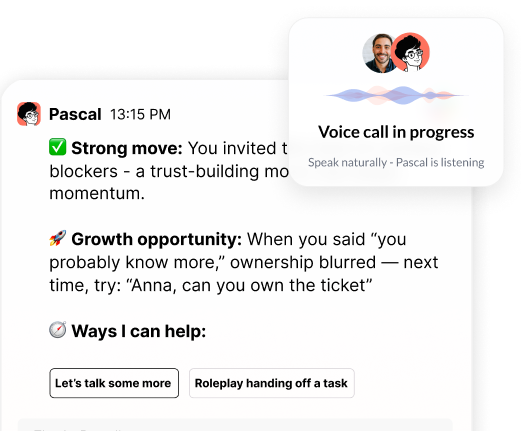
Pascal by Pinnacle delivers AI coaching embedded in the tools your managers already use. Our platform is customizable to your company's values, culture, and competency frameworks. See how Pascal works for your organization.

.png)
.webp)
“Thank you for setting the great foundation for my promotion; now I have a plan!"

Curious to see how AI Coaching can 10X the impact and scale of your development initiatives. Book a demo today for: