

An AI coach needs role, goals, performance signals, and interaction history—enough to eliminate friction and deliver personalized guidance without creating privacy risk. The right amount varies by use case, but effective systems balance minimum viable context with maximum coaching impact.
AI coaches without sufficient context deliver generic advice that managers ignore. A system that doesn't know your people, your culture, or how work happens cannot provide guidance that drives behavior change.
Context serves three functions: it eliminates friction by preventing managers from repeatedly explaining situations, enables personalization that feels like having a coach who knows you, and builds trust through demonstrated understanding of specific challenges.
Delta reduced performance review prep time from 60 minutes to 10 minutes by giving their AI coach sufficient context. That efficiency came from the system knowing employees well enough to eliminate manual data entry.
Systems requiring manual context entry see 60-80% drop-off within 30 days. Managers rate contextual guidance 4.2x more valuable than generic advice.
Effective AI coaching systems integrate four data layers. Each layer serves a distinct purpose, and the combination creates coaching that feels relevant and actionable.
Data Breakdown:
• Context Layer: Individual Employee Information | What It Includes: Role, level, function, tenure, career goals, development priorities, performance review history, personality assessments, manager-direct report relationships | Purpose: Establishes who someone is professionally and what they're working toward | Impact on Coaching: Enables personalized guidance aligned with career trajectory and development needs
• Context Layer: Organizational Knowledge | What It Includes: Company values, leadership competency frameworks, policies, career progression paths, strategic priorities | Purpose: Grounds coaching in your company's specific culture and expectations | Impact on Coaching: Ensures advice fits your organization's definition of success and cultural norms
• Context Layer: Real-Time Work Patterns | What It Includes: Meeting attendance and participation, communication patterns in Slack or Teams, collaboration dynamics, project involvement, feedback received from peers and managers | Purpose: Provides observation of actual work behavior, not just self-reported information | Impact on Coaching: Differentiates AI coaching from traditional coaching through in-the-moment understanding
• Context Layer: Temporal Context | What It Includes: Recent conversations, progress on development goals over time, behavioral patterns and changes, upcoming milestones, historical interactions | Purpose: Maintains continuity and tracks development journey | Impact on Coaching: Transforms chatbot interactions into coaching relationships with memory
When a manager asks "How do I give feedback to Sarah about her presentation skills?", here's how each layer contributes: Individual information tells the AI that Sarah is a senior engineer working toward a tech lead role. Organizational knowledge provides your company's feedback framework and leadership competencies. Real-time patterns show that Sarah speaks less in executive meetings than peer meetings. Temporal context reveals she's been working on executive presence for three months and received similar feedback from her skip-level manager two weeks ago. The AI can now suggest specific, actionable coaching that builds on Sarah's progress rather than starting from scratch.
Systems build sufficient context to provide meaningful insights within one to two weeks when they observe real work rather than waiting for manual input.
More context doesn't automatically mean better coaching. There's a threshold beyond which additional data creates diminishing returns or undermines trust.
At minimal context levels (role and goals only), AI coaches provide generic advice with low relevance. Manager trust remains high, but sustained use drops off quickly.
At moderate context levels (adding performance data and work patterns), coaching becomes personalized and actionable. Comfort levels remain moderate and initial adoption stays high if value is clear.
Deep context (including communication content and meeting transcripts) enables hyper-contextual, proactive coaching. This requires strong privacy safeguards but delivers the highest adoption rates when trust is established.
Excessive context (adding personal life or health data) creates marginal improvement with significant privacy risk, low trust, and poor adoption.
Jeff Diana, former CHRO at Calendly and Atlassian, emphasizes that "so much of the real learning and value that comes from this comes from in-context coaching in the moment to drive performance and to solve problems in the moment." That in-context coaching requires the AI to understand the moment—which means being present, not just hearing about it later.
The optimal zone is deep context with strong privacy protections. But that raises an important question: how do you protect privacy when the AI is reading Slack messages and listening to meetings?
Deep context requires privacy protections to maintain trust and compliance. The balance works through five safeguards.
Individual control and transparency. Users must know when the AI coach is present and have the ability to opt out of specific meetings or conversations. Systems send notifications at the beginning of calls explaining how users can remove the coach from the room. When you opt out of a Monday meeting, the AI has no record that meeting occurred. Your Tuesday 1:1 proceeds with the context the AI built from meetings you didn't opt out of. The continuity isn't perfect, but the control is real.
Confidentiality guarantees. Individual coaching conversations remain private. No personal intelligence is shared with the organization. No one will trust their coach if it reports on them to management. Each person gets their own instance that doesn't share information with others.
Anonymized aggregated insights only. When providing organizational-level insights to leadership, all data is anonymized and aggregated. Systems provide trends like engagement patterns, common development themes, and skill gaps across departments—but only when there are enough participants to protect individual privacy (typically 10+ people in a cohort).
Enterprise-grade security. SOC2 compliance (a security certification that verifies data protection practices), encryption in transit and at rest, and clear data retention policies are table stakes. Customer data is never used to train models. Your company's data remains yours.
Sensitive topic escalation. AI coaches must recognize when conversations require human expertise. Systems include moderation flags and sensitive topics escalation to ensure appropriate human involvement when it matters most.
The difference between acceptable observation and surveillance comes down to purpose and control. Reading Slack messages to provide coaching on communication style (with user consent and opt-out ability) is observation. Keystroke tracking to measure productivity without user knowledge is surveillance. The principle: if the employee can't control it and doesn't benefit from it, it's surveillance.
The right context level depends on your use case, organizational culture, and readiness for change. Map your specific coaching objectives to the context required to achieve them.
For basic manager enablement (helping managers prepare for 1:1s, structure feedback conversations), moderate context is sufficient. You need role information, goals, and recent performance data. Deep observation of every meeting isn't necessary.
For cultural transformation (driving specific behavioral changes across the organization), deep context is essential. You need the AI coach in meetings, observing actual behavior, providing real-time feedback on the specific competencies that matter to your culture.
For leadership development (accelerating new leader onboarding, supporting high-potential talent), deep context plus temporal tracking creates the most impact. The AI needs to understand not just current state but progress over time, adapting coaching as leaders develop.
Implementation follows a three-phase approach over 12 weeks, starting with foundational data and progressively adding observational context based on pilot results.
Phase 1: Establish Baseline Context (Weeks 1-4)
Integrate HRIS data, upload organizational documentation (values, competency frameworks, policies), and collect individual goals and development priorities. This adds individual employee information and organizational knowledge layers. Track data integration completeness and user profile accuracy.
Phase 2: Add Observational Context (Weeks 5-8)
Enable meeting attendance and communication platform integration. Launch opt-in pilots with early adopters. This adds real-time work patterns and temporal context layers. Track pilot participation rate, early adopter feedback, and initial engagement metrics.
Phase 3: Measure and Optimize (Weeks 9-12)
Track adoption metrics (active users, session frequency, feature use), engagement depth (conversation length, topics covered), and behavior change indicators (feedback quality improvements, 1:1 consistency). Refine all layers based on usage patterns. Measure active user percentage, coaching session frequency, manager-reported value, and behavior change evidence.
Start with a clear hypothesis about which context layers will drive specific outcomes, then run structured 12-week pilots to validate before scaling. Organizations that try to implement everything at once overwhelm both the system and their people.
Not all data improves coaching outcomes. Some data creates risk without meaningful benefit.
Personal health information beyond what employees voluntarily share. HIPAA-regulated data, mental health records, and medical information create compliance risk and don't improve workplace coaching. If an employee chooses to discuss health challenges with their AI coach, that's their decision—but the system shouldn't access medical records.
Financial details like salary, bonuses, or equity beyond what's necessary for career progression conversations. Compensation data can bias coaching interactions and create uncomfortable dynamics. Role and level are sufficient context.
Personal life details the employee hasn't chosen to share. Family situations, relationship status, political views, religious beliefs—these should only enter the coaching relationship if the employee brings them up.
Surveillance-level monitoring like keystroke tracking, screen recording, or productivity scores. These create an environment of distrust that undermines the coaching relationship. There's a difference between observing meeting participation (which provides coaching context) and monitoring every action (which feels like Big Brother).
Peer performance comparisons. While aggregated benchmarks can be useful, individual-level comparisons ("You're performing worse than Sarah") create toxic dynamics. AI coaching should focus on personal growth, not relative ranking.
The principle is simple: if data doesn't directly improve the coaching interaction and creates privacy or trust concerns, leave it out.
• AI coaches need four context layers to be effective: individual employee information, organizational knowledge, real-time work patterns, and temporal context tracking progress over time
• Deep context with strong privacy safeguards delivers the highest coaching effectiveness and manager adoption—systems requiring manual context entry see 60-80% drop-off within 30 days
• Essential privacy protections include individual control over AI presence, confidentiality guarantees for coaching conversations, anonymized aggregated insights only, and enterprise-grade security with SOC2 compliance
• The right context level depends on your use case—basic manager enablement needs moderate context, while cultural transformation requires deep observational context with the AI present in meetings
• Clear boundaries matter: personal health information, detailed financial data, surveillance-level monitoring, and peer performance comparisons should remain off-limits to protect trust and effectiveness
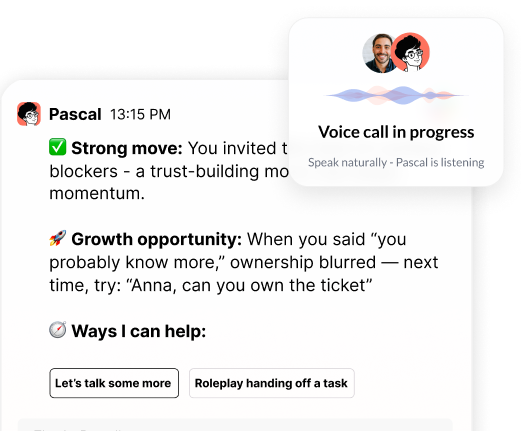
Ready to see how context-aware AI coaching works in practice? See how Pascal works inside Slack to deliver personalized guidance without requiring managers to explain everything from scratch.
Header photo by Vitaly Gariev on Unsplash

.png)
.webp)
“Thank you for setting the great foundation for my promotion; now I have a plan!"

Curious to see how AI Coaching can 10X the impact and scale of your development initiatives. Book a demo today for: