

An AI coach needs role information, performance history, team dynamics, and company culture to deliver useful guidance. It doesn't need personal details about health, family, or beliefs. The challenge is gathering enough context to eliminate friction without creating surveillance risk.
Context means the AI understands your situation without repeated explanations. A manager shouldn't need to re-introduce their team structure, explain company values, or recap last quarter's performance review every time they ask for coaching.
Four types of context drive effective coaching:
Individual employee data: Role, tenure, career goals, performance feedback, and development priorities. This ensures coaching aligns with where someone is professionally and what they're working toward.
Organizational knowledge: Company values, competencies, cultural norms, and leadership frameworks. Without this, an AI might suggest approaches that contradict your established practices.
Real-time work patterns: Meeting dynamics, communication style, and team interactions. This is where embedded AI gains advantage—it observes actual behavior rather than relying on self-reported information.
Temporal context: Performance cycles, goal-setting seasons, and organizational changes. Coaching that ignores timing (suggesting major initiatives right before a busy season) won't get applied.
Generic AI tools lack this foundation. They provide advice that sounds reasonable but doesn't fit your culture. Managers abandon tools that require extensive setup or repeated context-sharing. HR Dive's 2026 analysis found organizations are refocusing on training effectiveness, which means coaching tools need to work immediately.
Human coaches meet with employees every 2-4 weeks and depend on what the employee remembers to share. They work from memory and notes, missing daily interactions that reveal patterns. Traditional coaching costs $200-500 per hour and is reserved for senior leaders.
AI coaches with proper integration observe actual interactions, meeting dynamics, and communication patterns in real-time. They're available 24/7 at a fraction of traditional costs.
Human coaches still excel at building deep trust through consistent relationships. They interpret complex emotional dynamics and unspoken concerns that require human intuition. They navigate sensitive personal or organizational situations that benefit from human judgment.
The emerging model uses AI coaching for daily guidance and skill development, reserving human coaches for senior leaders, high-stakes transitions, or complex interpersonal challenges.
Without understanding your culture, team dynamics, and individual situations, an AI coach becomes a generic chatbot. Managers waste time explaining situations the AI should already understand. Advice contradicts your company's values or established processes. Coaching feels impersonal and disconnected from real challenges.
Adoption rates collapse. Organizations see less than 20% sustained engagement with generic tools. HR teams face pressure to justify the investment when usage drops.
Excessive data access creates privacy concerns, potential bias amplification, and legal exposure. Accessing protected characteristics (age, health status, family situation) creates discrimination liability. Unstructured data from emails or messages may contain sensitive information that shouldn't inform coaching. GDPR, CCPA, and other privacy regulations impose strict requirements on employee data processing.
Employees won't trust a coach they believe is monitoring them for management. Without trust, people won't engage honestly, and coaching becomes superficial.
Effective AI coaching requires work-relevant context, not personal biographical details. Providing information about family situations, health conditions, or personal beliefs creates privacy risk without improving coaching quality.
Include: Current role, tenure, and career trajectory. Performance review feedback and development goals. Skills assessments and competency evaluations. Team structure and reporting relationships. Communication preferences and working style.
Exclude: Personal health information or disability status. Family composition or caregiving responsibilities. Religious beliefs or political affiliations. Financial information beyond compensation band. Protected characteristics like age, race, or gender (unless specifically relevant to DEI coaching initiatives with proper safeguards).
The principle: coaches need enough information to deliver personalized guidance without creating surveillance concerns. This means integrating with your HRIS for role and goal data, your performance management system for feedback history, and your communication platforms for interaction patterns—but never accessing personal emails, health records, or private communications.
The solution is architectural: individual conversations remain confidential while aggregated, anonymized patterns surface to leadership. This gives organizations insights to improve culture and development programs without compromising individual trust.
Implementation requires strict data isolation. Each person has their own instance that doesn't share information with others. Conversations and observations remain private. No individual-level data reaches HR or management.
What organizations receive: Anonymized, aggregated insights about common skill gaps, frequently discussed challenges, and development themes across teams (only when there are enough participants to protect individual privacy). Engagement metrics showing adoption and usage patterns at the team or department level. Behavioral trend data that helps HR understand where additional support or training might be needed.
This mirrors how recruiting tools aggregate interview data or how engagement surveys protect individual responses while revealing organizational patterns. The difference is that AI coaching generates continuous insights rather than quarterly snapshots.
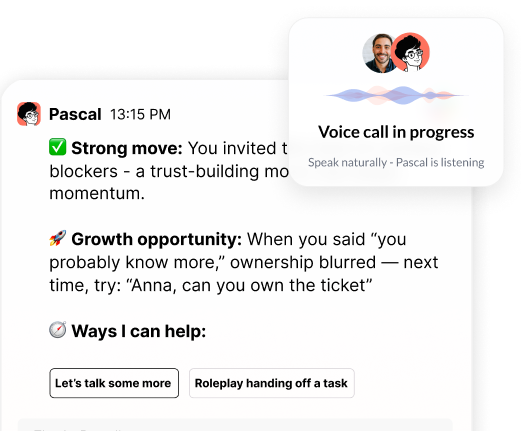
The most effective approach embeds the AI coach in existing workflow tools (Slack, Teams, Zoom, Google Meet) so it gathers context automatically without requiring manual data entry or separate logins. This eliminates the adoption barrier of "one more tool" while giving the coach real-time understanding of actual work.
An embedded coach joins meetings when invited, observes team dynamics, and provides feedback based on what happened rather than what someone remembers later. It sits in communication channels, understanding ongoing conversations and project context. Managers get coaching in the moment, when they're most likely to apply it.
Privacy protections in embedded systems: Users control which meetings the coach joins through calendar invitations. The coach can be removed from any conversation at any time. The platform only processes work-related communications, never personal messages. All data remains encrypted and isolated at the individual level.
The alternative (requiring managers to manually input context into a separate platform) creates friction that kills adoption. Training tools that don't integrate seamlessly into workflow get abandoned quickly.
Effective AI coaching systems include guardrails that recognize when a conversation has moved beyond appropriate scope and escalate to human experts. This protects both the organization and the individual while maintaining trust for routine guidance.
Implementation requires moderation flags that detect sensitive topics (harassment, discrimination, mental health crises, legal concerns). When these flags trigger, the system provides immediate resources and escalates to appropriate human support: HR, legal, EAP services, or external counseling. The AI acknowledges its limitations rather than attempting to handle situations that require human judgment.
Organization-specific controls allow companies to define additional escalation triggers based on their unique needs and risk profile. Some organizations want immediate escalation for any mention of workplace safety. Others need specific protocols for handling customer complaints or regulatory concerns.
This prevents the scenario where an AI coach provides inappropriate guidance on sensitive matters while still delivering value for the 95% of conversations that involve skill development, feedback preparation, or communication coaching.
• Effective AI coaching requires four context layers: individual employee data, organizational knowledge, real-time work patterns, and temporal context—but never personal biographical details that create privacy risk
• Provide enough information to eliminate friction and deliver personalized guidance without creating surveillance concerns or compliance exposure
• Individual conversations must remain confidential while aggregated, anonymized insights surface to leadership—this architectural separation is essential for trust and adoption
• Embedded AI coaches that work inside Slack, Teams, and meetings gather context automatically and provide in-the-moment coaching, eliminating the friction that kills adoption with standalone tools
• Proper guardrails and escalation protocols ensure sensitive topics get routed to human experts while the AI coach handles routine development conversations
Pascal by Pinnacle lives where work happens—joining meetings, sitting in Slack or Teams, and understanding your culture from day one. With SOC2 compliance and complete conversation confidentiality, Pascal shows how the right context drives behavior change. See how Pascal works inside your workflow.
Header photo by Vitaly Gariev on Unsplash

.png)
.webp)
“Thank you for setting the great foundation for my promotion; now I have a plan!"

Curious to see how AI Coaching can 10X the impact and scale of your development initiatives. Book a demo today for: