

An effective AI coach needs role information, performance history, team dynamics, and company culture. This baseline—enough to personalize guidance without creating privacy risk—lets the AI provide relevant coaching without requiring managers to repeatedly explain situations.
Sufficient context means the AI knows enough about your people and organization to provide guidance managers will trust and apply.
Four layers drive coaching effectiveness:
Individual employee data provides the foundation: role, tenure, career goals, current performance feedback, and development areas. Without this baseline, the AI can't tailor guidance to where someone is in their career.
Organizational knowledge ensures coaching reinforces your culture. This includes values, competency frameworks, and leadership expectations. Generic best practices often conflict with how leadership works in your organization.
Real-time work patterns separate effective AI coaching from chatbots. Communication style in meetings, team interaction dynamics, and how someone delegates or gives feedback create the specificity managers need. Gallup research from 2017 found that 70% of variance in team engagement comes down to the manager.
Temporal context grounds guidance in what's happening now: performance review cycles, goal-setting seasons, organizational changes, and team transitions.
Privacy matters as much as context. Effective AI coaching requires data isolation (each person's coach instance remains private), transparent data usage policies, and user control over what the AI observes.
AI coaches operating without real context default to generic advice that managers ignore within weeks. Without knowledge of team dynamics, communication patterns, and organizational culture, even sophisticated AI models produce coaching that feels irrelevant.
The context gap creates three failure modes.
Friction overload forces managers to repeatedly explain situations, team backgrounds, and company context before getting useful guidance. This creates abandonment within 2-3 uses.
Generic platitudes emerge when the AI doesn't understand your competency frameworks or values, delivering textbook responses disconnected from how leadership works in your organization.
Missed opportunities proliferate because the AI can't identify patterns across interactions or spot blind spots in communication style without longitudinal observation.
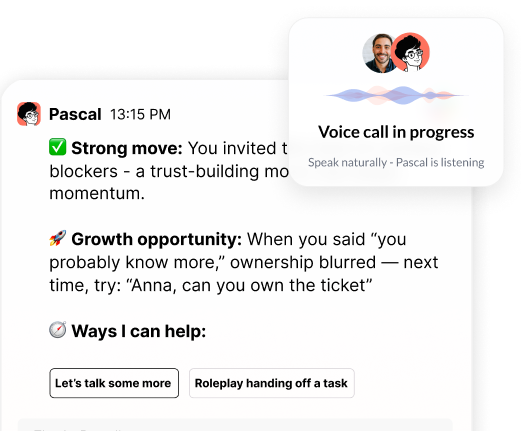
The embedded advantage eliminates context-setting burden. Instead of asking "How should I give feedback to a struggling team member?" managers can ask "How should I have handled that moment in today's standup when Sarah pushed back on the timeline?" and get coaching grounded in what happened.
The minimum includes four elements: role and career information, performance signals, team dynamics, and company culture.
Data Breakdown:
• Context Layer: Role & Career | What It Includes: Title, function, tenure, career goals, skills inventory | Why It Matters: Ensures coaching aligns with current responsibilities and growth trajectory
• Context Layer: Performance Signals | What It Includes: Recent review feedback, current goals, identified development areas | Why It Matters: Grounds coaching in actual performance conversations and priorities
• Context Layer: Team Dynamics | What It Includes: Direct reports, key collaborators, communication patterns from meetings | Why It Matters: Enables coaching on real relationships and interaction styles
• Context Layer: Company Culture | What It Includes: Values, competencies, leadership frameworks, training materials | Why It Matters: Ensures coaching reinforces your specific culture
What you can skip initially: Detailed biographical information, compensation data, sensitive HR case history, and personal demographics beyond role-relevant context add privacy risk without proportional coaching value.
Effective context requires connecting to your HRIS for role and career data, performance management system for goals and feedback, and communication platforms for real-time dynamics.
Context depth determines whether managers trust and apply AI coaching or abandon it as irrelevant. Shallow context produces generic advice managers ignore. Excessive context creates privacy concerns that kill adoption. Optimal context delivers personalized guidance while maintaining trust.
The adoption curve follows a clear pattern.
At zero context, AI coaching functions as a chatbot delivering textbook responses. Managers try it once or twice, find it unhelpful, and never return.
At minimal context (just role and title), the AI can tailor advice slightly but still misses the specifics that make guidance actionable.
The inflection point occurs when the AI gains access to performance data, team dynamics, and organizational culture. Coaching becomes specific: "Based on your last three one-on-ones with Alex, here's how to address the delegation pattern you've been working on."
Beyond optimal context lies the privacy danger zone. When AI coaches access personal communications, detailed biographical data, or information employees haven't explicitly shared, trust erodes.
Certain categories create privacy risk without improving coaching outcomes and should remain off-limits: personal communications outside work contexts, detailed biographical information beyond role-relevant facts, compensation data, sensitive HR case files, and demographic information that could enable bias.
Personal communications including private messages, personal email, and non-work social media should never feed AI coaching systems. Even if technically accessible through work accounts, this data crosses the line from professional development into surveillance.
Detailed biographical information like family status, personal interests unrelated to work, residential information, and financial details creates risk without value. AI coaches need to know career goals and professional development areas, not personal life details that could enable discrimination.
Compensation data rarely improves coaching quality but creates privacy concerns. Managers need coaching on communication, delegation, feedback, and team dynamics—not salary decisions.
Sensitive HR case files including disciplinary actions, accommodation requests, legal matters, and investigation details must remain in HR systems with appropriate access controls.
Demographic information beyond role-relevant context risks embedding bias into coaching systems. While understanding someone's function and career stage helps, data like age, gender, race, or national origin should never influence coaching recommendations.
Balancing context and privacy requires three mechanisms: transparent data usage policies that employees understand and control, technical isolation ensuring individual coaching remains confidential, and governance frameworks that define acceptable use and enforce boundaries.
Transparency starts with clear communication. Employees need to know exactly what data the AI coach accesses, how it uses that information, and what remains private. Vague privacy policies kill trust.
Technical isolation protects individual privacy while enabling organizational insights. Each user's instance operates independently—conversations, observations, and coaching remain private to that individual. The organization receives only anonymized, aggregated data when sufficient participants exist to protect individual privacy.
Governance frameworks define boundaries. Organizations implementing AI coaching need policies covering what data the system can access, how long it retains information, who can view aggregated insights, and what triggers human escalation.
The result is AI coaching that delivers personalized guidance without compromising trust. Managers get specific, actionable advice grounded in their work. Employees maintain privacy and control. Organizations gain insights into coaching effectiveness and development trends without surveillance.
• Context requirements include role information, performance history, team dynamics, and company culture—enough to personalize guidance without creating privacy risk
• Context depth impacts adoption: shallow context produces generic advice managers ignore; optimal context drives engagement; excessive context kills trust
• Certain data should remain off-limits: personal communications, detailed biographical information, compensation data, sensitive HR cases, and demographic information beyond role-relevant facts
• Technical isolation protects privacy while enabling coaching effectiveness—individual instances remain confidential while organizations receive anonymized, aggregated insights
• Transparency and user control build trust—employees need to know what data their coach accesses and maintain the ability to review or delete information
Header photo by Austin Distel on Unsplash

.png)
.webp)
“Thank you for setting the great foundation for my promotion; now I have a plan!"

Curious to see how AI Coaching can 10X the impact and scale of your development initiatives. Book a demo today for: