

An AI coach needs role information, performance history, team dynamics, and company culture—protected by privacy safeguards that keep individual conversations confidential while providing aggregated organizational insights.
AI coaching works when it has four context layers: individual employee data (role, goals, performance history), organizational knowledge (values, competencies, culture), real-time work patterns (meeting dynamics, communication style), and temporal context (performance cycles, goal-setting seasons).
Individual context includes job title, level, function, career aspirations, performance review history, 360 feedback results, and personality assessments. A first-time manager needs different guidance than a senior director. The AI coach should recognize that distinction automatically.
Organizational context covers company values, leadership competencies, cultural norms, team structures, and reporting relationships. This separates a coach that understands your company from one that delivers generic best practices. When your organization values "radical candor" versus "diplomatic consensus-building," the coaching should reflect that reality.
Real-time context captures meeting attendance patterns, communication frequency, collaboration networks, and decision-making contexts. Human executive coaches work with limited context—whatever their coachee chooses to share in scheduled sessions. They're not in the room for actual interactions, don't have access to performance data, and can't observe team dynamics.
Temporal context tracks performance review cycles, promotion timelines, goal-setting periods, and organizational changes. A manager preparing for year-end reviews needs different support than one onboarding a new team member in Q1.
Generic AI tools like ChatGPT lack organizational context. They can't distinguish between coaching a first-time manager at a 200-person SaaS company versus a senior director at a 4,000-person life sciences firm.
More context improves coaching relevance up to a threshold. Beyond that point, additional data creates privacy concerns without improving outcomes. The inflection point occurs when the AI coach knows enough to eliminate repetitive explanations but not so much that employees feel surveilled.
Contextual coaching in the moment drives performance improvements that classroom training cannot match. The difference lies in specificity. An AI coach that knows a manager is preparing for a difficult performance conversation with a specific direct report, understands that direct report's performance history and communication preferences, recognizes the company's feedback framework, and has observed previous 1:1 dynamics can deliver specific, actionable coaching.
The context-performance curve breaks into four zones:
Minimal context produces generic advice, high friction, and low adoption. Managers abandon the tool within 2-3 weeks because it requires too much explanation. Every interaction starts from zero.
Functional context delivers role-specific guidance with moderate friction and inconsistent adoption. The AI coach knows your title and function but not your team dynamics, performance history, or company culture.
Optimal context enables personalized coaching with minimal friction and sustained engagement. The AI coach proactively recommends relevant guidance based on observed patterns. Managers trust the advice because it reflects their actual work environment and relationships.
Excessive context triggers privacy concerns, trust erosion, legal risks, and employee opt-out. When employees believe the AI coach is monitoring them for HR or leadership, they turn it off.
Employees won't trust a coach they believe is monitoring them. Individual conversations should never get shared with managers or HR. Only anonymized, aggregated insights should surface to leadership, and only when there are enough participants to protect individual privacy.
HR leaders should provide organizational data while allowing employees to control personal context sharing. The most effective model separates mandatory organizational context from opt-in personal data.
Mandatory organizational context should include the organizational chart and reporting structures, job titles and levels, functional areas, company values and leadership competencies, performance review frameworks and timing, and team structures and project assignments. This information enables the AI coach to understand the organizational landscape without requiring personal disclosure.
Opt-in personal context remains employee-controlled: personality assessments like DISC or Myers-Briggs, career aspirations and development goals, 360 feedback results, personal communication preferences, and specific performance improvement areas. Employees progressively add this context as they build trust with the AI coach.
The implementation approach matters. Start with organizational context during onboarding, then allow employees to progressively add personal context through actual interactions rather than requiring extensive profile completion upfront.
Data governance requirements aren't just legal compliance—they're trust-building mechanisms that determine adoption rates. Any AI coaching implementation should include clear data handling policies, explicit opt-out mechanisms, and regular privacy audits.
Adequate context means the AI coach can deliver specific, actionable guidance without requiring employees to repeatedly explain their situation, team dynamics, or organizational constraints. It's the difference between a coach that says "here are five feedback frameworks" and one that says "based on your last three 1:1s with Sarah and her recent project challenges, here's how to structure tomorrow's conversation using your company's feedback model."
Every time an employee must explain background information the AI coach should already know, friction increases and trust decreases. After three or four interactions where the coach asks for the same context, employees stop using it. They return to asking colleagues, guessing, or avoiding difficult conversations.
Adequate context eliminates three friction points:
Repetitive explanations disappear when the AI coach remembers previous conversations, team dynamics, and organizational norms. Managers shouldn't need to re-explain their team structure, company values, or ongoing performance issues every time they seek guidance.
Generic advice transforms into specific recommendations when the AI coach knows actual relationships, communication patterns, and cultural expectations. Instead of "schedule regular 1:1s," the coach suggests "your Thursday 1:1 with Marcus is tomorrow—here's how to address the feedback gap you mentioned last week."
Missed opportunities for proactive coaching reduce when the AI coach observes real work patterns and can surface relevant guidance before problems escalate. A coach that notices a manager consistently avoiding difficult conversations can intervene with specific support rather than waiting for the manager to ask.
Privacy safeguards must protect individual confidentiality while enabling organizational insights. The architecture separates individual-level data (never shared) from aggregated, anonymized patterns (available to leadership when sufficient participants exist).
Individual-level protection operates through several mechanisms. Each employee has their own isolated instance that doesn't share information across accounts. Conversations remain private—no manager, HR leader, or executive can access individual coaching sessions. Employees control which meetings the coach joins and can remove it at any time.
Organizational-level insights emerge only through strict anonymization. Leadership receives aggregated data showing trends across teams—common skill gaps, behavioral patterns, engagement levels—but only when there are enough participants to prevent individual identification.
If employees believe the AI coach is monitoring them for management, they won't use it. The confidentiality model should mirror the relationship with a human executive coach—what you discuss stays private unless you choose to share it.
Clear communication about data handling, transparent opt-out mechanisms, and consistent reinforcement of privacy boundaries build the trust necessary for meaningful coaching relationships.
Without sufficient context, AI coaching becomes another abandoned HR tool that promised transformation but delivered generic advice managers could have Googled. The pattern is predictable: initial enthusiasm during rollout, declining usage within weeks, and eventual abandonment as managers return to informal peer advice or simply avoid difficult situations.
The generic advice trap emerges immediately. When the AI coach doesn't know your team dynamics, company culture, or individual performance history, it defaults to textbook responses. "Practice active listening" and "provide specific feedback" are technically correct but useless when a manager needs help navigating a specific conflict with a specific person in a specific organizational context.
Managers who must repeatedly explain their situation, team structure, and organizational norms eventually stop using the tool. After the third time explaining that your company uses a "radical candor" feedback model rather than a "compliment sandwich" approach, most managers give up and ask a colleague instead.
Missed coaching opportunities multiply when the AI coach can't observe actual work patterns. A manager who consistently avoids difficult conversations, talks over team members in meetings, or misses cultural cues won't receive relevant coaching because the AI coach isn't in the room to notice these patterns.
The business impact shows up in familiar metrics: low engagement scores, inconsistent manager quality, slow new manager ramp time, and training programs that don't translate into behavior change.
• AI coaches need four context layers: individual employee data, organizational knowledge, real-time work patterns, and temporal context aligned with performance cycles
• HR leaders should provide mandatory organizational context while keeping personal data opt-in and employee-controlled
• Privacy safeguards must separate individual-level confidentiality from aggregated organizational insights, with strict anonymization thresholds
• Without adequate context, AI coaching degenerates into generic advice that managers abandon within weeks
See how Pascal works inside Slack, Teams, and your existing workflow. Pascal by Pinnacle delivers AI coaching with the context your managers need—integrated across your tech stack, protected by enterprise-grade privacy safeguards, and trusted by organizations that take both effectiveness and confidentiality seriously. Learn more about Pascal.
Header photo by Austin Distel on Unsplash

.png)
.webp)
“Thank you for setting the great foundation for my promotion; now I have a plan!"

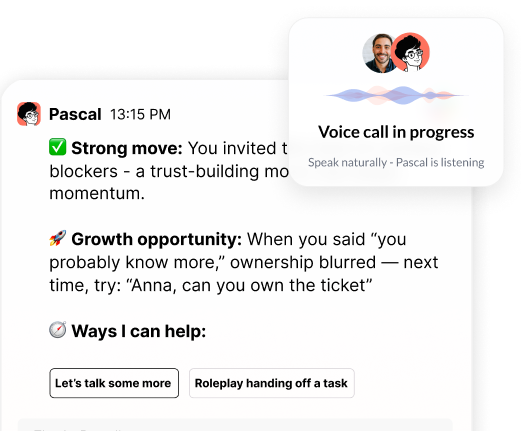
Curious to see how AI Coaching can 10X the impact and scale of your development initiatives. Book a demo today for: