

An effective AI coach requires four layers of context: individual employee data (role, goals, performance history), organizational knowledge (values, competencies, culture), real-time work patterns (meeting dynamics, communication style), and temporal context (performance cycles, goal-setting seasons). This minimum viable context model eliminates friction without creating surveillance risk.
CHROs evaluating AI coaching platforms face a question vendor demos often skip: what specific employee information should you provide to maximize coaching effectiveness while protecting privacy and maintaining trust? The answer separates effective coaching solutions from expensive chatbots that get abandoned within weeks.
Context means the AI understands who your employees are, how they work, and what matters in your organization—without requiring them to re-explain their situation every time they seek guidance. HR decisions involve policy nuance, jurisdictional rules, eligibility, and role-specific variations that generic AI models cannot handle.
The difference between useful coaching and generic advice lies in whether the AI knows your people and culture. Individual context includes role, tenure, career aspirations, performance history, development goals, personality assessments (DISC, StrengthsFinder), and manager relationships. Organizational context covers company values, leadership competencies, cultural norms, communication patterns, and strategic priorities.
Behavioral context captures meeting participation patterns, communication style, feedback delivery approach, and decision-making tendencies. Temporal context tracks performance review cycles, goal-setting seasons, organizational changes, and team transitions.
The right amount of context follows a "minimum viable context" principle: enough to personalize guidance and earn trust, but not so much that it creates privacy concerns or enables surveillance.
Essential data includes role information, team structure, performance objectives, development goals, and company culture alignment. Valuable but optional data covers communication preferences, working style assessments, career trajectory, and historical performance data. Unnecessary and risky information includes personal health details, family information, political beliefs, financial data, or protected class information. The red line is real-time monitoring data that feels like surveillance rather than support.
When employees feel monitored, they disengage, and the entire data layer disappears.
Data Breakdown:
• Context Type: Individual | Data Sources: HRIS, performance reviews, assessments | Coaching Impact: Personalized career guidance | Privacy Considerations: Requires explicit consent
• Context Type: Organizational | Data Sources: Culture docs, competency frameworks | Coaching Impact: Culturally aligned advice | Privacy Considerations: Company-level, low risk
• Context Type: Behavioral | Data Sources: Meetings, Slack/Teams, email patterns | Coaching Impact: Real-time skill development | Privacy Considerations: Opt-in participation required
• Context Type: Temporal | Data Sources: Performance cycles, org changes | Coaching Impact: Timely, relevant coaching | Privacy Considerations: Aggregated trends only
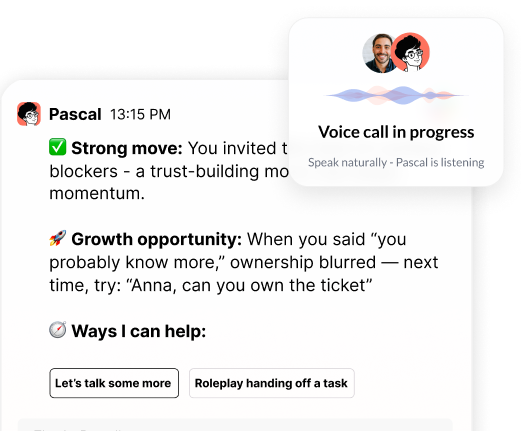
AI coaches become more effective when they observe actual workplace interactions rather than relying on self-reported information. An AI coach that sits in meetings, monitors Slack conversations, and understands email patterns can provide context-aware feedback in the moments that matter, not days later when the situation has passed.
Meeting participation means the AI joins meetings (with user permission) to observe communication patterns, leadership presence, and team dynamics. Asynchronous communication through Slack and Teams integration reveals how managers give feedback, handle conflict, and build relationships. Behavioral patterns over time show whether coaching is driving actual behavior change, not just awareness.
This approach enables the AI to suggest course corrections during conversations, not after the damage is done. Traditional coaching provides quarterly snapshots; embedded AI coaching provides continuous, high-fidelity insights.
Jeff Diana, former CHRO at Calendly, Atlassian, and SuccessFactors, puts it this way: "Real learning and value come from in-context coaching—solving problems in the moment, not in a classroom."
AI coaching with proper context integration surpasses traditional human coaching in several dimensions, while human coaches retain advantages in complex interpersonal situations. The key difference: AI coaches can be present in every meeting and conversation, while human coaches rely on what their clients choose to share.
Human coaches meet monthly or quarterly; AI coaches observe daily interactions. Human coaches depend on client self-reporting (often biased or incomplete); AI coaches access objective behavioral data. Human coaches vary in quality and approach; AI coaches apply consistent frameworks. Human coaching costs $200–$500 per hour; AI coaching delivers 24/7 availability at a fraction of the cost.
However, human coaches excel at navigating sensitive situations, reading emotional nuance, and providing strategic career guidance that requires industry expertise. Effective platforms address this through escalation protocols—when conversations involve legal risk, mental health concerns, or complex ethical dilemmas, the system flags them for human expert review.
Data Breakdown:
• Coaching Type: Traditional Human | Observation Frequency: Monthly/Quarterly | Data Source: Self-reported | Cost per Manager: $200–$500/hour | Availability: Scheduled only
• Coaching Type: AI Coaching | Observation Frequency: Continuous | Data Source: Behavioral + self-reported | Cost per Manager: Subscription-based | Availability: 24/7
An AI coach without adequate context defaults to generic advice that managers ignore—the same problem that plagues most AI implementations.
Generic responses occur when the AI doesn't know your culture and suggests approaches that conflict with company values. Repeated explanations waste manager time as they re-explain situations, team dynamics, and organizational context. Low trust develops when advice feels disconnected from reality, causing managers to stop using the tool within weeks.
No behavior change happens because generic guidance doesn't address the specific leadership challenges managers face daily. Wasted investment turns the platform into another underutilized HR tool that looked good in the demo but failed in practice.
Start with foundational context and layer in behavioral data over time. The fastest path to value is integrating basic employee information (roles, goals, team structure) and company culture documents, then adding real-time observation capabilities as trust builds.
Phase 1 (Week 1–2): Connect HRIS data, upload competency frameworks, and integrate company values documents. This gives the AI enough context to provide culturally aligned guidance immediately.
Phase 2 (Week 3–4): Enable Slack and Teams integration for asynchronous communication patterns. Managers opt in individually, building comfort with the platform.
Phase 3 (Month 2): Introduce meeting observation with clear consent protocols. The AI joins meetings only when invited, and users can remove it anytime.
Phase 4 (Month 3+): Integrate performance review data and development plans as managers see value and trust deepens.
This phased approach prevents overwhelming employees while building the context depth that makes coaching useful. Organizations that try to integrate everything at once often trigger privacy concerns that kill adoption before value can be demonstrated.
Deep context requires deep privacy protections. The most effective AI coaching platforms operate on a foundation of individual trust and confidentiality, with clear boundaries around what data is collected, how it's used, and who can access it.
User control means employees decide which meetings the AI joins and can remove it anytime. Data isolation ensures each person has their own instance that doesn't share information with others. No HR reporting means individual-level data never goes to HR—only anonymized, aggregated insights about organizational trends.
Transparent notices appear at the start of every call explaining how users can opt out. SOC2 compliance and enterprise-grade security protect data from breaches. Escalation protocols flag sensitive topics (legal risk, mental health, harassment) for human expert review rather than AI-only handling.
These safeguards aren't optional features—they're the foundation that makes deep context integration possible. Without them, employees won't trust the coach enough to use it, and the entire data layer disappears.
• AI coaches need four context layers to be effective: individual employee data, organizational knowledge, real-time work patterns, and temporal context
• The "minimum viable context" model includes role, goals, performance history, and culture—but excludes personal health, family, or protected class information
• Real-time observation of meetings and communication improves coaching quality compared to self-reported data alone
• AI coaching with proper context surpasses traditional coaching in frequency, data completeness, and scalability, while human coaches excel at complex interpersonal situations
• Privacy safeguards (user control, data isolation, no HR reporting, transparent notices) are mandatory for deep context integration to work
See how Pascal works inside Slack, Teams, and your meetings to deliver context-aware coaching at heypinnacle.com.
Header photo by Redd Francisco on Unsplash

.png)
.webp)
“Thank you for setting the great foundation for my promotion; now I have a plan!"

Curious to see how AI Coaching can 10X the impact and scale of your development initiatives. Book a demo today for: